

252
10 Sustainability
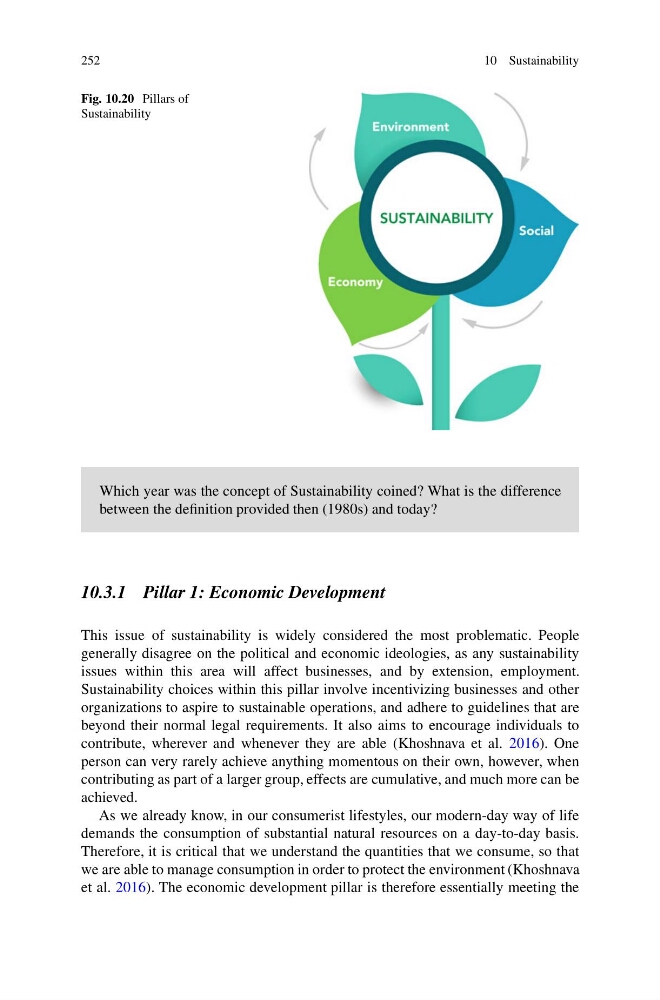
Fig. 10.20 Pillars of
Sustainability
Which year was the concept of Sustainability coined? What is the difference
between the definition provided then (1980s) and today?
10.3.1 Pillar 1: Economic Development
This issue of sustainability is widely considered the most problematic. People
generally disagree on the political and economic ideologies, as any sustainability
issues within this area will affect businesses, and by extension, employment.
Sustainability choices within this pillar involve incentivizing businesses and other
organizations to aspire to sustainable operations, and adhere to guidelines that are
beyond their normal legal requirements. It also aims to encourage individuals to
contribute, wherever and whenever they are able (Khoshnava et al. 2016). One
person can very rarely achieve anything momentous on their own, however, when
contributing as part of a larger group, effects are cumulative, and much more can be
achieved.
As we already know, in our consumerist lifestyles, our modern-day way of life
demands the consumption of substantial natural resources on a day-to-day basis.
Therefore, it is critical that we understand the quantities that we consume, so that
we are able to manage consumption in order to protect the environment (Khoshnava
et al. 2016). The economic development pillar is therefore essentially meeting the
10 Sustainability
Fig. 10.20 Pillars of
Sustainability
Which year was the concept of Sustainability coined? What is the difference
between the definition provided then (1980s) and today?
10.3.1 Pillar 1: Economic Development
This issue of sustainability is widely considered the most problematic. People
generally disagree on the political and economic ideologies, as any sustainability
issues within this area will affect businesses, and by extension, employment.
Sustainability choices within this pillar involve incentivizing businesses and other
organizations to aspire to sustainable operations, and adhere to guidelines that are
beyond their normal legal requirements. It also aims to encourage individuals to
contribute, wherever and whenever they are able (Khoshnava et al. 2016). One
person can very rarely achieve anything momentous on their own, however, when
contributing as part of a larger group, effects are cumulative, and much more can be
achieved.
As we already know, in our consumerist lifestyles, our modern-day way of life
demands the consumption of substantial natural resources on a day-to-day basis.
Therefore, it is critical that we understand the quantities that we consume, so that
we are able to manage consumption in order to protect the environment (Khoshnava
et al. 2016). The economic development pillar is therefore essentially meeting the