

4.11 Individual Matter: Paul Berg
101
actions have contributed to a rise of the panda population. Consequently, the
IUCN upgraded the status of the giant panda in 2016 from endangered to
vulnerable. Despite the higher population being good news today, predictions
suggest that climate change will lead to the extinction of 35% of the bamboo
habitat occupied by panda within the next 75 years (Li et al. 2010).
If you were given a chance to help the giant panda, what would you
do?
4.11 Individual Matter: Paul Berg
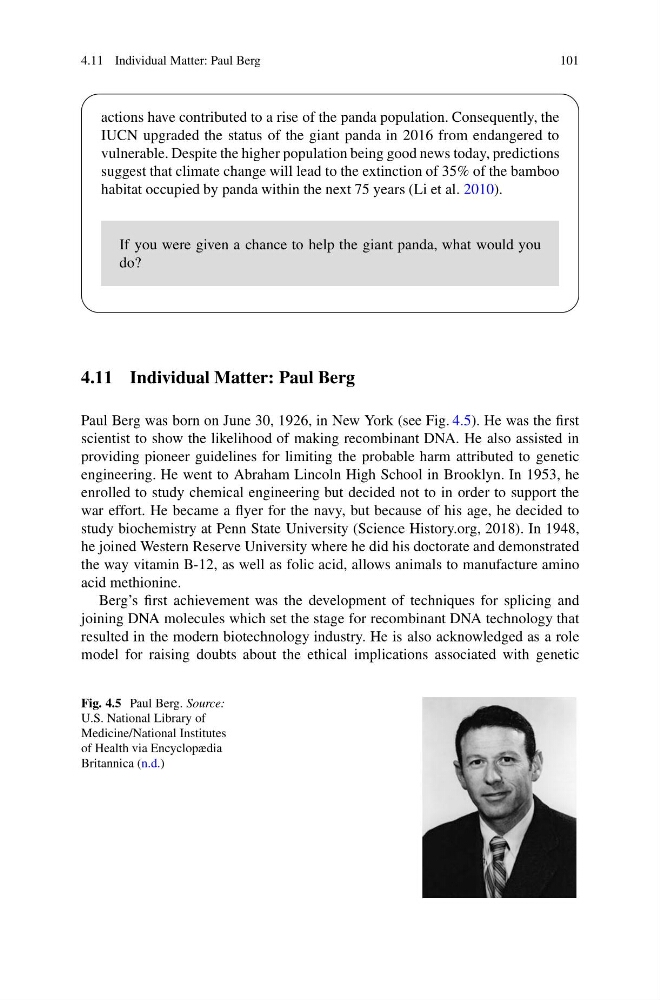
Paul Berg was born on June 30, 1926, in New York (see Fig. 4.5). He was the first
scientist to show the likelihood of making recombinant DNA. He also assisted in
providing pioneer guidelines for limiting the probable harm attributed to genetic
engineering. He went to Abraham Lincoln High School in Brooklyn. In 1953, he
enrolled to study chemical engineering but decided not to in order to support the
war effort. He became a flyer for the navy, but because of his age, he decided to
study biochemistry at Penn State University (Science History.org, 2018). In 1948,
he joined Western Reserve University where he did his doctorate and demonstrated
the way vitamin B-12, as well as folic acid, allows animals to manufacture amino
acid methionine.
Berg’s first achievement was the development of techniques for splicing and
joining DNA molecules which set the stage for recombinant DNA technology that
resulted in the modern biotechnology industry. He is also acknowledged as a role
model for raising doubts about the ethical implications associated with genetic
Fig. 4.5 Paul Berg. Source:
U.S. National Library of
Medicine/National Institutes
of Health via Encyclopædia
Britannica (n.d.)
101
actions have contributed to a rise of the panda population. Consequently, the
IUCN upgraded the status of the giant panda in 2016 from endangered to
vulnerable. Despite the higher population being good news today, predictions
suggest that climate change will lead to the extinction of 35% of the bamboo
habitat occupied by panda within the next 75 years (Li et al. 2010).
If you were given a chance to help the giant panda, what would you
do?
4.11 Individual Matter: Paul Berg
Paul Berg was born on June 30, 1926, in New York (see Fig. 4.5). He was the first
scientist to show the likelihood of making recombinant DNA. He also assisted in
providing pioneer guidelines for limiting the probable harm attributed to genetic
engineering. He went to Abraham Lincoln High School in Brooklyn. In 1953, he
enrolled to study chemical engineering but decided not to in order to support the
war effort. He became a flyer for the navy, but because of his age, he decided to
study biochemistry at Penn State University (Science History.org, 2018). In 1948,
he joined Western Reserve University where he did his doctorate and demonstrated
the way vitamin B-12, as well as folic acid, allows animals to manufacture amino
acid methionine.
Berg’s first achievement was the development of techniques for splicing and
joining DNA molecules which set the stage for recombinant DNA technology that
resulted in the modern biotechnology industry. He is also acknowledged as a role
model for raising doubts about the ethical implications associated with genetic
Fig. 4.5 Paul Berg. Source:
U.S. National Library of
Medicine/National Institutes
of Health via Encyclopædia
Britannica (n.d.)