

100
4 Effects of Everyday Activities on the Ecosystem
crucial effect on the weather and climate. However, similar to the biogeochemical
cycles, the impact of extinction on weather and climate remains unknown due to
limited research.
(continued)
Case Study 4.3: Giant panda
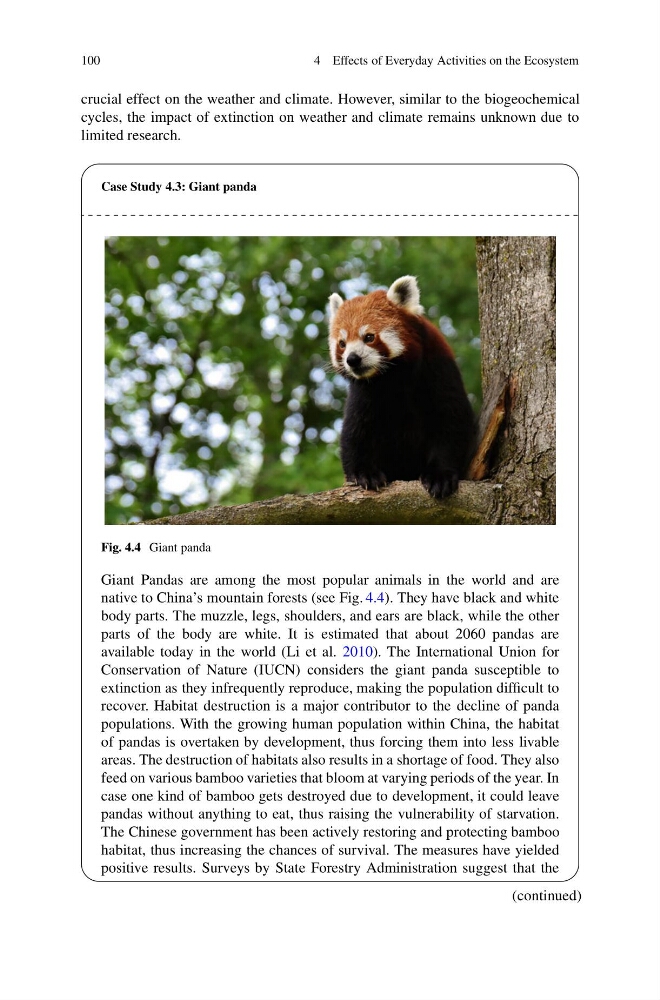
Fig. 4.4 Giant panda
Giant Pandas are among the most popular animals in the world and are
native to China’s mountain forests (see Fig. 4.4). They have black and white
body parts. The muzzle, legs, shoulders, and ears are black, while the other
parts of the body are white. It is estimated that about 2060 pandas are
available today in the world (Li et al. 2010). The International Union for
Conservation of Nature (IUCN) considers the giant panda susceptible to
extinction as they infrequently reproduce, making the population difficult to
recover. Habitat destruction is a major contributor to the decline of panda
populations. With the growing human population within China, the habitat
of pandas is overtaken by development, thus forcing them into less livable
areas. The destruction of habitats also results in a shortage of food. They also
feed on various bamboo varieties that bloom at varying periods of the year. In
case one kind of bamboo gets destroyed due to development, it could leave
pandas without anything to eat, thus raising the vulnerability of starvation.
The Chinese government has been actively restoring and protecting bamboo
habitat, thus increasing the chances of survival. The measures have yielded
positive results. Surveys by State Forestry Administration suggest that the
4 Effects of Everyday Activities on the Ecosystem
crucial effect on the weather and climate. However, similar to the biogeochemical
cycles, the impact of extinction on weather and climate remains unknown due to
limited research.
(continued)
Case Study 4.3: Giant panda
Fig. 4.4 Giant panda
Giant Pandas are among the most popular animals in the world and are
native to China’s mountain forests (see Fig. 4.4). They have black and white
body parts. The muzzle, legs, shoulders, and ears are black, while the other
parts of the body are white. It is estimated that about 2060 pandas are
available today in the world (Li et al. 2010). The International Union for
Conservation of Nature (IUCN) considers the giant panda susceptible to
extinction as they infrequently reproduce, making the population difficult to
recover. Habitat destruction is a major contributor to the decline of panda
populations. With the growing human population within China, the habitat
of pandas is overtaken by development, thus forcing them into less livable
areas. The destruction of habitats also results in a shortage of food. They also
feed on various bamboo varieties that bloom at varying periods of the year. In
case one kind of bamboo gets destroyed due to development, it could leave
pandas without anything to eat, thus raising the vulnerability of starvation.
The Chinese government has been actively restoring and protecting bamboo
habitat, thus increasing the chances of survival. The measures have yielded
positive results. Surveys by State Forestry Administration suggest that the