

64
silt), and finally settle in the forest during slack high tide as the friction caused by
the high mangrove vegetation density slows tidal currents. Wrack or mangrove
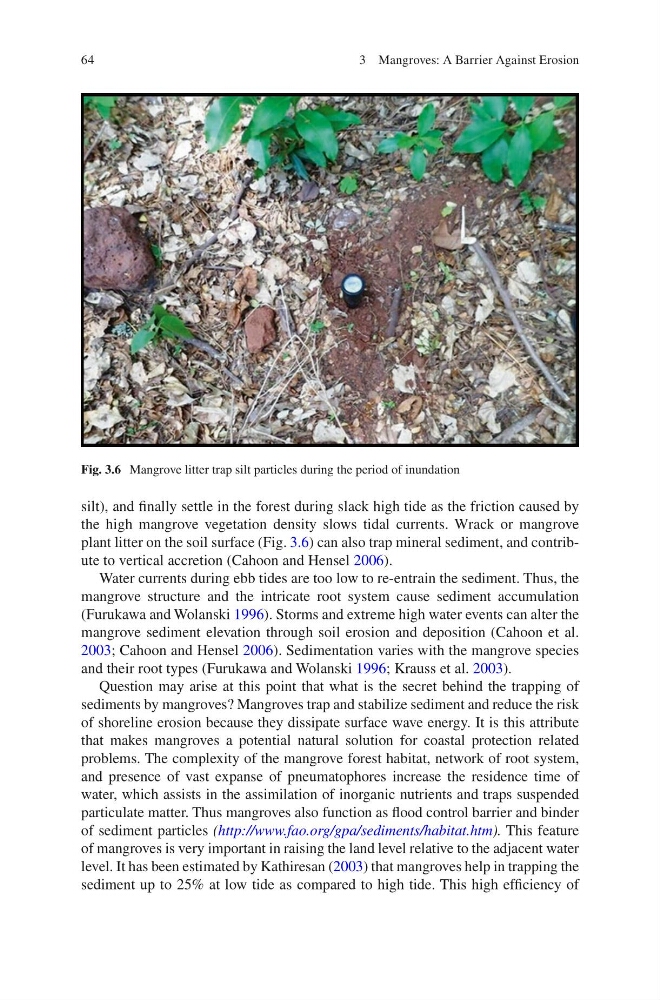
plant litter on the soil surface (Fig. 3.6) can also trap mineral sediment, and contribute to vertical accretion (Cahoon and Hensel 2006).
Water currents during ebb tides are too low to re-entrain the sediment. Thus, the
mangrove structure and the intricate root system cause sediment accumulation
(Furukawa and Wolanski 1996). Storms and extreme high water events can alter the
mangrove sediment elevation through soil erosion and deposition (Cahoon et al.
2003; Cahoon and Hensel 2006). Sedimentation varies with the mangrove species
and their root types (Furukawa and Wolanski 1996; Krauss et al. 2003).
Question may arise at this point that what is the secret behind the trapping of
sediments by mangroves? Mangroves trap and stabilize sediment and reduce the risk
of shoreline erosion because they dissipate surface wave energy. It is this attribute
that makes mangroves a potential natural solution for coastal protection related
problems. The complexity of the mangrove forest habitat, network of root system,
and presence of vast expanse of pneumatophores increase the residence time of
water, which assists in the assimilation of inorganic nutrients and traps suspended
particulate matter. Thus mangroves also function as flood control barrier and binder
of sediment particles (http://www.fao.org/gpa/sediments/habitat.htm). This feature
of mangroves is very important in raising the land level relative to the adjacent water
level. It has been estimated by Kathiresan (2003) that mangroves help in trapping the
sediment up to 25% at low tide as compared to high tide. This high efficiency of
Fig. 3.6 Mangrove litter trap silt particles during the period of inundation
3 Mangroves: A Barrier Against Erosion
silt), and finally settle in the forest during slack high tide as the friction caused by
the high mangrove vegetation density slows tidal currents. Wrack or mangrove
plant litter on the soil surface (Fig. 3.6) can also trap mineral sediment, and contribute to vertical accretion (Cahoon and Hensel 2006).
Water currents during ebb tides are too low to re-entrain the sediment. Thus, the
mangrove structure and the intricate root system cause sediment accumulation
(Furukawa and Wolanski 1996). Storms and extreme high water events can alter the
mangrove sediment elevation through soil erosion and deposition (Cahoon et al.
2003; Cahoon and Hensel 2006). Sedimentation varies with the mangrove species
and their root types (Furukawa and Wolanski 1996; Krauss et al. 2003).
Question may arise at this point that what is the secret behind the trapping of
sediments by mangroves? Mangroves trap and stabilize sediment and reduce the risk
of shoreline erosion because they dissipate surface wave energy. It is this attribute
that makes mangroves a potential natural solution for coastal protection related
problems. The complexity of the mangrove forest habitat, network of root system,
and presence of vast expanse of pneumatophores increase the residence time of
water, which assists in the assimilation of inorganic nutrients and traps suspended
particulate matter. Thus mangroves also function as flood control barrier and binder
of sediment particles (http://www.fao.org/gpa/sediments/habitat.htm). This feature
of mangroves is very important in raising the land level relative to the adjacent water
level. It has been estimated by Kathiresan (2003) that mangroves help in trapping the
sediment up to 25% at low tide as compared to high tide. This high efficiency of
Fig. 3.6 Mangrove litter trap silt particles during the period of inundation
3 Mangroves: A Barrier Against Erosion