

63
meandering nature of the river course. The siltation and clogging of the Bidyadhari
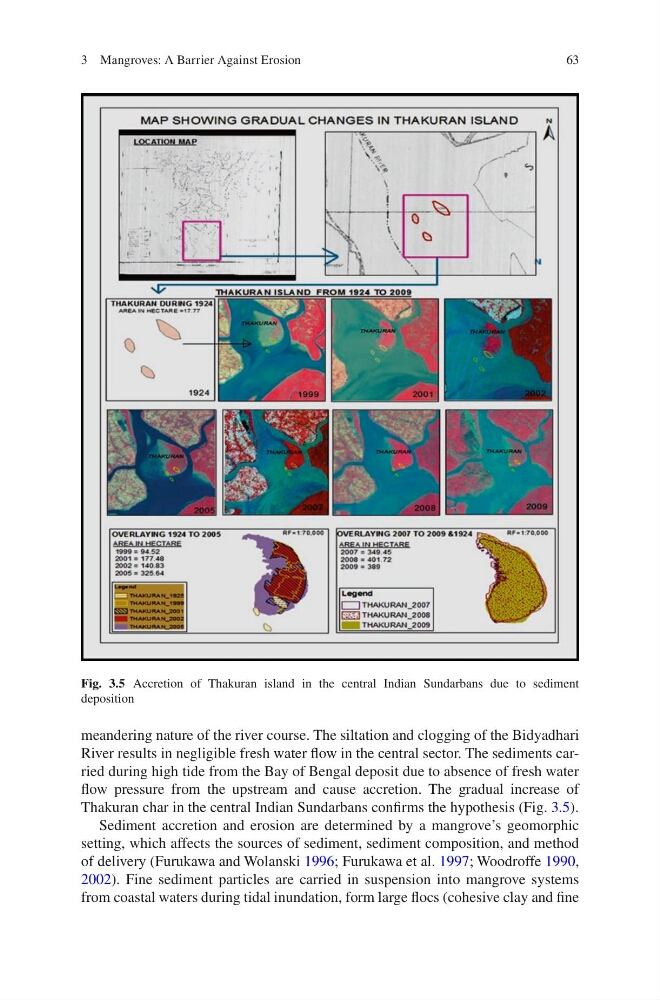
River results in negligible fresh water flow in the central sector. The sediments carried during high tide from the Bay of Bengal deposit due to absence of fresh water
flow pressure from the upstream and cause accretion. The gradual increase of
Thakuran char in the central Indian Sundarbans confirms the hypothesis (Fig. 3.5).
Sediment accretion and erosion are determined by a mangrove’s geomorphic
setting, which affects the sources of sediment, sediment composition, and method
of delivery (Furukawa and Wolanski 1996; Furukawa et al. 1997; Woodroffe 1990,
2002). Fine sediment particles are carried in suspension into mangrove systems
from coastal waters during tidal inundation, form large flocs (cohesive clay and fine
Fig. 3.5 Accretion of Thakuran island in the central Indian Sundarbans due to sediment
deposition
3 Mangroves: A Barrier Against Erosion
meandering nature of the river course. The siltation and clogging of the Bidyadhari
River results in negligible fresh water flow in the central sector. The sediments carried during high tide from the Bay of Bengal deposit due to absence of fresh water
flow pressure from the upstream and cause accretion. The gradual increase of
Thakuran char in the central Indian Sundarbans confirms the hypothesis (Fig. 3.5).
Sediment accretion and erosion are determined by a mangrove’s geomorphic
setting, which affects the sources of sediment, sediment composition, and method
of delivery (Furukawa and Wolanski 1996; Furukawa et al. 1997; Woodroffe 1990,
2002). Fine sediment particles are carried in suspension into mangrove systems
from coastal waters during tidal inundation, form large flocs (cohesive clay and fine
Fig. 3.5 Accretion of Thakuran island in the central Indian Sundarbans due to sediment
deposition
3 Mangroves: A Barrier Against Erosion