

65
trapping suspended sediment may be attributed to widespread occurrence of numerous respiratory roots in Avicennia and to compactly arching stilt roots of Rhizophora.
The density of mangrove species and their complexity of root systems thus constitute most important factors, for determining the sedimentation process.
Along with true mangroves, associate floral species also play a major role in
sediment accretion and rise in land level. Salt marshes accrete sediments and
organic matter and can keep pace with sea level rise as long as sediment supplies
are adequate. Increased flooding related to increased rainfall and runoff can bring
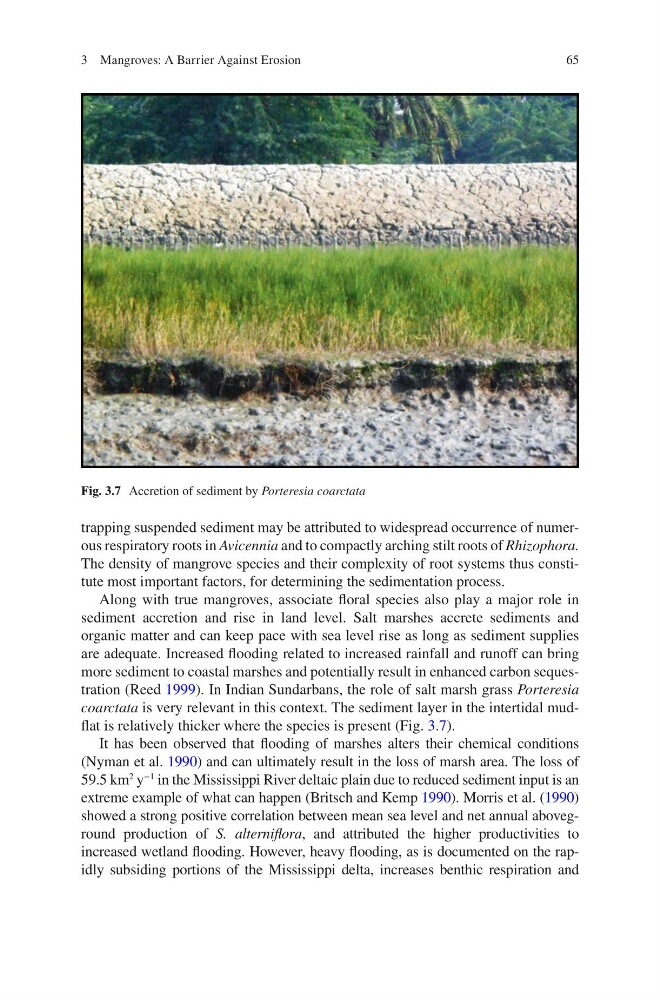
more sediment to coastal marshes and potentially result in enhanced carbon sequestration (Reed 1999). In Indian Sundarbans, the role of salt marsh grass Porteresia
coarctata is very relevant in this context. The sediment layer in the intertidal mudflat is relatively thicker where the species is present (Fig. 3.7).
It has been observed that flooding of marshes alters their chemical conditions
(Nyman et al. 1990) and can ultimately result in the loss of marsh area. The loss of
59.5 km
2
y
−1
in the Mississippi River deltaic plain due to reduced sediment input is an
extreme example of what can happen (Britsch and Kemp 1990). Morris et al. (1990)
showed a strong positive correlation between mean sea level and net annual aboveground production of S. alterniflora, and attributed the higher productivities to
increased wetland flooding. However, heavy flooding, as is documented on the rapidly subsiding portions of the Mississippi delta, increases benthic respiration and
Fig. 3.7 Accretion of sediment by Porteresia coarctata
3 Mangroves: A Barrier Against Erosion
trapping suspended sediment may be attributed to widespread occurrence of numerous respiratory roots in Avicennia and to compactly arching stilt roots of Rhizophora.
The density of mangrove species and their complexity of root systems thus constitute most important factors, for determining the sedimentation process.
Along with true mangroves, associate floral species also play a major role in
sediment accretion and rise in land level. Salt marshes accrete sediments and
organic matter and can keep pace with sea level rise as long as sediment supplies
are adequate. Increased flooding related to increased rainfall and runoff can bring
more sediment to coastal marshes and potentially result in enhanced carbon sequestration (Reed 1999). In Indian Sundarbans, the role of salt marsh grass Porteresia
coarctata is very relevant in this context. The sediment layer in the intertidal mudflat is relatively thicker where the species is present (Fig. 3.7).
It has been observed that flooding of marshes alters their chemical conditions
(Nyman et al. 1990) and can ultimately result in the loss of marsh area. The loss of
59.5 km
2
y
−1
in the Mississippi River deltaic plain due to reduced sediment input is an
extreme example of what can happen (Britsch and Kemp 1990). Morris et al. (1990)
showed a strong positive correlation between mean sea level and net annual aboveground production of S. alterniflora, and attributed the higher productivities to
increased wetland flooding. However, heavy flooding, as is documented on the rapidly subsiding portions of the Mississippi delta, increases benthic respiration and
Fig. 3.7 Accretion of sediment by Porteresia coarctata
3 Mangroves: A Barrier Against Erosion