

303
• Setting up of tiger prawn seed bank (nursery) in the high saline zone of
Sundarbans and linking the same with the hatcheries of adjoining states like
Andhra Pradesh or Odisha.
• Increase of awareness programme amongst the prawn seed collectors.
• Promotion and subsequent scaling up of non-conventional pilot projects like oyster
culture, seaweed culture, fish feed preparation from mangrove associate floral species, preparation of food items from mangrove fruits and mangrove associate species etc. to broaden the avenue of mangrove-centric alternative livelihood for future.
Wood Collection, Tourism and Handicrafts
A considerable percentage of the people of Indian Sundarbans are engaged in wood
collection and many of the operations in context to wood collection are done in an
illegal way. The collection of wood orients more towards fuel wood gathering compared to timber harvesting. In reality, large scale time based logging is done under
the direct control of Forest Department, Government of West Bengal. As a result of
this, scope for direct livelihood earning through legal timber harvesting is almost nil
for the local inhabitants and island dwellers. However, plantations raised under
social forestry have the option for timber harvest mainly from two non-mangrove
species, Eucalyptus (Eucalyptus grandis) and Akashmani (Accacia auriculiformis).
It is to be noted that these two species are not suitable in the mangrove environment/
ecosystem from the ecological point of view.
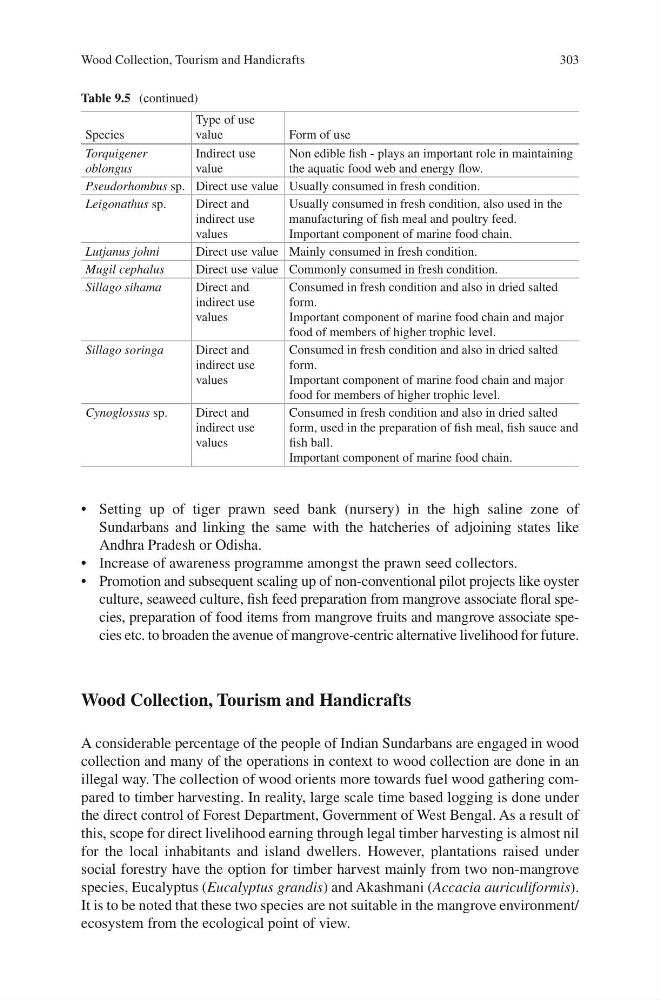
Table 9.5 (continued)
Species
Type of use
value
Form of use
Torquigener
oblongus
Indirect use
value
Non edible fish - plays an important role in maintaining
the aquatic food web and energy flow.
Pseudorhombus sp. Direct use value Usually consumed in fresh condition.
Leigonathus sp.
Direct and
indirect use
values
Usually consumed in fresh condition, also used in the
manufacturing of fish meal and poultry feed.
Important component of marine food chain.
Lutjanus johni
Direct use value Mainly consumed in fresh condition.
Mugil cephalus
Direct use value Commonly consumed in fresh condition.
Sillago sihama
Direct and
indirect use
values
Consumed in fresh condition and also in dried salted
form.
Important component of marine food chain and major
food of members of higher trophic level.
Sillago soringa
Direct and
indirect use
values
Consumed in fresh condition and also in dried salted
form.
Important component of marine food chain and major
food for members of higher trophic level.
Cynoglossus sp.
Direct and
indirect use
values
Consumed in fresh condition and also in dried salted
form, used in the preparation of fish meal, fish sauce and
fish ball.
Important component of marine food chain.
Wood Collection, Tourism and Handicrafts
• Setting up of tiger prawn seed bank (nursery) in the high saline zone of
Sundarbans and linking the same with the hatcheries of adjoining states like
Andhra Pradesh or Odisha.
• Increase of awareness programme amongst the prawn seed collectors.
• Promotion and subsequent scaling up of non-conventional pilot projects like oyster
culture, seaweed culture, fish feed preparation from mangrove associate floral species, preparation of food items from mangrove fruits and mangrove associate species etc. to broaden the avenue of mangrove-centric alternative livelihood for future.
Wood Collection, Tourism and Handicrafts
A considerable percentage of the people of Indian Sundarbans are engaged in wood
collection and many of the operations in context to wood collection are done in an
illegal way. The collection of wood orients more towards fuel wood gathering compared to timber harvesting. In reality, large scale time based logging is done under
the direct control of Forest Department, Government of West Bengal. As a result of
this, scope for direct livelihood earning through legal timber harvesting is almost nil
for the local inhabitants and island dwellers. However, plantations raised under
social forestry have the option for timber harvest mainly from two non-mangrove
species, Eucalyptus (Eucalyptus grandis) and Akashmani (Accacia auriculiformis).
It is to be noted that these two species are not suitable in the mangrove environment/
ecosystem from the ecological point of view.
Table 9.5 (continued)
Species
Type of use
value
Form of use
Torquigener
oblongus
Indirect use
value
Non edible fish - plays an important role in maintaining
the aquatic food web and energy flow.
Pseudorhombus sp. Direct use value Usually consumed in fresh condition.
Leigonathus sp.
Direct and
indirect use
values
Usually consumed in fresh condition, also used in the
manufacturing of fish meal and poultry feed.
Important component of marine food chain.
Lutjanus johni
Direct use value Mainly consumed in fresh condition.
Mugil cephalus
Direct use value Commonly consumed in fresh condition.
Sillago sihama
Direct and
indirect use
values
Consumed in fresh condition and also in dried salted
form.
Important component of marine food chain and major
food of members of higher trophic level.
Sillago soringa
Direct and
indirect use
values
Consumed in fresh condition and also in dried salted
form.
Important component of marine food chain and major
food for members of higher trophic level.
Cynoglossus sp.
Direct and
indirect use
values
Consumed in fresh condition and also in dried salted
form, used in the preparation of fish meal, fish sauce and
fish ball.
Important component of marine food chain.
Wood Collection, Tourism and Handicrafts