

304
Many people in Indian Sundarbans are also engaged in tourism and this livelihood is concentrated in the western and central sectors of Indian Sundarbans. In the
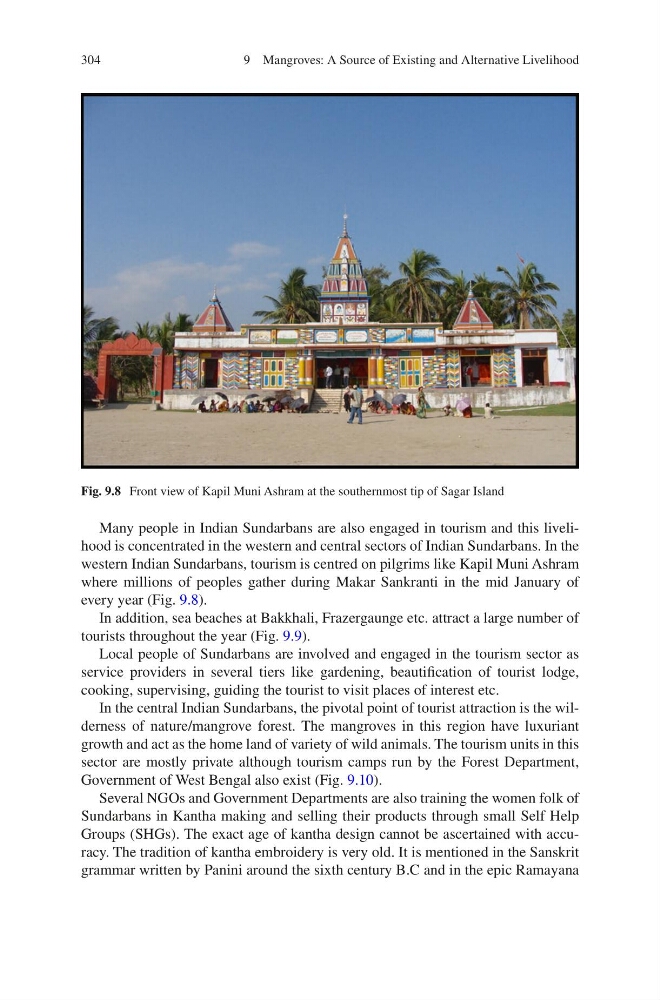
western Indian Sundarbans, tourism is centred on pilgrims like Kapil Muni Ashram
where millions of peoples gather during Makar Sankranti in the mid January of
every year (Fig. 9.8).
In addition, sea beaches at Bakkhali, Frazergaunge etc. attract a large number of
tourists throughout the year (Fig. 9.9).
Local people of Sundarbans are involved and engaged in the tourism sector as
service providers in several tiers like gardening, beautification of tourist lodge,
cooking, supervising, guiding the tourist to visit places of interest etc.
In the central Indian Sundarbans, the pivotal point of tourist attraction is the wilderness of nature/mangrove forest. The mangroves in this region have luxuriant
growth and act as the home land of variety of wild animals. The tourism units in this
sector are mostly private although tourism camps run by the Forest Department,
Government of West Bengal also exist (Fig. 9.10).
Several NGOs and Government Departments are also training the women folk of
Sundarbans in Kantha making and selling their products through small Self Help
Groups (SHGs). The exact age of kantha design cannot be ascertained with accuracy. The tradition of kantha embroidery is very old. It is mentioned in the Sanskrit
grammar written by Panini around the sixth century B.C and in the epic Ramayana
Fig. 9.8 Front view of Kapil Muni Ashram at the southernmost tip of Sagar Island
9 Mangroves: A Source of Existing and Alternative Livelihood
Many people in Indian Sundarbans are also engaged in tourism and this livelihood is concentrated in the western and central sectors of Indian Sundarbans. In the
western Indian Sundarbans, tourism is centred on pilgrims like Kapil Muni Ashram
where millions of peoples gather during Makar Sankranti in the mid January of
every year (Fig. 9.8).
In addition, sea beaches at Bakkhali, Frazergaunge etc. attract a large number of
tourists throughout the year (Fig. 9.9).
Local people of Sundarbans are involved and engaged in the tourism sector as
service providers in several tiers like gardening, beautification of tourist lodge,
cooking, supervising, guiding the tourist to visit places of interest etc.
In the central Indian Sundarbans, the pivotal point of tourist attraction is the wilderness of nature/mangrove forest. The mangroves in this region have luxuriant
growth and act as the home land of variety of wild animals. The tourism units in this
sector are mostly private although tourism camps run by the Forest Department,
Government of West Bengal also exist (Fig. 9.10).
Several NGOs and Government Departments are also training the women folk of
Sundarbans in Kantha making and selling their products through small Self Help
Groups (SHGs). The exact age of kantha design cannot be ascertained with accuracy. The tradition of kantha embroidery is very old. It is mentioned in the Sanskrit
grammar written by Panini around the sixth century B.C and in the epic Ramayana
Fig. 9.8 Front view of Kapil Muni Ashram at the southernmost tip of Sagar Island
9 Mangroves: A Source of Existing and Alternative Livelihood