

301
Junput (Stn. 3) is situated in the Medinipur (East) district of coastal West Bengal,
which is noted for its high aquatic salinity owing to its proximity to the Bay of
Bengal. The extremely high salinity has posed an inhibitory effect on the growth
and survival of mangroves in this station. Existence of salt pans has made the soil of
the area hypersaline in nature. Although the station has no industry around its vicinity, but the presence of Digha tourist center and Shankarpur fishing harbour close to
the station has multiplied the anthropogenic pressure around the zone.
In all these stations, tiger prawn seeds collection is a very common scene in
which the coastal and estuarine waters are screened in search of target species (seeds
of Penaeus monodon) by using nets of very fine mesh size. This activity traps a
varied spectrum of several fin fish juveniles (non-target species), which are subsequently thrown away and destroyed.
Collections of 10 nets were randomly mixed and a constant weight of 10 gm was
preserved in 4% formaldehyde. The average numbers of different juvenile fin fishes
were counted from this 10 gm sample and their total numbers were expressed as
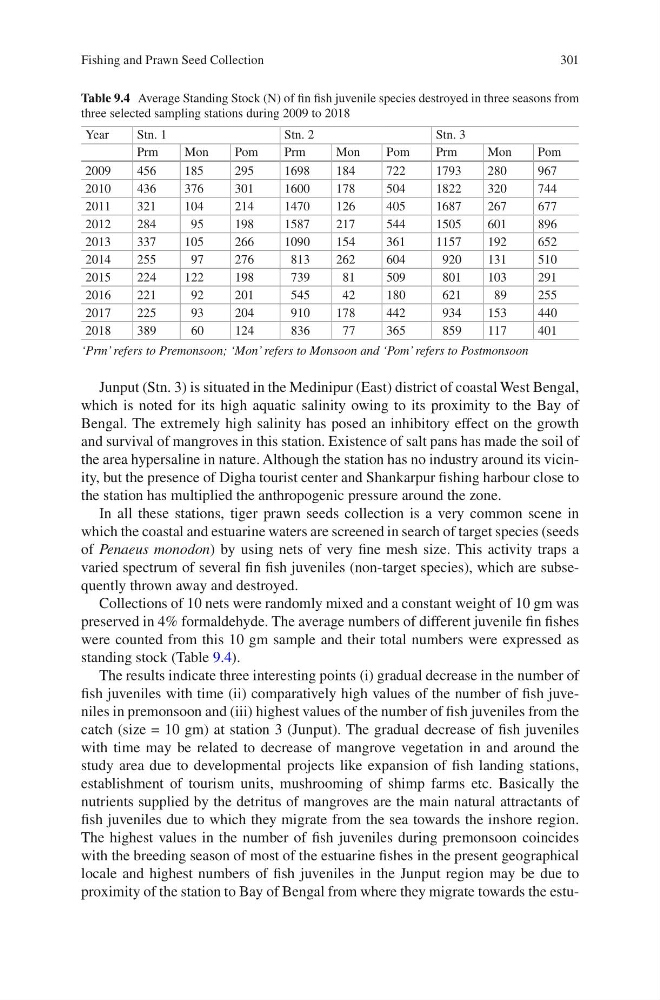
standing stock (Table 9.4).
The results indicate three interesting points (i) gradual decrease in the number of
fish juveniles with time (ii) comparatively high values of the number of fish juveniles in premonsoon and (iii) highest values of the number of fish juveniles from the
catch (size = 10 gm) at station 3 (Junput). The gradual decrease of fish juveniles
with time may be related to decrease of mangrove vegetation in and around the
study area due to developmental projects like expansion of fish landing stations,
establishment of tourism units, mushrooming of shimp farms etc. Basically the
nutrients supplied by the detritus of mangroves are the main natural attractants of
fish juveniles due to which they migrate from the sea towards the inshore region.
The highest values in the number of fish juveniles during premonsoon coincides
with the breeding season of most of the estuarine fishes in the present geographical
locale and highest numbers of fish juveniles in the Junput region may be due to
proximity of the station to Bay of Bengal from where they migrate towards the estuTable 9.4 Average Standing Stock (N) of fin fish juvenile species destroyed in three seasons from
three selected sampling stations during 2009 to 2018
Year
Stn. 1
Stn. 2
Stn. 3
Prm
Mon
Pom
Prm
Mon
Pom
Prm
Mon
Pom
2009
456
185
295
1698
184
722
1793
280
967
2010
436
376
301
1600
178
504
1822
320
744
2011
321
104
214
1470
126
405
1687
267
677
2012
284
95
198
1587
217
544
1505
601
896
2013
337
105
266
1090
154
361
1157
192
652
2014
255
97
276
813
262
604
920
131
510
2015
224
122
198
739
81
509
801
103
291
2016
221
92
201
545
42
180
621
89
255
2017
225
93
204
910
178
442
934
153
440
2018
389
60
124
836
77
365
859
117
401
‘Prm’ refers to Premonsoon; ‘Mon’ refers to Monsoon and ‘Pom’ refers to Postmonsoon
Fishing and Prawn Seed Collection
Junput (Stn. 3) is situated in the Medinipur (East) district of coastal West Bengal,
which is noted for its high aquatic salinity owing to its proximity to the Bay of
Bengal. The extremely high salinity has posed an inhibitory effect on the growth
and survival of mangroves in this station. Existence of salt pans has made the soil of
the area hypersaline in nature. Although the station has no industry around its vicinity, but the presence of Digha tourist center and Shankarpur fishing harbour close to
the station has multiplied the anthropogenic pressure around the zone.
In all these stations, tiger prawn seeds collection is a very common scene in
which the coastal and estuarine waters are screened in search of target species (seeds
of Penaeus monodon) by using nets of very fine mesh size. This activity traps a
varied spectrum of several fin fish juveniles (non-target species), which are subsequently thrown away and destroyed.
Collections of 10 nets were randomly mixed and a constant weight of 10 gm was
preserved in 4% formaldehyde. The average numbers of different juvenile fin fishes
were counted from this 10 gm sample and their total numbers were expressed as
standing stock (Table 9.4).
The results indicate three interesting points (i) gradual decrease in the number of
fish juveniles with time (ii) comparatively high values of the number of fish juveniles in premonsoon and (iii) highest values of the number of fish juveniles from the
catch (size = 10 gm) at station 3 (Junput). The gradual decrease of fish juveniles
with time may be related to decrease of mangrove vegetation in and around the
study area due to developmental projects like expansion of fish landing stations,
establishment of tourism units, mushrooming of shimp farms etc. Basically the
nutrients supplied by the detritus of mangroves are the main natural attractants of
fish juveniles due to which they migrate from the sea towards the inshore region.
The highest values in the number of fish juveniles during premonsoon coincides
with the breeding season of most of the estuarine fishes in the present geographical
locale and highest numbers of fish juveniles in the Junput region may be due to
proximity of the station to Bay of Bengal from where they migrate towards the estuTable 9.4 Average Standing Stock (N) of fin fish juvenile species destroyed in three seasons from
three selected sampling stations during 2009 to 2018
Year
Stn. 1
Stn. 2
Stn. 3
Prm
Mon
Pom
Prm
Mon
Pom
Prm
Mon
Pom
2009
456
185
295
1698
184
722
1793
280
967
2010
436
376
301
1600
178
504
1822
320
744
2011
321
104
214
1470
126
405
1687
267
677
2012
284
95
198
1587
217
544
1505
601
896
2013
337
105
266
1090
154
361
1157
192
652
2014
255
97
276
813
262
604
920
131
510
2015
224
122
198
739
81
509
801
103
291
2016
221
92
201
545
42
180
621
89
255
2017
225
93
204
910
178
442
934
153
440
2018
389
60
124
836
77
365
859
117
401
‘Prm’ refers to Premonsoon; ‘Mon’ refers to Monsoon and ‘Pom’ refers to Postmonsoon
Fishing and Prawn Seed Collection