

253
in intertidal and shallow waters in 91,345 tonnes (wet weight) and 75,373 tonnes in
deep water (Table 8.8), which consists 6000 tonnes of agar yielding seaweeds and
the remaining quantity of edible and other seaweeds. At present there are about 30
agar and algin manufacturing units in India, but still the quantity of seaweed beds
from Tamil Nadu coast is insufficient to meet the raw material requirements of
Indian seaweed industries (Kaliperumal 1994).
Algal abundance and diversity are largely determined by the physico-chemical
characteristics of mangal (Mazda et al. 1990) and these may be extremely variable.
As with mangrove themselves, the most successful macroalgae have special adaptations that help them to tolerate extreme conditions.
Salinity, temperature, desiccation, tidal inundation, wave action, wetting frequency and light intensity are all environmental factors likely to produce patterns of
horizontal and vertical distribution seen in many mangrove associate algae (Phillips
et al. 1994; Farnsworth and Ellision 1996). In the Gazi Bay of Kenya, there is distinct macroalgal zonation. The upper intertidal is covered by Boodleopsis pusilla
while the mid-intertidal zone is dominated by Halophilus opuntia, Gracilaria salicornia and G. corticata. The low water mark has primarily Halimeda macroloba
and Avrainvillea obscura (Coppenjans et al. 1992). A distinct zonation has also
been described for algae growing on the pneumatophores of Avicennia marina
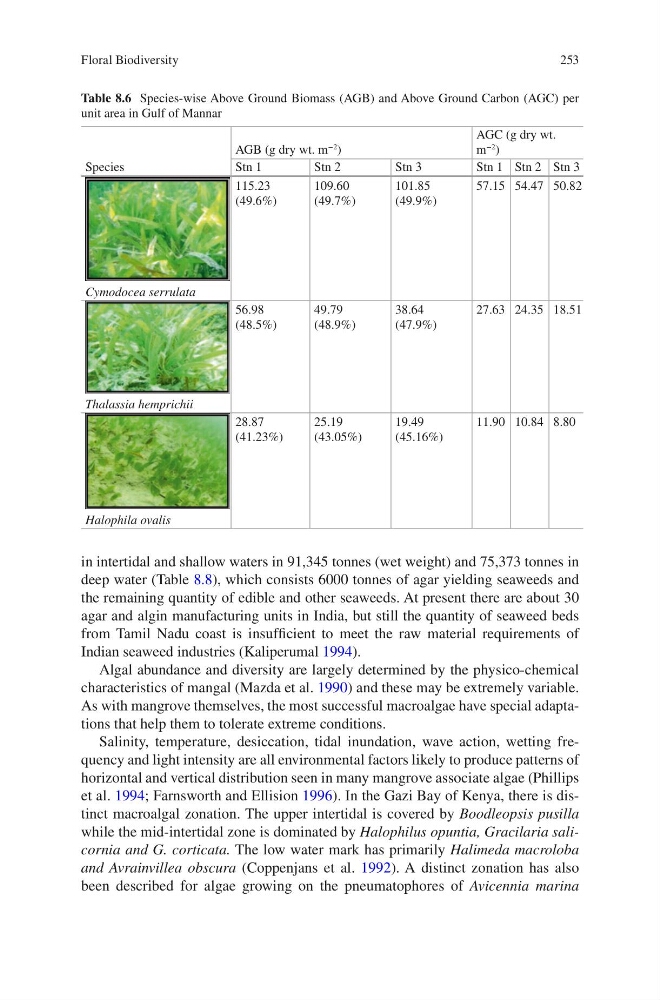
Table 8.6 Species-wise Above Ground Biomass (AGB) and Above Ground Carbon (AGC) per
unit area in Gulf of Mannar
Species
AGB (g dry wt. m
−2 )
AGC (g dry wt.
m
−2
)
Stn 1
Stn 2
Stn 3
Stn 1 Stn 2 Stn 3
Cymodocea serrulata
115.23
(49.6%)
109.60
(49.7%)
101.85
(49.9%)
57.15 54.47 50.82
Thalassia hemprichii
56.98
(48.5%)
49.79
(48.9%)
38.64
(47.9%)
27.63 24.35 18.51
Halophila ovalis
28.87
(41.23%)
25.19
(43.05%)
19.49
(45.16%)
11.90 10.84 8.80
Floral Biodiversity
in intertidal and shallow waters in 91,345 tonnes (wet weight) and 75,373 tonnes in
deep water (Table 8.8), which consists 6000 tonnes of agar yielding seaweeds and
the remaining quantity of edible and other seaweeds. At present there are about 30
agar and algin manufacturing units in India, but still the quantity of seaweed beds
from Tamil Nadu coast is insufficient to meet the raw material requirements of
Indian seaweed industries (Kaliperumal 1994).
Algal abundance and diversity are largely determined by the physico-chemical
characteristics of mangal (Mazda et al. 1990) and these may be extremely variable.
As with mangrove themselves, the most successful macroalgae have special adaptations that help them to tolerate extreme conditions.
Salinity, temperature, desiccation, tidal inundation, wave action, wetting frequency and light intensity are all environmental factors likely to produce patterns of
horizontal and vertical distribution seen in many mangrove associate algae (Phillips
et al. 1994; Farnsworth and Ellision 1996). In the Gazi Bay of Kenya, there is distinct macroalgal zonation. The upper intertidal is covered by Boodleopsis pusilla
while the mid-intertidal zone is dominated by Halophilus opuntia, Gracilaria salicornia and G. corticata. The low water mark has primarily Halimeda macroloba
and Avrainvillea obscura (Coppenjans et al. 1992). A distinct zonation has also
been described for algae growing on the pneumatophores of Avicennia marina
Table 8.6 Species-wise Above Ground Biomass (AGB) and Above Ground Carbon (AGC) per
unit area in Gulf of Mannar
Species
AGB (g dry wt. m
−2 )
AGC (g dry wt.
m
−2
)
Stn 1
Stn 2
Stn 3
Stn 1 Stn 2 Stn 3
Cymodocea serrulata
115.23
(49.6%)
109.60
(49.7%)
101.85
(49.9%)
57.15 54.47 50.82
Thalassia hemprichii
56.98
(48.5%)
49.79
(48.9%)
38.64
(47.9%)
27.63 24.35 18.51
Halophila ovalis
28.87
(41.23%)
25.19
(43.05%)
19.49
(45.16%)
11.90 10.84 8.80
Floral Biodiversity