

7
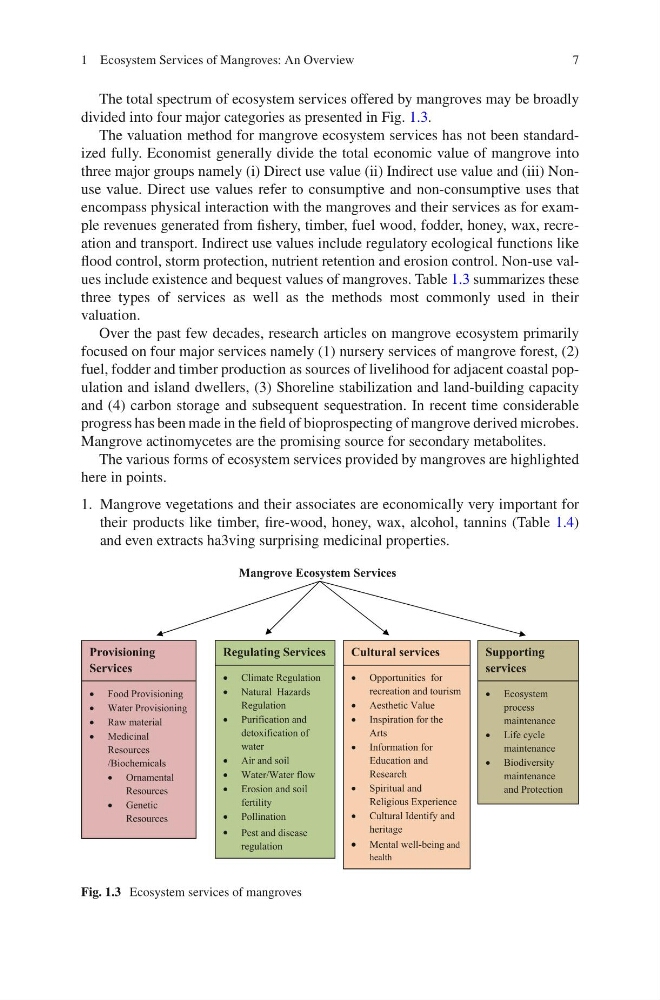
The total spectrum of ecosystem services offered by mangroves may be broadly
divided into four major categories as presented in Fig. 1.3.
The valuation method for mangrove ecosystem services has not been standardized fully. Economist generally divide the total economic value of mangrove into
three major groups namely (i) Direct use value (ii) Indirect use value and (iii) Nonuse value. Direct use values refer to consumptive and non-consumptive uses that
encompass physical interaction with the mangroves and their services as for example revenues generated from fishery, timber, fuel wood, fodder, honey, wax, recreation and transport. Indirect use values include regulatory ecological functions like
flood control, storm protection, nutrient retention and erosion control. Non-use values include existence and bequest values of mangroves. Table 1.3 summarizes these
three types of services as well as the methods most commonly used in their
valuation.
Over the past few decades, research articles on mangrove ecosystem primarily
focused on four major services namely (1) nursery services of mangrove forest, (2)
fuel, fodder and timber production as sources of livelihood for adjacent coastal population and island dwellers, (3) Shoreline stabilization and land-building capacity
and (4) carbon storage and subsequent sequestration. In recent time considerable
progress has been made in the field of bioprospecting of mangrove derived microbes.
Mangrove actinomycetes are the promising source for secondary metabolites.
The various forms of ecosystem services provided by mangroves are highlighted
here in points.
1. Mangrove vegetations and their associates are economically very important for
their products like timber, fire-wood, honey, wax, alcohol, tannins (Table 1.4)
and even extracts ha3ving surprising medicinal properties.
Fig. 1.3 Ecosystem services of mangroves
1 Ecosystem Services of Mangroves: An Overview
The total spectrum of ecosystem services offered by mangroves may be broadly
divided into four major categories as presented in Fig. 1.3.
The valuation method for mangrove ecosystem services has not been standardized fully. Economist generally divide the total economic value of mangrove into
three major groups namely (i) Direct use value (ii) Indirect use value and (iii) Nonuse value. Direct use values refer to consumptive and non-consumptive uses that
encompass physical interaction with the mangroves and their services as for example revenues generated from fishery, timber, fuel wood, fodder, honey, wax, recreation and transport. Indirect use values include regulatory ecological functions like
flood control, storm protection, nutrient retention and erosion control. Non-use values include existence and bequest values of mangroves. Table 1.3 summarizes these
three types of services as well as the methods most commonly used in their
valuation.
Over the past few decades, research articles on mangrove ecosystem primarily
focused on four major services namely (1) nursery services of mangrove forest, (2)
fuel, fodder and timber production as sources of livelihood for adjacent coastal population and island dwellers, (3) Shoreline stabilization and land-building capacity
and (4) carbon storage and subsequent sequestration. In recent time considerable
progress has been made in the field of bioprospecting of mangrove derived microbes.
Mangrove actinomycetes are the promising source for secondary metabolites.
The various forms of ecosystem services provided by mangroves are highlighted
here in points.
1. Mangrove vegetations and their associates are economically very important for
their products like timber, fire-wood, honey, wax, alcohol, tannins (Table 1.4)
and even extracts ha3ving surprising medicinal properties.
Fig. 1.3 Ecosystem services of mangroves
1 Ecosystem Services of Mangroves: An Overview