

142
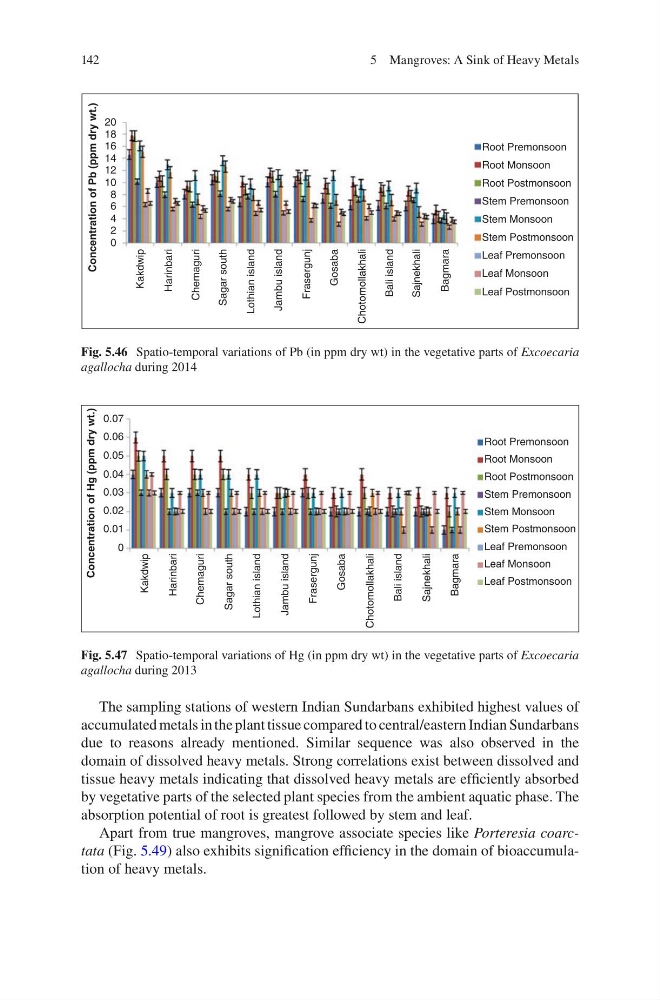
The sampling stations of western Indian Sundarbans exhibited highest values of
accumulated metals in the plant tissue compared to central/eastern Indian Sundarbans
due to reasons already mentioned. Similar sequence was also observed in the
domain of dissolved heavy metals. Strong correlations exist between dissolved and
tissue heavy metals indicating that dissolved heavy metals are efficiently absorbed
by vegetative parts of the selected plant species from the ambient aquatic phase. The
absorption potential of root is greatest followed by stem and leaf.
Apart from true mangroves, mangrove associate species like Porteresia coarctata (Fig. 5.49) also exhibits signification efficiency in the domain of bioaccumulation of heavy metals.
Kakdwip
Harinbari
Chemaguri
Sagar south
Lothian island
Jambu island
Frasergunj
Gosaba
Chotomollakhali
Bali island
Sajnekhali
Bagmara
Root Premonsoon
Stem Premonsoon
Leaf Premonsoon
Leaf Monsoon
Stem Postmonsoon
Leaf Postmonsoon
Stem Monsoon
Root Postmonsoon
Root Monsoon
Concentration of Pb (ppm dry wt.)
18
20
16
14
12
10
8
6
4
2
0
Fig. 5.46 Spatio-temporal variations of Pb (in ppm dry wt) in the vegetative parts of Excoecaria
agallocha during 2014
Kakdwip
Harinbari
Chemaguri
Sagar south
Lothian island
Jambu island
Frasergunj
Gosaba
Chotomollakhali
Bali island
Sajnekhali
Bagmara
Root Premonsoon
Stem Premonsoon
Leaf Premonsoon
Leaf Monsoon
Stem Postmonsoon
Leaf Postmonsoon
Stem Monsoon
Root Postmonsoon
Root Monsoon
Concentration of Hg (ppm dry wt.)
0.07
0.06
0.05
0.04
0.03
0.02
0.01
0
Fig. 5.47 Spatio-temporal variations of Hg (in ppm dry wt) in the vegetative parts of Excoecaria
agallocha during 2013
5 Mangroves: A Sink of Heavy Metals
The sampling stations of western Indian Sundarbans exhibited highest values of
accumulated metals in the plant tissue compared to central/eastern Indian Sundarbans
due to reasons already mentioned. Similar sequence was also observed in the
domain of dissolved heavy metals. Strong correlations exist between dissolved and
tissue heavy metals indicating that dissolved heavy metals are efficiently absorbed
by vegetative parts of the selected plant species from the ambient aquatic phase. The
absorption potential of root is greatest followed by stem and leaf.
Apart from true mangroves, mangrove associate species like Porteresia coarctata (Fig. 5.49) also exhibits signification efficiency in the domain of bioaccumulation of heavy metals.
Kakdwip
Harinbari
Chemaguri
Sagar south
Lothian island
Jambu island
Frasergunj
Gosaba
Chotomollakhali
Bali island
Sajnekhali
Bagmara
Root Premonsoon
Stem Premonsoon
Leaf Premonsoon
Leaf Monsoon
Stem Postmonsoon
Leaf Postmonsoon
Stem Monsoon
Root Postmonsoon
Root Monsoon
Concentration of Pb (ppm dry wt.)
18
20
16
14
12
10
8
6
4
2
0
Fig. 5.46 Spatio-temporal variations of Pb (in ppm dry wt) in the vegetative parts of Excoecaria
agallocha during 2014
Kakdwip
Harinbari
Chemaguri
Sagar south
Lothian island
Jambu island
Frasergunj
Gosaba
Chotomollakhali
Bali island
Sajnekhali
Bagmara
Root Premonsoon
Stem Premonsoon
Leaf Premonsoon
Leaf Monsoon
Stem Postmonsoon
Leaf Postmonsoon
Stem Monsoon
Root Postmonsoon
Root Monsoon
Concentration of Hg (ppm dry wt.)
0.07
0.06
0.05
0.04
0.03
0.02
0.01
0
Fig. 5.47 Spatio-temporal variations of Hg (in ppm dry wt) in the vegetative parts of Excoecaria
agallocha during 2013
5 Mangroves: A Sink of Heavy Metals