

Crafting Luxury with ‘More-ish’ Qualities …
153
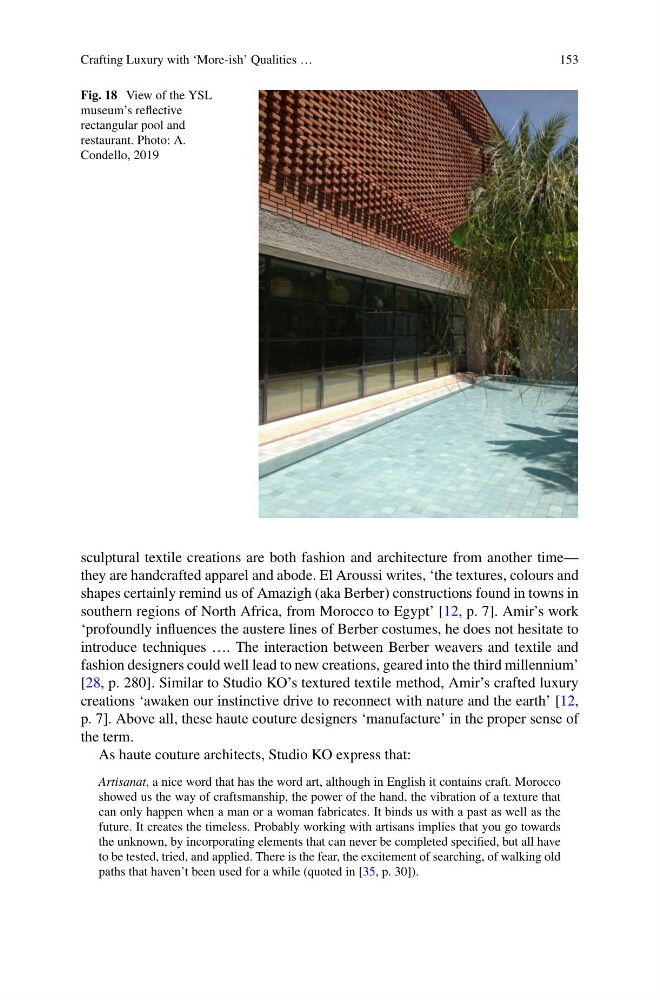
Fig. 18 View of the YSL
museum’s reflective
rectangular pool and
restaurant. Photo: A.
Condello, 2019
sculptural textile creations are both fashion and architecture from another time—
they are handcrafted apparel and abode. El Aroussi writes, ‘the textures, colours and
shapes certainly remind us of Amazigh (aka Berber) constructions found in towns in
southern regions of North Africa, from Morocco to Egypt’ [12, p. 7]. Amir’s work
‘profoundly influences the austere lines of Berber costumes, he does not hesitate to
introduce techniques …. The interaction between Berber weavers and textile and
fashion designers could well lead to new creations, geared into the third millennium’
[28, p. 280]. Similar to Studio KO’s textured textile method, Amir’s crafted luxury
creations ‘awaken our instinctive drive to reconnect with nature and the earth’ [12,
p. 7]. Above all, these haute couture designers ‘manufacture’ in the proper sense of
the term.
As haute couture architects, Studio KO express that:
Artisanat, a nice word that has the word art, although in English it contains craft. Morocco
showed us the way of craftsmanship, the power of the hand, the vibration of a texture that
can only happen when a man or a woman fabricates. It binds us with a past as well as the
future. It creates the timeless. Probably working with artisans implies that you go towards
the unknown, by incorporating elements that can never be completed specified, but all have
to be tested, tried, and applied. There is the fear, the excitement of searching, of walking old
paths that haven’t been used for a while (quoted in [35, p. 30]).
153
Fig. 18 View of the YSL
museum’s reflective
rectangular pool and
restaurant. Photo: A.
Condello, 2019
sculptural textile creations are both fashion and architecture from another time—
they are handcrafted apparel and abode. El Aroussi writes, ‘the textures, colours and
shapes certainly remind us of Amazigh (aka Berber) constructions found in towns in
southern regions of North Africa, from Morocco to Egypt’ [12, p. 7]. Amir’s work
‘profoundly influences the austere lines of Berber costumes, he does not hesitate to
introduce techniques …. The interaction between Berber weavers and textile and
fashion designers could well lead to new creations, geared into the third millennium’
[28, p. 280]. Similar to Studio KO’s textured textile method, Amir’s crafted luxury
creations ‘awaken our instinctive drive to reconnect with nature and the earth’ [12,
p. 7]. Above all, these haute couture designers ‘manufacture’ in the proper sense of
the term.
As haute couture architects, Studio KO express that:
Artisanat, a nice word that has the word art, although in English it contains craft. Morocco
showed us the way of craftsmanship, the power of the hand, the vibration of a texture that
can only happen when a man or a woman fabricates. It binds us with a past as well as the
future. It creates the timeless. Probably working with artisans implies that you go towards
the unknown, by incorporating elements that can never be completed specified, but all have
to be tested, tried, and applied. There is the fear, the excitement of searching, of walking old
paths that haven’t been used for a while (quoted in [35, p. 30]).