

152
A. Condello
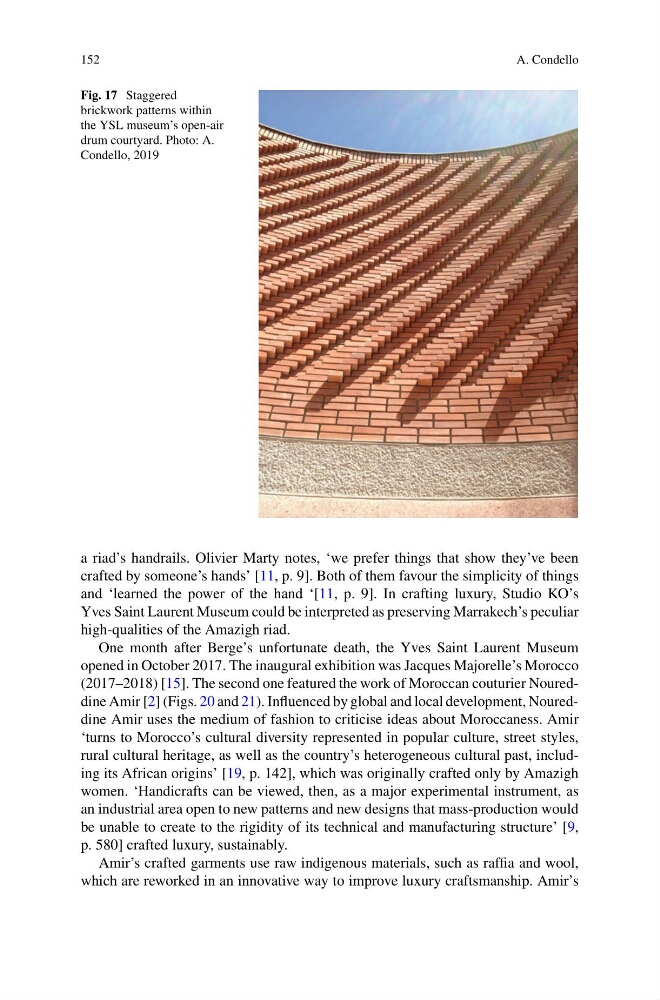
Fig. 17 Staggered
brickwork patterns within
the YSL museum’s open-air
drum courtyard. Photo: A.
Condello, 2019
a riad’s handrails. Olivier Marty notes, ‘we prefer things that show they’ve been
crafted by someone’s hands’ [11, p. 9]. Both of them favour the simplicity of things
and ‘learned the power of the hand ‘[11, p. 9]. In crafting luxury, Studio KO’s
Yves Saint Laurent Museum could be interpreted as preserving Marrakech’s peculiar
high-qualities of the Amazigh riad.
One month after Berge’s unfortunate death, the Yves Saint Laurent Museum
opened in October 2017. The inaugural exhibition was Jacques Majorelle’s Morocco
(2017–2018) [15]. The second one featured the work of Moroccan couturier Noureddine Amir [2] (Figs. 20 and 21). Influenced by global and local development, Noureddine Amir uses the medium of fashion to criticise ideas about Moroccaness. Amir
‘turns to Morocco’s cultural diversity represented in popular culture, street styles,
rural cultural heritage, as well as the country’s heterogeneous cultural past, including its African origins’ [19, p. 142], which was originally crafted only by Amazigh
women. ‘Handicrafts can be viewed, then, as a major experimental instrument, as
an industrial area open to new patterns and new designs that mass-production would
be unable to create to the rigidity of its technical and manufacturing structure’ [9,
p. 580] crafted luxury, sustainably.
Amir’s crafted garments use raw indigenous materials, such as raffia and wool,
which are reworked in an innovative way to improve luxury craftsmanship. Amir’s
A. Condello
Fig. 17 Staggered
brickwork patterns within
the YSL museum’s open-air
drum courtyard. Photo: A.
Condello, 2019
a riad’s handrails. Olivier Marty notes, ‘we prefer things that show they’ve been
crafted by someone’s hands’ [11, p. 9]. Both of them favour the simplicity of things
and ‘learned the power of the hand ‘[11, p. 9]. In crafting luxury, Studio KO’s
Yves Saint Laurent Museum could be interpreted as preserving Marrakech’s peculiar
high-qualities of the Amazigh riad.
One month after Berge’s unfortunate death, the Yves Saint Laurent Museum
opened in October 2017. The inaugural exhibition was Jacques Majorelle’s Morocco
(2017–2018) [15]. The second one featured the work of Moroccan couturier Noureddine Amir [2] (Figs. 20 and 21). Influenced by global and local development, Noureddine Amir uses the medium of fashion to criticise ideas about Moroccaness. Amir
‘turns to Morocco’s cultural diversity represented in popular culture, street styles,
rural cultural heritage, as well as the country’s heterogeneous cultural past, including its African origins’ [19, p. 142], which was originally crafted only by Amazigh
women. ‘Handicrafts can be viewed, then, as a major experimental instrument, as
an industrial area open to new patterns and new designs that mass-production would
be unable to create to the rigidity of its technical and manufacturing structure’ [9,
p. 580] crafted luxury, sustainably.
Amir’s crafted garments use raw indigenous materials, such as raffia and wool,
which are reworked in an innovative way to improve luxury craftsmanship. Amir’s