

Crafting Luxury with ‘More-ish’ Qualities …
135
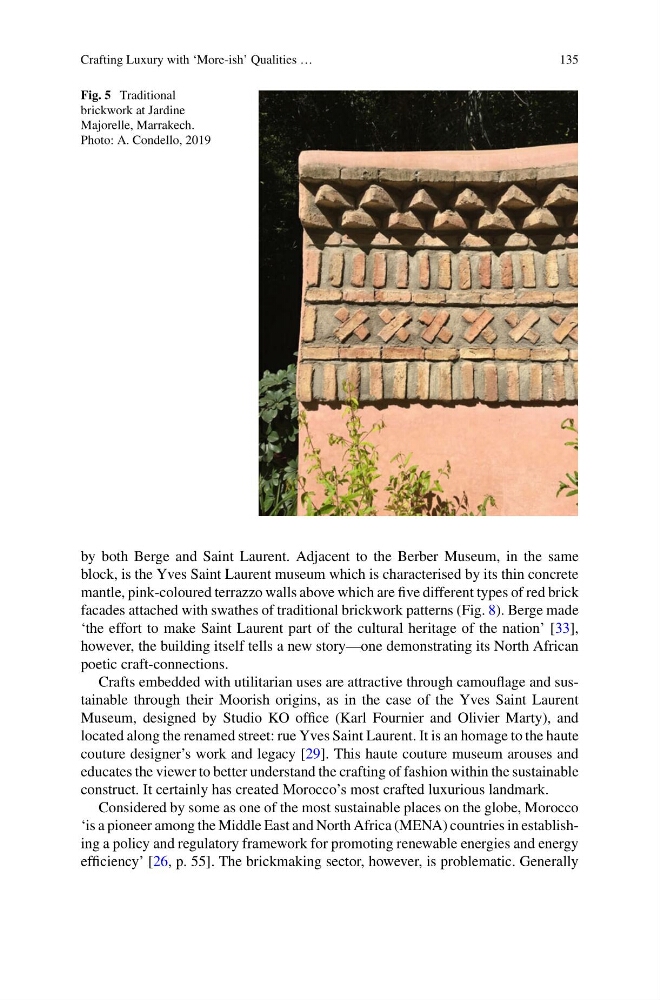
Fig. 5 Traditional
brickwork at Jardine
Majorelle, Marrakech.
Photo: A. Condello, 2019
by both Berge and Saint Laurent. Adjacent to the Berber Museum, in the same
block, is the Yves Saint Laurent museum which is characterised by its thin concrete
mantle, pink-coloured terrazzo walls above which are five different types of red brick
facades attached with swathes of traditional brickwork patterns (Fig. 8). Berge made
‘the effort to make Saint Laurent part of the cultural heritage of the nation’ [33],
however, the building itself tells a new story—one demonstrating its North African
poetic craft-connections.
Crafts embedded with utilitarian uses are attractive through camouflage and sustainable through their Moorish origins, as in the case of the Yves Saint Laurent
Museum, designed by Studio KO office (Karl Fournier and Olivier Marty), and
located along the renamed street: rue Yves Saint Laurent. It is an homage to the haute
couture designer’s work and legacy [29]. This haute couture museum arouses and
educates the viewer to better understand the crafting of fashion within the sustainable
construct. It certainly has created Morocco’s most crafted luxurious landmark.
Considered by some as one of the most sustainable places on the globe, Morocco
‘is a pioneer among the Middle East and North Africa (MENA) countries in establishing a policy and regulatory framework for promoting renewable energies and energy
efficiency’ [26, p. 55]. The brickmaking sector, however, is problematic. Generally
135
Fig. 5 Traditional
brickwork at Jardine
Majorelle, Marrakech.
Photo: A. Condello, 2019
by both Berge and Saint Laurent. Adjacent to the Berber Museum, in the same
block, is the Yves Saint Laurent museum which is characterised by its thin concrete
mantle, pink-coloured terrazzo walls above which are five different types of red brick
facades attached with swathes of traditional brickwork patterns (Fig. 8). Berge made
‘the effort to make Saint Laurent part of the cultural heritage of the nation’ [33],
however, the building itself tells a new story—one demonstrating its North African
poetic craft-connections.
Crafts embedded with utilitarian uses are attractive through camouflage and sustainable through their Moorish origins, as in the case of the Yves Saint Laurent
Museum, designed by Studio KO office (Karl Fournier and Olivier Marty), and
located along the renamed street: rue Yves Saint Laurent. It is an homage to the haute
couture designer’s work and legacy [29]. This haute couture museum arouses and
educates the viewer to better understand the crafting of fashion within the sustainable
construct. It certainly has created Morocco’s most crafted luxurious landmark.
Considered by some as one of the most sustainable places on the globe, Morocco
‘is a pioneer among the Middle East and North Africa (MENA) countries in establishing a policy and regulatory framework for promoting renewable energies and energy
efficiency’ [26, p. 55]. The brickmaking sector, however, is problematic. Generally