

134
A. Condello
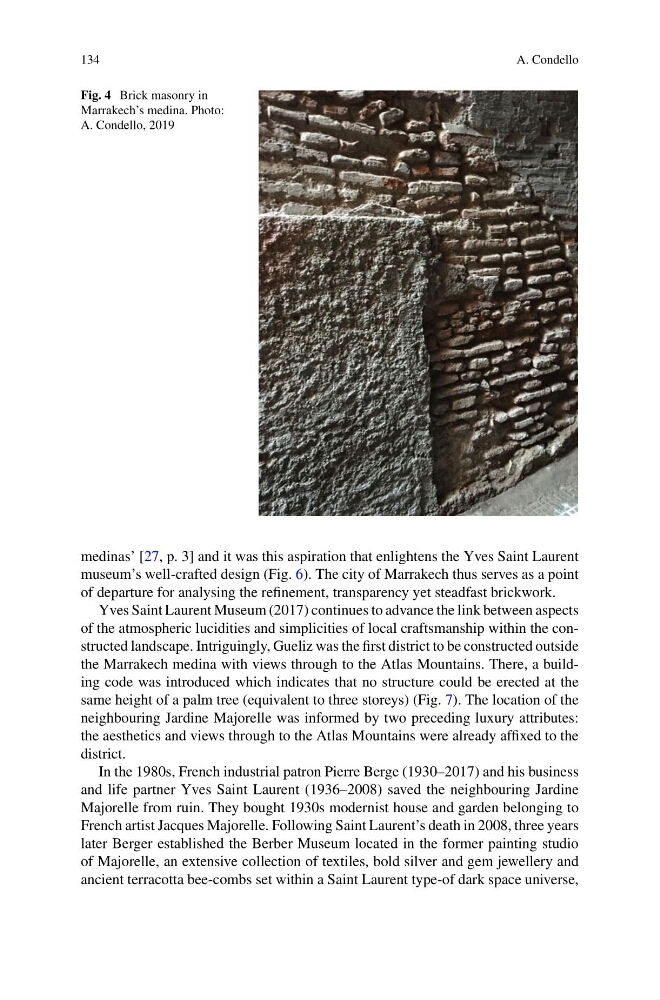
Fig. 4 Brick masonry in
Marrakech’s medina. Photo:
A. Condello, 2019
medinas’ [27, p. 3] and it was this aspiration that enlightens the Yves Saint Laurent
museum’s well-crafted design (Fig. 6). The city of Marrakech thus serves as a point
of departure for analysing the refinement, transparency yet steadfast brickwork.
Yves Saint Laurent Museum (2017) continues to advance the link between aspects
of the atmospheric lucidities and simplicities of local craftsmanship within the constructed landscape. Intriguingly, Gueliz was the first district to be constructed outside
the Marrakech medina with views through to the Atlas Mountains. There, a building code was introduced which indicates that no structure could be erected at the
same height of a palm tree (equivalent to three storeys) (Fig. 7). The location of the
neighbouring Jardine Majorelle was informed by two preceding luxury attributes:
the aesthetics and views through to the Atlas Mountains were already affixed to the
district.
In the 1980s, French industrial patron Pierre Berge (1930–2017) and his business
and life partner Yves Saint Laurent (1936–2008) saved the neighbouring Jardine
Majorelle from ruin. They bought 1930s modernist house and garden belonging to
French artist Jacques Majorelle. Following Saint Laurent’s death in 2008, three years
later Berger established the Berber Museum located in the former painting studio
of Majorelle, an extensive collection of textiles, bold silver and gem jewellery and
ancient terracotta bee-combs set within a Saint Laurent type-of dark space universe,
A. Condello
Fig. 4 Brick masonry in
Marrakech’s medina. Photo:
A. Condello, 2019
medinas’ [27, p. 3] and it was this aspiration that enlightens the Yves Saint Laurent
museum’s well-crafted design (Fig. 6). The city of Marrakech thus serves as a point
of departure for analysing the refinement, transparency yet steadfast brickwork.
Yves Saint Laurent Museum (2017) continues to advance the link between aspects
of the atmospheric lucidities and simplicities of local craftsmanship within the constructed landscape. Intriguingly, Gueliz was the first district to be constructed outside
the Marrakech medina with views through to the Atlas Mountains. There, a building code was introduced which indicates that no structure could be erected at the
same height of a palm tree (equivalent to three storeys) (Fig. 7). The location of the
neighbouring Jardine Majorelle was informed by two preceding luxury attributes:
the aesthetics and views through to the Atlas Mountains were already affixed to the
district.
In the 1980s, French industrial patron Pierre Berge (1930–2017) and his business
and life partner Yves Saint Laurent (1936–2008) saved the neighbouring Jardine
Majorelle from ruin. They bought 1930s modernist house and garden belonging to
French artist Jacques Majorelle. Following Saint Laurent’s death in 2008, three years
later Berger established the Berber Museum located in the former painting studio
of Majorelle, an extensive collection of textiles, bold silver and gem jewellery and
ancient terracotta bee-combs set within a Saint Laurent type-of dark space universe,