

Crafting Luxury with ‘More-ish’ Qualities …
133
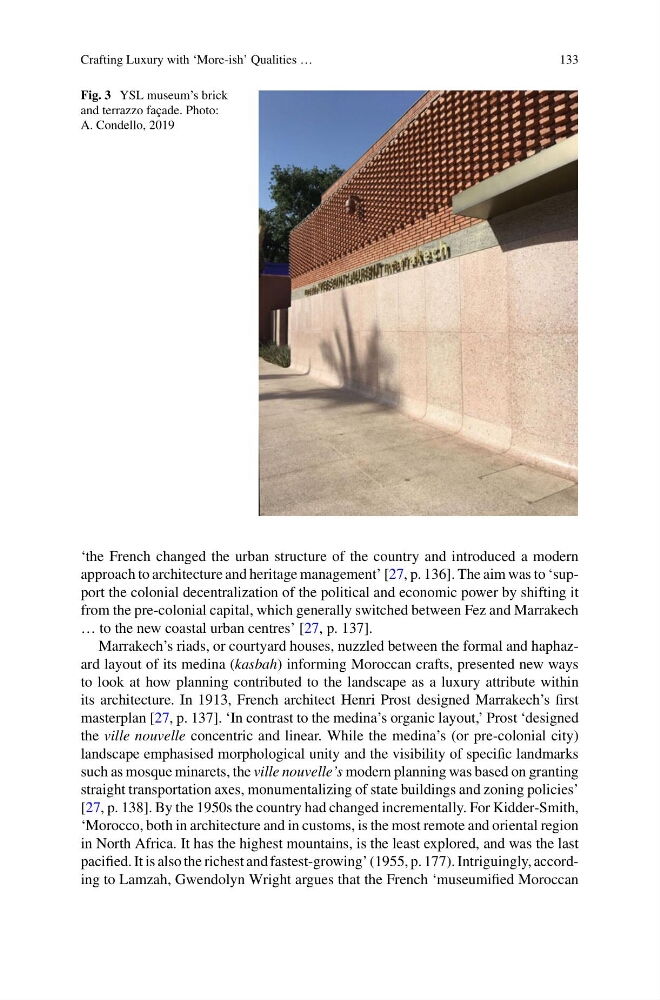
Fig. 3 YSL museum’s brick
and terrazzo façade. Photo:
A. Condello, 2019
‘the French changed the urban structure of the country and introduced a modern
approach to architecture and heritage management’ [27, p. 136]. The aim was to ‘support the colonial decentralization of the political and economic power by shifting it
from the pre-colonial capital, which generally switched between Fez and Marrakech
… to the new coastal urban centres’ [27, p. 137].
Marrakech’s riads, or courtyard houses, nuzzled between the formal and haphazard layout of its medina (kasbah) informing Moroccan crafts, presented new ways
to look at how planning contributed to the landscape as a luxury attribute within
its architecture. In 1913, French architect Henri Prost designed Marrakech’s first
masterplan [27, p. 137]. ‘In contrast to the medina’s organic layout,’ Prost ‘designed
the ville nouvelle concentric and linear. While the medina’s (or pre-colonial city)
landscape emphasised morphological unity and the visibility of specific landmarks
such as mosque minarets, the ville nouvelle’s modern planning was based on granting
straight transportation axes, monumentalizing of state buildings and zoning policies’
[27, p. 138]. By the 1950s the country had changed incrementally. For Kidder-Smith,
‘Morocco, both in architecture and in customs, is the most remote and oriental region
in North Africa. It has the highest mountains, is the least explored, and was the last
pacified. It is also the richest and fastest-growing’ (1955, p. 177). Intriguingly, according to Lamzah, Gwendolyn Wright argues that the French ‘museumified Moroccan
133
Fig. 3 YSL museum’s brick
and terrazzo façade. Photo:
A. Condello, 2019
‘the French changed the urban structure of the country and introduced a modern
approach to architecture and heritage management’ [27, p. 136]. The aim was to ‘support the colonial decentralization of the political and economic power by shifting it
from the pre-colonial capital, which generally switched between Fez and Marrakech
… to the new coastal urban centres’ [27, p. 137].
Marrakech’s riads, or courtyard houses, nuzzled between the formal and haphazard layout of its medina (kasbah) informing Moroccan crafts, presented new ways
to look at how planning contributed to the landscape as a luxury attribute within
its architecture. In 1913, French architect Henri Prost designed Marrakech’s first
masterplan [27, p. 137]. ‘In contrast to the medina’s organic layout,’ Prost ‘designed
the ville nouvelle concentric and linear. While the medina’s (or pre-colonial city)
landscape emphasised morphological unity and the visibility of specific landmarks
such as mosque minarets, the ville nouvelle’s modern planning was based on granting
straight transportation axes, monumentalizing of state buildings and zoning policies’
[27, p. 138]. By the 1950s the country had changed incrementally. For Kidder-Smith,
‘Morocco, both in architecture and in customs, is the most remote and oriental region
in North Africa. It has the highest mountains, is the least explored, and was the last
pacified. It is also the richest and fastest-growing’ (1955, p. 177). Intriguingly, according to Lamzah, Gwendolyn Wright argues that the French ‘museumified Moroccan