

Luxury Craftsmanship as an Alternative to Building Social …
117
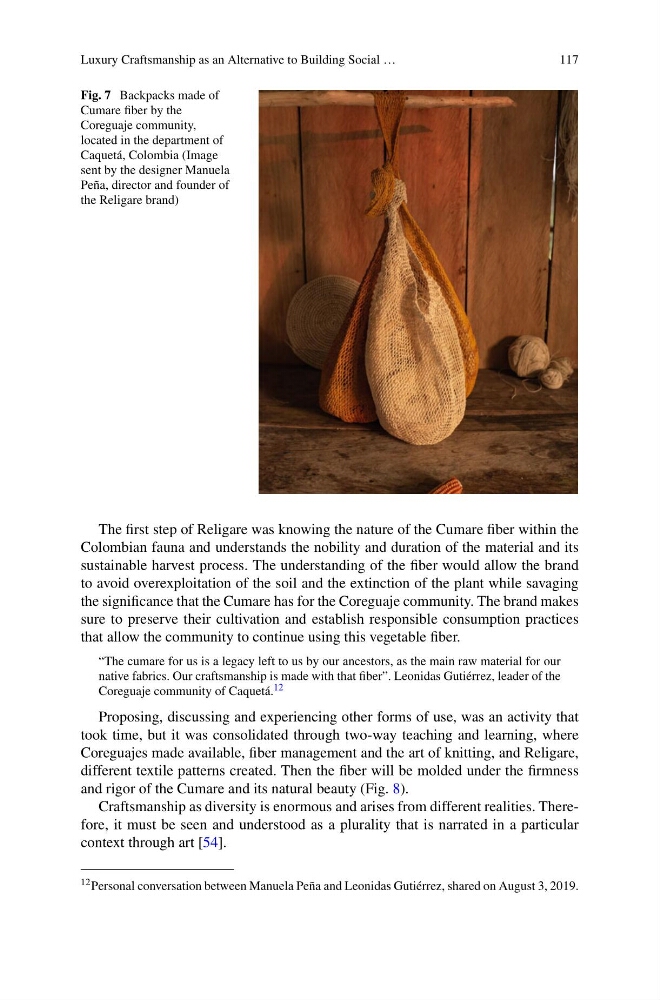
Fig. 7 Backpacks made of
Cumare fiber by the
Coreguaje community,
located in the department of
Caquetá, Colombia (Image
sent by the designer Manuela
Peña, director and founder of
the Religare brand)
The first step of Religare was knowing the nature of the Cumare fiber within the
Colombian fauna and understands the nobility and duration of the material and its
sustainable harvest process. The understanding of the fiber would allow the brand
to avoid overexploitation of the soil and the extinction of the plant while savaging
the significance that the Cumare has for the Coreguaje community. The brand makes
sure to preserve their cultivation and establish responsible consumption practices
that allow the community to continue using this vegetable fiber.
“The cumare for us is a legacy left to us by our ancestors, as the main raw material for our
native fabrics. Our craftsmanship is made with that fiber”. Leonidas Gutiérrez, leader of the
Coreguaje community of Caquetá. 12
Proposing, discussing and experiencing other forms of use, was an activity that
took time, but it was consolidated through two-way teaching and learning, where
Coreguajes made available, fiber management and the art of knitting, and Religare,
different textile patterns created. Then the fiber will be molded under the firmness
and rigor of the Cumare and its natural beauty (Fig. 8).
Craftsmanship as diversity is enormous and arises from different realities. Therefore, it must be seen and understood as a plurality that is narrated in a particular
context through art [54].
12 Personal conversation between Manuela Peña and Leonidas Gutiérrez, shared on August 3, 2019.
117
Fig. 7 Backpacks made of
Cumare fiber by the
Coreguaje community,
located in the department of
Caquetá, Colombia (Image
sent by the designer Manuela
Peña, director and founder of
the Religare brand)
The first step of Religare was knowing the nature of the Cumare fiber within the
Colombian fauna and understands the nobility and duration of the material and its
sustainable harvest process. The understanding of the fiber would allow the brand
to avoid overexploitation of the soil and the extinction of the plant while savaging
the significance that the Cumare has for the Coreguaje community. The brand makes
sure to preserve their cultivation and establish responsible consumption practices
that allow the community to continue using this vegetable fiber.
“The cumare for us is a legacy left to us by our ancestors, as the main raw material for our
native fabrics. Our craftsmanship is made with that fiber”. Leonidas Gutiérrez, leader of the
Coreguaje community of Caquetá. 12
Proposing, discussing and experiencing other forms of use, was an activity that
took time, but it was consolidated through two-way teaching and learning, where
Coreguajes made available, fiber management and the art of knitting, and Religare,
different textile patterns created. Then the fiber will be molded under the firmness
and rigor of the Cumare and its natural beauty (Fig. 8).
Craftsmanship as diversity is enormous and arises from different realities. Therefore, it must be seen and understood as a plurality that is narrated in a particular
context through art [54].
12 Personal conversation between Manuela Peña and Leonidas Gutiérrez, shared on August 3, 2019.