

Role of Radiation Treatment as a Cost-Effective Tool for Cotton …
329
0
5
10
15
20
25
30
2
4
6
K/S
Microwave Radiation Time (min.)
RS-RC RS-NRC NRS-RC NRS-NRC Simultaneously
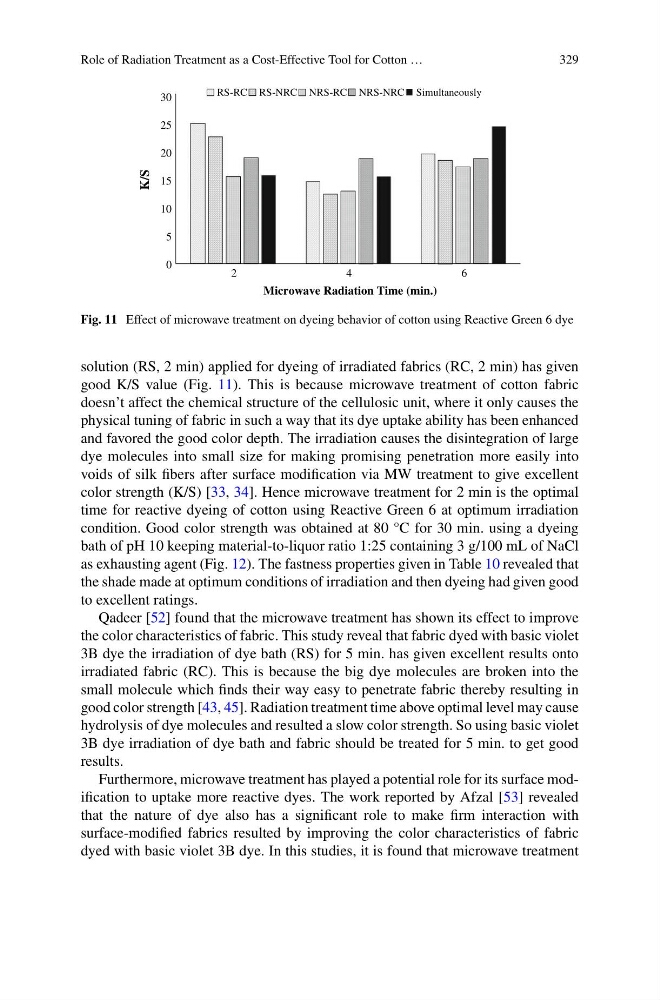
Fig. 11 Effect of microwave treatment on dyeing behavior of cotton using Reactive Green 6 dye
solution (RS, 2 min) applied for dyeing of irradiated fabrics (RC, 2 min) has given
good K/S value (Fig. 11). This is because microwave treatment of cotton fabric
doesn’t affect the chemical structure of the cellulosic unit, where it only causes the
physical tuning of fabric in such a way that its dye uptake ability has been enhanced
and favored the good color depth. The irradiation causes the disintegration of large
dye molecules into small size for making promising penetration more easily into
voids of silk fibers after surface modification via MW treatment to give excellent
color strength (K/S) [33, 34]. Hence microwave treatment for 2 min is the optimal
time for reactive dyeing of cotton using Reactive Green 6 at optimum irradiation
condition. Good color strength was obtained at 80 °C for 30 min. using a dyeing
bath of pH 10 keeping material-to-liquor ratio 1:25 containing 3 g/100 mL of NaCl
as exhausting agent (Fig. 12). The fastness properties given in Table 10 revealed that
the shade made at optimum conditions of irradiation and then dyeing had given good
to excellent ratings.
Qadeer [52] found that the microwave treatment has shown its effect to improve
the color characteristics of fabric. This study reveal that fabric dyed with basic violet
3B dye the irradiation of dye bath (RS) for 5 min. has given excellent results onto
irradiated fabric (RC). This is because the big dye molecules are broken into the
small molecule which finds their way easy to penetrate fabric thereby resulting in
good color strength [43, 45]. Radiation treatment time above optimal level may cause
hydrolysis of dye molecules and resulted a slow color strength. So using basic violet
3B dye irradiation of dye bath and fabric should be treated for 5 min. to get good
results.
Furthermore, microwave treatment has played a potential role for its surface modification to uptake more reactive dyes. The work reported by Afzal [53] revealed
that the nature of dye also has a significant role to make firm interaction with
surface-modified fabrics resulted by improving the color characteristics of fabric
dyed with basic violet 3B dye. In this studies, it is found that microwave treatment
329
0
5
10
15
20
25
30
2
4
6
K/S
Microwave Radiation Time (min.)
RS-RC RS-NRC NRS-RC NRS-NRC Simultaneously
Fig. 11 Effect of microwave treatment on dyeing behavior of cotton using Reactive Green 6 dye
solution (RS, 2 min) applied for dyeing of irradiated fabrics (RC, 2 min) has given
good K/S value (Fig. 11). This is because microwave treatment of cotton fabric
doesn’t affect the chemical structure of the cellulosic unit, where it only causes the
physical tuning of fabric in such a way that its dye uptake ability has been enhanced
and favored the good color depth. The irradiation causes the disintegration of large
dye molecules into small size for making promising penetration more easily into
voids of silk fibers after surface modification via MW treatment to give excellent
color strength (K/S) [33, 34]. Hence microwave treatment for 2 min is the optimal
time for reactive dyeing of cotton using Reactive Green 6 at optimum irradiation
condition. Good color strength was obtained at 80 °C for 30 min. using a dyeing
bath of pH 10 keeping material-to-liquor ratio 1:25 containing 3 g/100 mL of NaCl
as exhausting agent (Fig. 12). The fastness properties given in Table 10 revealed that
the shade made at optimum conditions of irradiation and then dyeing had given good
to excellent ratings.
Qadeer [52] found that the microwave treatment has shown its effect to improve
the color characteristics of fabric. This study reveal that fabric dyed with basic violet
3B dye the irradiation of dye bath (RS) for 5 min. has given excellent results onto
irradiated fabric (RC). This is because the big dye molecules are broken into the
small molecule which finds their way easy to penetrate fabric thereby resulting in
good color strength [43, 45]. Radiation treatment time above optimal level may cause
hydrolysis of dye molecules and resulted a slow color strength. So using basic violet
3B dye irradiation of dye bath and fabric should be treated for 5 min. to get good
results.
Furthermore, microwave treatment has played a potential role for its surface modification to uptake more reactive dyes. The work reported by Afzal [53] revealed
that the nature of dye also has a significant role to make firm interaction with
surface-modified fabrics resulted by improving the color characteristics of fabric
dyed with basic violet 3B dye. In this studies, it is found that microwave treatment