

328
S. Adeel et al.
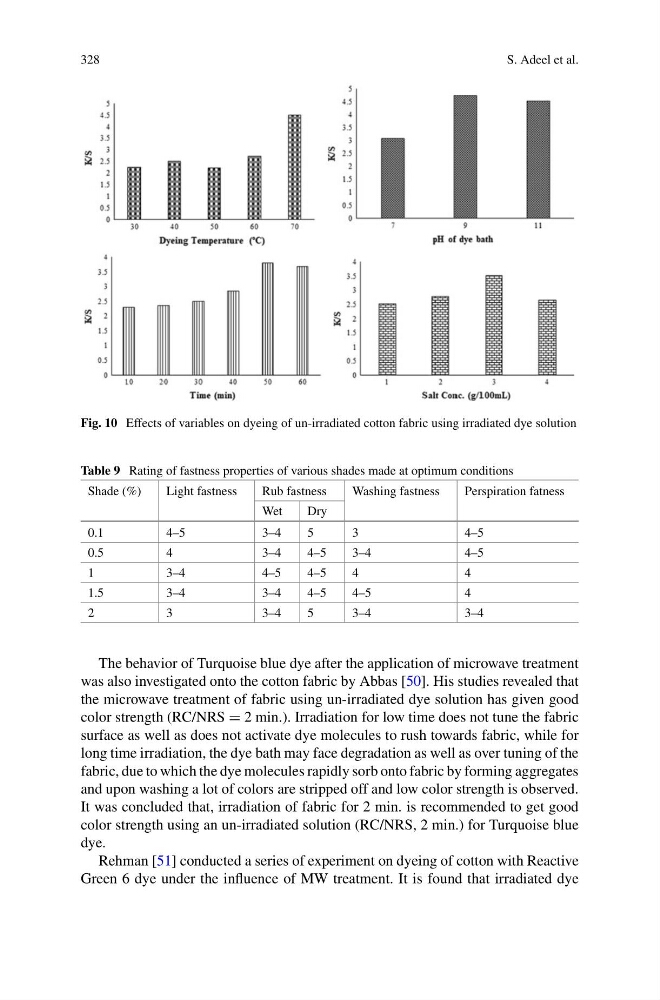
Fig. 10 Effects of variables on dyeing of un-irradiated cotton fabric using irradiated dye solution
Table 9 Rating of fastness properties of various shades made at optimum conditions
Shade (%)
Light fastness
Rub fastness
Washing fastness
Perspiration fatness
Wet
Dry
0.1
4–5
3–4
5
3
4–5
0.5
4
3–4
4–5
3–4
4–5
1
3–4
4–5
4–5
4
4
1.5
3–4
3–4
4–5
4–5
4
2
3
3–4
5
3–4
3–4
The behavior of Turquoise blue dye after the application of microwave treatment
was also investigated onto the cotton fabric by Abbas [50]. His studies revealed that
the microwave treatment of fabric using un-irradiated dye solution has given good
color strength (RC/NRS = 2 min.). Irradiation for low time does not tune the fabric
surface as well as does not activate dye molecules to rush towards fabric, while for
long time irradiation, the dye bath may face degradation as well as over tuning of the
fabric, due to which the dye molecules rapidly sorb onto fabric by forming aggregates
and upon washing a lot of colors are stripped off and low color strength is observed.
It was concluded that, irradiation of fabric for 2 min. is recommended to get good
color strength using an un-irradiated solution (RC/NRS, 2 min.) for Turquoise blue
dye.
Rehman [51] conducted a series of experiment on dyeing of cotton with Reactive
Green 6 dye under the influence of MW treatment. It is found that irradiated dye
S. Adeel et al.
Fig. 10 Effects of variables on dyeing of un-irradiated cotton fabric using irradiated dye solution
Table 9 Rating of fastness properties of various shades made at optimum conditions
Shade (%)
Light fastness
Rub fastness
Washing fastness
Perspiration fatness
Wet
Dry
0.1
4–5
3–4
5
3
4–5
0.5
4
3–4
4–5
3–4
4–5
1
3–4
4–5
4–5
4
4
1.5
3–4
3–4
4–5
4–5
4
2
3
3–4
5
3–4
3–4
The behavior of Turquoise blue dye after the application of microwave treatment
was also investigated onto the cotton fabric by Abbas [50]. His studies revealed that
the microwave treatment of fabric using un-irradiated dye solution has given good
color strength (RC/NRS = 2 min.). Irradiation for low time does not tune the fabric
surface as well as does not activate dye molecules to rush towards fabric, while for
long time irradiation, the dye bath may face degradation as well as over tuning of the
fabric, due to which the dye molecules rapidly sorb onto fabric by forming aggregates
and upon washing a lot of colors are stripped off and low color strength is observed.
It was concluded that, irradiation of fabric for 2 min. is recommended to get good
color strength using an un-irradiated solution (RC/NRS, 2 min.) for Turquoise blue
dye.
Rehman [51] conducted a series of experiment on dyeing of cotton with Reactive
Green 6 dye under the influence of MW treatment. It is found that irradiated dye