

Role of Radiation Treatment as a Cost-Effective Tool for Cotton …
323
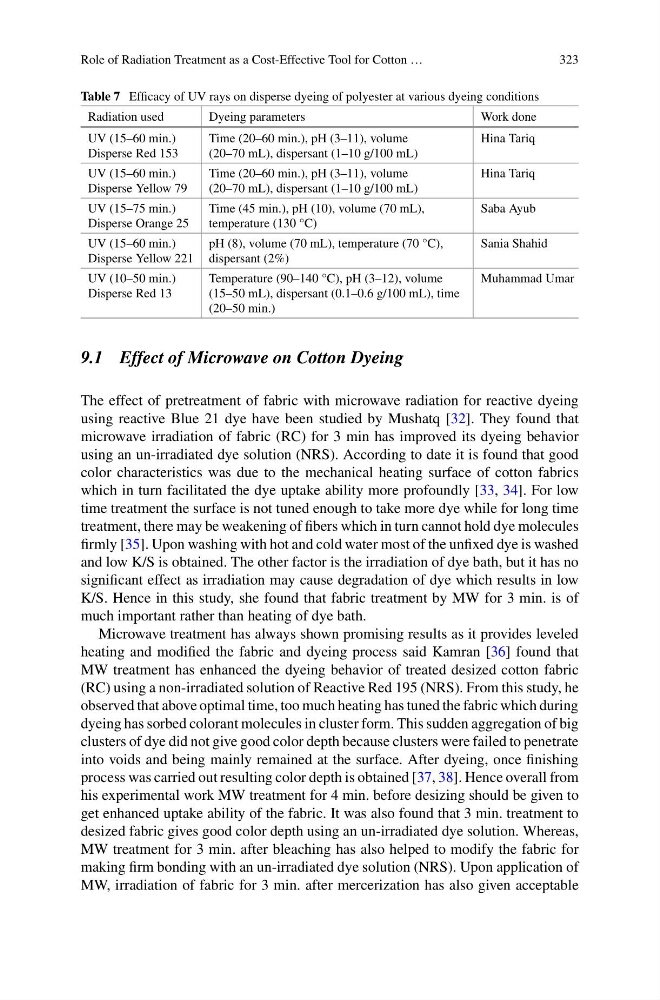
Table 7 Efficacy of UV rays on disperse dyeing of polyester at various dyeing conditions
Radiation used
Dyeing parameters
Work done
UV (15–60 min.)
Disperse Red 153
Time (20–60 min.), pH (3–11), volume
(20–70 mL), dispersant (1–10 g/100 mL)
Hina Tariq
UV (15–60 min.)
Disperse Yellow 79
Time (20–60 min.), pH (3–11), volume
(20–70 mL), dispersant (1–10 g/100 mL)
Hina Tariq
UV (15–75 min.)
Disperse Orange 25
Time (45 min.), pH (10), volume (70 mL),
temperature (130 °C)
Saba Ayub
UV (15–60 min.)
Disperse Yellow 221
pH (8), volume (70 mL), temperature (70 °C),
dispersant (2%)
Sania Shahid
UV (10–50 min.)
Disperse Red 13
Temperature (90–140 °C), pH (3–12), volume
(15–50 mL), dispersant (0.1–0.6 g/100 mL), time
(20–50 min.)
Muhammad Umar
9.1 Effect of Microwave on Cotton Dyeing
The effect of pretreatment of fabric with microwave radiation for reactive dyeing
using reactive Blue 21 dye have been studied by Mushatq [32]. They found that
microwave irradiation of fabric (RC) for 3 min has improved its dyeing behavior
using an un-irradiated dye solution (NRS). According to date it is found that good
color characteristics was due to the mechanical heating surface of cotton fabrics
which in turn facilitated the dye uptake ability more profoundly [33, 34]. For low
time treatment the surface is not tuned enough to take more dye while for long time
treatment, there may be weakening of fibers which in turn cannot hold dye molecules
firmly [35]. Upon washing with hot and cold water most of the unfixed dye is washed
and low K/S is obtained. The other factor is the irradiation of dye bath, but it has no
significant effect as irradiation may cause degradation of dye which results in low
K/S. Hence in this study, she found that fabric treatment by MW for 3 min. is of
much important rather than heating of dye bath.
Microwave treatment has always shown promising results as it provides leveled
heating and modified the fabric and dyeing process said Kamran [36] found that
MW treatment has enhanced the dyeing behavior of treated desized cotton fabric
(RC) using a non-irradiated solution of Reactive Red 195 (NRS). From this study, he
observed that above optimal time, too much heating has tuned the fabric which during
dyeing has sorbed colorant molecules in cluster form. This sudden aggregation of big
clusters of dye did not give good color depth because clusters were failed to penetrate
into voids and being mainly remained at the surface. After dyeing, once finishing
process was carried out resulting color depth is obtained [37, 38]. Hence overall from
his experimental work MW treatment for 4 min. before desizing should be given to
get enhanced uptake ability of the fabric. It was also found that 3 min. treatment to
desized fabric gives good color depth using an un-irradiated dye solution. Whereas,
MW treatment for 3 min. after bleaching has also helped to modify the fabric for
making firm bonding with an un-irradiated dye solution (NRS). Upon application of
MW, irradiation of fabric for 3 min. after mercerization has also given acceptable
323
Table 7 Efficacy of UV rays on disperse dyeing of polyester at various dyeing conditions
Radiation used
Dyeing parameters
Work done
UV (15–60 min.)
Disperse Red 153
Time (20–60 min.), pH (3–11), volume
(20–70 mL), dispersant (1–10 g/100 mL)
Hina Tariq
UV (15–60 min.)
Disperse Yellow 79
Time (20–60 min.), pH (3–11), volume
(20–70 mL), dispersant (1–10 g/100 mL)
Hina Tariq
UV (15–75 min.)
Disperse Orange 25
Time (45 min.), pH (10), volume (70 mL),
temperature (130 °C)
Saba Ayub
UV (15–60 min.)
Disperse Yellow 221
pH (8), volume (70 mL), temperature (70 °C),
dispersant (2%)
Sania Shahid
UV (10–50 min.)
Disperse Red 13
Temperature (90–140 °C), pH (3–12), volume
(15–50 mL), dispersant (0.1–0.6 g/100 mL), time
(20–50 min.)
Muhammad Umar
9.1 Effect of Microwave on Cotton Dyeing
The effect of pretreatment of fabric with microwave radiation for reactive dyeing
using reactive Blue 21 dye have been studied by Mushatq [32]. They found that
microwave irradiation of fabric (RC) for 3 min has improved its dyeing behavior
using an un-irradiated dye solution (NRS). According to date it is found that good
color characteristics was due to the mechanical heating surface of cotton fabrics
which in turn facilitated the dye uptake ability more profoundly [33, 34]. For low
time treatment the surface is not tuned enough to take more dye while for long time
treatment, there may be weakening of fibers which in turn cannot hold dye molecules
firmly [35]. Upon washing with hot and cold water most of the unfixed dye is washed
and low K/S is obtained. The other factor is the irradiation of dye bath, but it has no
significant effect as irradiation may cause degradation of dye which results in low
K/S. Hence in this study, she found that fabric treatment by MW for 3 min. is of
much important rather than heating of dye bath.
Microwave treatment has always shown promising results as it provides leveled
heating and modified the fabric and dyeing process said Kamran [36] found that
MW treatment has enhanced the dyeing behavior of treated desized cotton fabric
(RC) using a non-irradiated solution of Reactive Red 195 (NRS). From this study, he
observed that above optimal time, too much heating has tuned the fabric which during
dyeing has sorbed colorant molecules in cluster form. This sudden aggregation of big
clusters of dye did not give good color depth because clusters were failed to penetrate
into voids and being mainly remained at the surface. After dyeing, once finishing
process was carried out resulting color depth is obtained [37, 38]. Hence overall from
his experimental work MW treatment for 4 min. before desizing should be given to
get enhanced uptake ability of the fabric. It was also found that 3 min. treatment to
desized fabric gives good color depth using an un-irradiated dye solution. Whereas,
MW treatment for 3 min. after bleaching has also helped to modify the fabric for
making firm bonding with an un-irradiated dye solution (NRS). Upon application of
MW, irradiation of fabric for 3 min. after mercerization has also given acceptable