

A. Patil et al
291
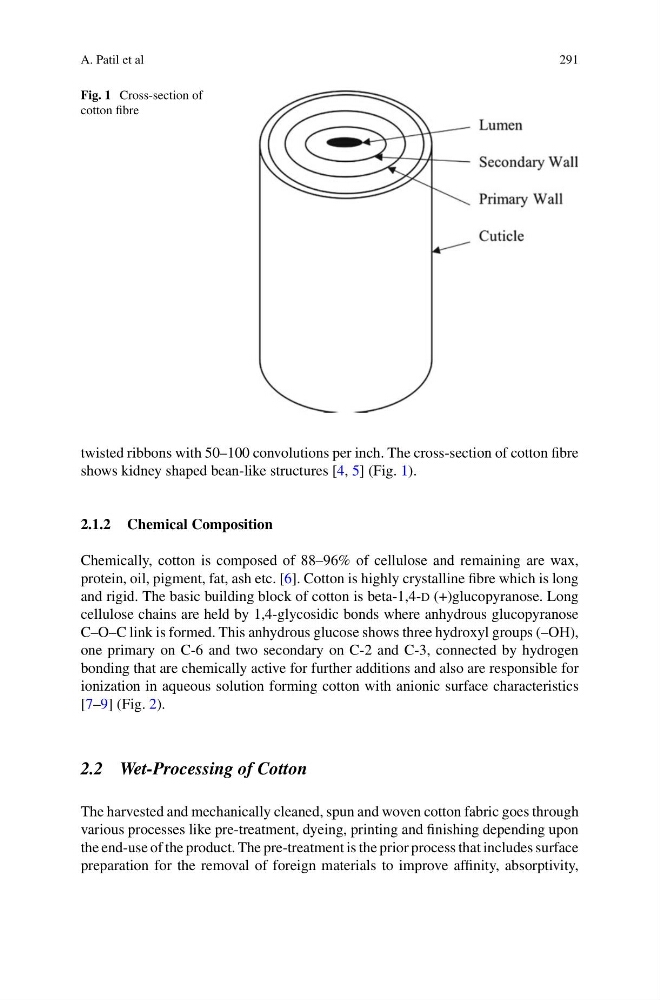
Fig. 1 Cross-section of
cotton fibre
twisted ribbons with 50–100 convolutions per inch. The cross-section of cotton fibre
shows kidney shaped bean-like structures [4, 5] (Fig. 1).
2.1.2 Chemical Composition
Chemically, cotton is composed of 88–96% of cellulose and remaining are wax,
protein, oil, pigment, fat, ash etc. [6]. Cotton is highly crystalline fibre which is long
and rigid. The basic building block of cotton is beta-1,4-d (+)glucopyranose. Long
cellulose chains are held by 1,4-glycosidic bonds where anhydrous glucopyranose
C–O–C link is formed. This anhydrous glucose shows three hydroxyl groups (–OH),
one primary on C-6 and two secondary on C-2 and C-3, connected by hydrogen
bonding that are chemically active for further additions and also are responsible for
ionization in aqueous solution forming cotton with anionic surface characteristics
[7–9] (Fig. 2).
2.2 Wet-Processing of Cotton
The harvested and mechanically cleaned, spun and woven cotton fabric goes through
various processes like pre-treatment, dyeing, printing and finishing depending upon
the end-use of the product. The pre-treatment is the prior process that includes surface
preparation for the removal of foreign materials to improve affinity, absorptivity,
291
Fig. 1 Cross-section of
cotton fibre
twisted ribbons with 50–100 convolutions per inch. The cross-section of cotton fibre
shows kidney shaped bean-like structures [4, 5] (Fig. 1).
2.1.2 Chemical Composition
Chemically, cotton is composed of 88–96% of cellulose and remaining are wax,
protein, oil, pigment, fat, ash etc. [6]. Cotton is highly crystalline fibre which is long
and rigid. The basic building block of cotton is beta-1,4-d (+)glucopyranose. Long
cellulose chains are held by 1,4-glycosidic bonds where anhydrous glucopyranose
C–O–C link is formed. This anhydrous glucose shows three hydroxyl groups (–OH),
one primary on C-6 and two secondary on C-2 and C-3, connected by hydrogen
bonding that are chemically active for further additions and also are responsible for
ionization in aqueous solution forming cotton with anionic surface characteristics
[7–9] (Fig. 2).
2.2 Wet-Processing of Cotton
The harvested and mechanically cleaned, spun and woven cotton fabric goes through
various processes like pre-treatment, dyeing, printing and finishing depending upon
the end-use of the product. The pre-treatment is the prior process that includes surface
preparation for the removal of foreign materials to improve affinity, absorptivity,