

292
Cationization as Tool for Functionalization of Cotton
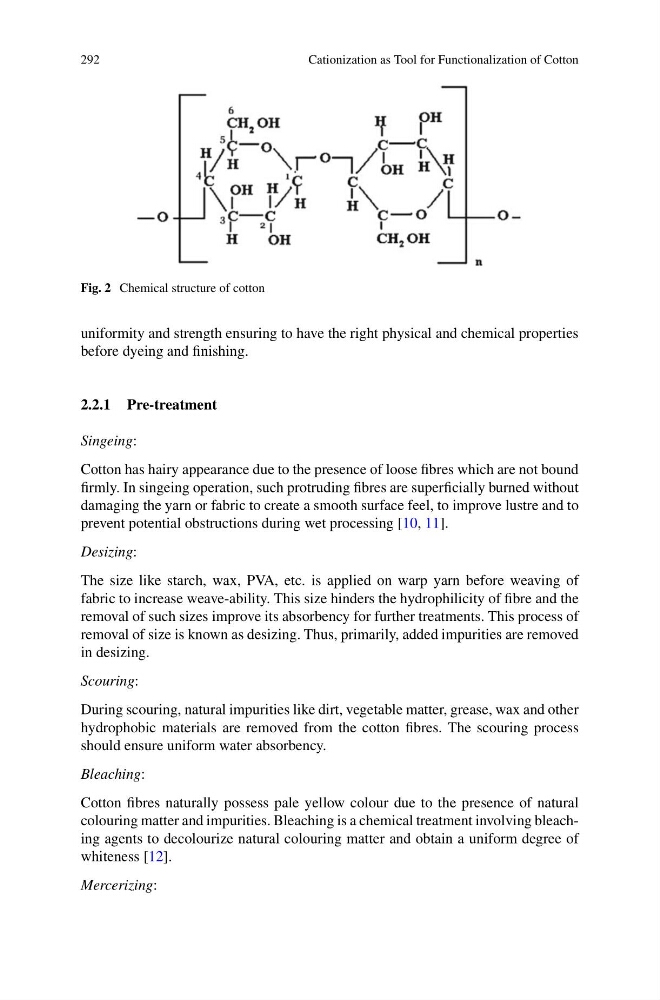
Fig. 2 Chemical structure of cotton
uniformity and strength ensuring to have the right physical and chemical properties
before dyeing and finishing.
2.2.1 Pre-treatment
Singeing:
Cotton has hairy appearance due to the presence of loose fibres which are not bound
firmly. In singeing operation, such protruding fibres are superficially burned without
damaging the yarn or fabric to create a smooth surface feel, to improve lustre and to
prevent potential obstructions during wet processing [10, 11].
Desizing:
The size like starch, wax, PVA, etc. is applied on warp yarn before weaving of
fabric to increase weave-ability. This size hinders the hydrophilicity of fibre and the
removal of such sizes improve its absorbency for further treatments. This process of
removal of size is known as desizing. Thus, primarily, added impurities are removed
in desizing.
Scouring:
During scouring, natural impurities like dirt, vegetable matter, grease, wax and other
hydrophobic materials are removed from the cotton fibres. The scouring process
should ensure uniform water absorbency.
Bleaching:
Cotton fibres naturally possess pale yellow colour due to the presence of natural
colouring matter and impurities. Bleaching is a chemical treatment involving bleaching agents to decolourize natural colouring matter and obtain a uniform degree of
whiteness [12].
Mercerizing:
Cationization as Tool for Functionalization of Cotton
Fig. 2 Chemical structure of cotton
uniformity and strength ensuring to have the right physical and chemical properties
before dyeing and finishing.
2.2.1 Pre-treatment
Singeing:
Cotton has hairy appearance due to the presence of loose fibres which are not bound
firmly. In singeing operation, such protruding fibres are superficially burned without
damaging the yarn or fabric to create a smooth surface feel, to improve lustre and to
prevent potential obstructions during wet processing [10, 11].
Desizing:
The size like starch, wax, PVA, etc. is applied on warp yarn before weaving of
fabric to increase weave-ability. This size hinders the hydrophilicity of fibre and the
removal of such sizes improve its absorbency for further treatments. This process of
removal of size is known as desizing. Thus, primarily, added impurities are removed
in desizing.
Scouring:
During scouring, natural impurities like dirt, vegetable matter, grease, wax and other
hydrophobic materials are removed from the cotton fibres. The scouring process
should ensure uniform water absorbency.
Bleaching:
Cotton fibres naturally possess pale yellow colour due to the presence of natural
colouring matter and impurities. Bleaching is a chemical treatment involving bleaching agents to decolourize natural colouring matter and obtain a uniform degree of
whiteness [12].
Mercerizing: