

266
T. A. Khattab and M. S. Abdelrahman
5 Halochromic Colorants
Halochromism is a reversible color change process depending on a medium pH
value. There are a broad range of color variations available which could be either
from one color to another or from colorless to colored product [81, 82]. The pHresponsive dyestuffs have been employed as analytical indicators. There are a huge
range of colored organic pH-responsive dyestuffs available and documented. The
major chemical categories of technically significant pH-responsive dyestuffs are
phthalides such as phenolphthalein and triarylmethines [83]. There are a range of
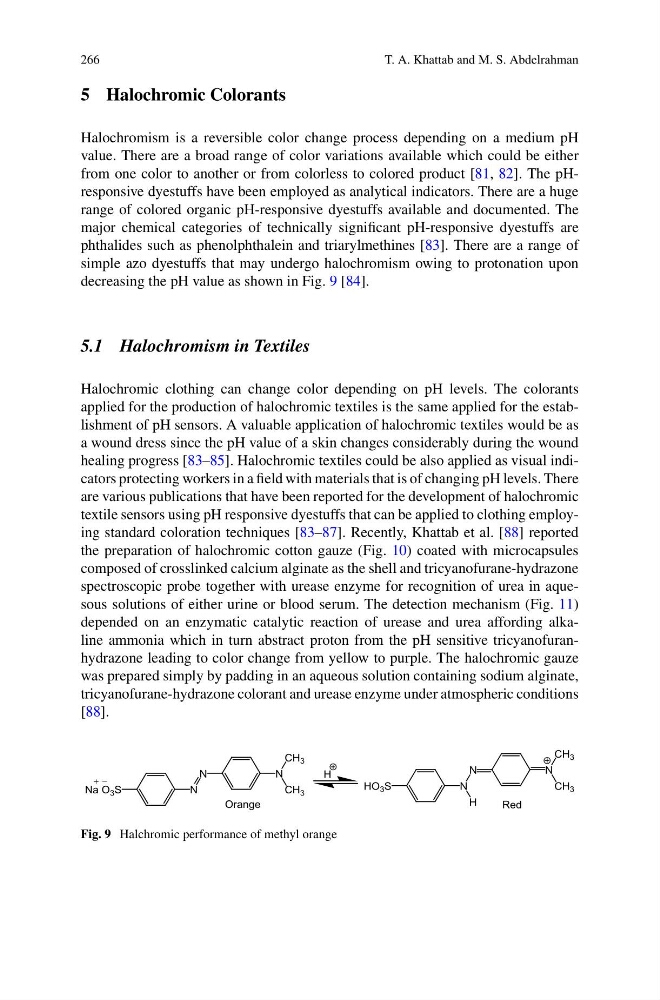
simple azo dyestuffs that may undergo halochromism owing to protonation upon
decreasing the pH value as shown in Fig. 9 [84].
5.1 Halochromism in Textiles
Halochromic clothing can change color depending on pH levels. The colorants
applied for the production of halochromic textiles is the same applied for the establishment of pH sensors. A valuable application of halochromic textiles would be as
a wound dress since the pH value of a skin changes considerably during the wound
healing progress [83–85]. Halochromic textiles could be also applied as visual indicators protecting workers in a field with materials that is of changing pH levels. There
are various publications that have been reported for the development of halochromic
textile sensors using pH responsive dyestuffs that can be applied to clothing employing standard coloration techniques [83–87]. Recently, Khattab et al. [88] reported
the preparation of halochromic cotton gauze (Fig. 10) coated with microcapsules
composed of crosslinked calcium alginate as the shell and tricyanofurane-hydrazone
spectroscopic probe together with urease enzyme for recognition of urea in aquesous solutions of either urine or blood serum. The detection mechanism (Fig. 11)
depended on an enzymatic catalytic reaction of urease and urea affording alkaline ammonia which in turn abstract proton from the pH sensitive tricyanofuranhydrazone leading to color change from yellow to purple. The halochromic gauze
was prepared simply by padding in an aqueous solution containing sodium alginate,
tricyanofurane-hydrazone colorant and urease enzyme under atmospheric conditions
[88].
Na O 3 S
N
N
N
CH 3
CH 3
Orange
Red
HO 3 S
N
N
N
CH 3
CH 3
H
H
Fig. 9 Halchromic performance of methyl orange
T. A. Khattab and M. S. Abdelrahman
5 Halochromic Colorants
Halochromism is a reversible color change process depending on a medium pH
value. There are a broad range of color variations available which could be either
from one color to another or from colorless to colored product [81, 82]. The pHresponsive dyestuffs have been employed as analytical indicators. There are a huge
range of colored organic pH-responsive dyestuffs available and documented. The
major chemical categories of technically significant pH-responsive dyestuffs are
phthalides such as phenolphthalein and triarylmethines [83]. There are a range of
simple azo dyestuffs that may undergo halochromism owing to protonation upon
decreasing the pH value as shown in Fig. 9 [84].
5.1 Halochromism in Textiles
Halochromic clothing can change color depending on pH levels. The colorants
applied for the production of halochromic textiles is the same applied for the establishment of pH sensors. A valuable application of halochromic textiles would be as
a wound dress since the pH value of a skin changes considerably during the wound
healing progress [83–85]. Halochromic textiles could be also applied as visual indicators protecting workers in a field with materials that is of changing pH levels. There
are various publications that have been reported for the development of halochromic
textile sensors using pH responsive dyestuffs that can be applied to clothing employing standard coloration techniques [83–87]. Recently, Khattab et al. [88] reported
the preparation of halochromic cotton gauze (Fig. 10) coated with microcapsules
composed of crosslinked calcium alginate as the shell and tricyanofurane-hydrazone
spectroscopic probe together with urease enzyme for recognition of urea in aquesous solutions of either urine or blood serum. The detection mechanism (Fig. 11)
depended on an enzymatic catalytic reaction of urease and urea affording alkaline ammonia which in turn abstract proton from the pH sensitive tricyanofuranhydrazone leading to color change from yellow to purple. The halochromic gauze
was prepared simply by padding in an aqueous solution containing sodium alginate,
tricyanofurane-hydrazone colorant and urease enzyme under atmospheric conditions
[88].
Na O 3 S
N
N
N
CH 3
CH 3
Orange
Red
HO 3 S
N
N
N
CH 3
CH 3
H
H
Fig. 9 Halchromic performance of methyl orange