

Fabrication of Superhydrophobic Textiles
205
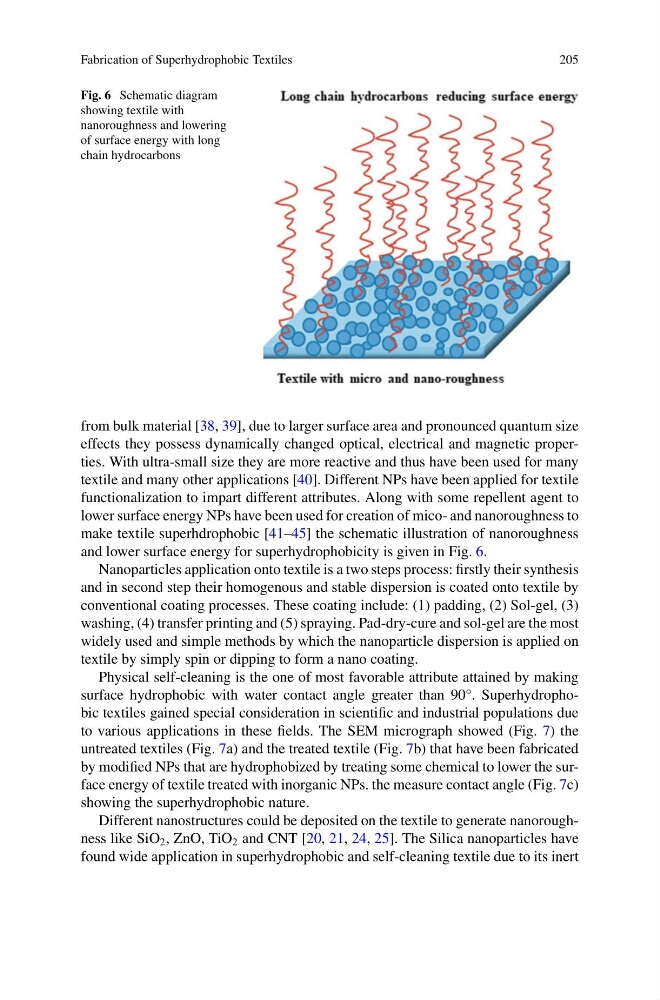
Fig. 6 Schematic diagram
showing textile with
nanoroughness and lowering
of surface energy with long
chain hydrocarbons
from bulk material [38, 39], due to larger surface area and pronounced quantum size
effects they possess dynamically changed optical, electrical and magnetic properties. With ultra-small size they are more reactive and thus have been used for many
textile and many other applications [40]. Different NPs have been applied for textile
functionalization to impart different attributes. Along with some repellent agent to
lower surface energy NPs have been used for creation of mico- and nanoroughness to
make textile superhdrophobic [41–45] the schematic illustration of nanoroughness
and lower surface energy for superhydrophobicity is given in Fig. 6.
Nanoparticles application onto textile is a two steps process: firstly their synthesis
and in second step their homogenous and stable dispersion is coated onto textile by
conventional coating processes. These coating include: (1) padding, (2) Sol-gel, (3)
washing, (4) transfer printing and (5) spraying. Pad-dry-cure and sol-gel are the most
widely used and simple methods by which the nanoparticle dispersion is applied on
textile by simply spin or dipping to form a nano coating.
Physical self-cleaning is the one of most favorable attribute attained by making
surface hydrophobic with water contact angle greater than 90°. Superhydrophobic textiles gained special consideration in scientific and industrial populations due
to various applications in these fields. The SEM micrograph showed (Fig. 7) the
untreated textiles (Fig. 7a) and the treated textile (Fig. 7b) that have been fabricated
by modified NPs that are hydrophobized by treating some chemical to lower the surface energy of textile treated with inorganic NPs. the measure contact angle (Fig. 7c)
showing the superhydrophobic nature.
Different nanostructures could be deposited on the textile to generate nanoroughness like SiO 2 , ZnO, TiO 2 and CNT [20, 21, 24, 25]. The Silica nanoparticles have
found wide application in superhydrophobic and self-cleaning textile due to its inert
205
Fig. 6 Schematic diagram
showing textile with
nanoroughness and lowering
of surface energy with long
chain hydrocarbons
from bulk material [38, 39], due to larger surface area and pronounced quantum size
effects they possess dynamically changed optical, electrical and magnetic properties. With ultra-small size they are more reactive and thus have been used for many
textile and many other applications [40]. Different NPs have been applied for textile
functionalization to impart different attributes. Along with some repellent agent to
lower surface energy NPs have been used for creation of mico- and nanoroughness to
make textile superhdrophobic [41–45] the schematic illustration of nanoroughness
and lower surface energy for superhydrophobicity is given in Fig. 6.
Nanoparticles application onto textile is a two steps process: firstly their synthesis
and in second step their homogenous and stable dispersion is coated onto textile by
conventional coating processes. These coating include: (1) padding, (2) Sol-gel, (3)
washing, (4) transfer printing and (5) spraying. Pad-dry-cure and sol-gel are the most
widely used and simple methods by which the nanoparticle dispersion is applied on
textile by simply spin or dipping to form a nano coating.
Physical self-cleaning is the one of most favorable attribute attained by making
surface hydrophobic with water contact angle greater than 90°. Superhydrophobic textiles gained special consideration in scientific and industrial populations due
to various applications in these fields. The SEM micrograph showed (Fig. 7) the
untreated textiles (Fig. 7a) and the treated textile (Fig. 7b) that have been fabricated
by modified NPs that are hydrophobized by treating some chemical to lower the surface energy of textile treated with inorganic NPs. the measure contact angle (Fig. 7c)
showing the superhydrophobic nature.
Different nanostructures could be deposited on the textile to generate nanoroughness like SiO 2 , ZnO, TiO 2 and CNT [20, 21, 24, 25]. The Silica nanoparticles have
found wide application in superhydrophobic and self-cleaning textile due to its inert