

204
M. Ashraf and S. Riaz
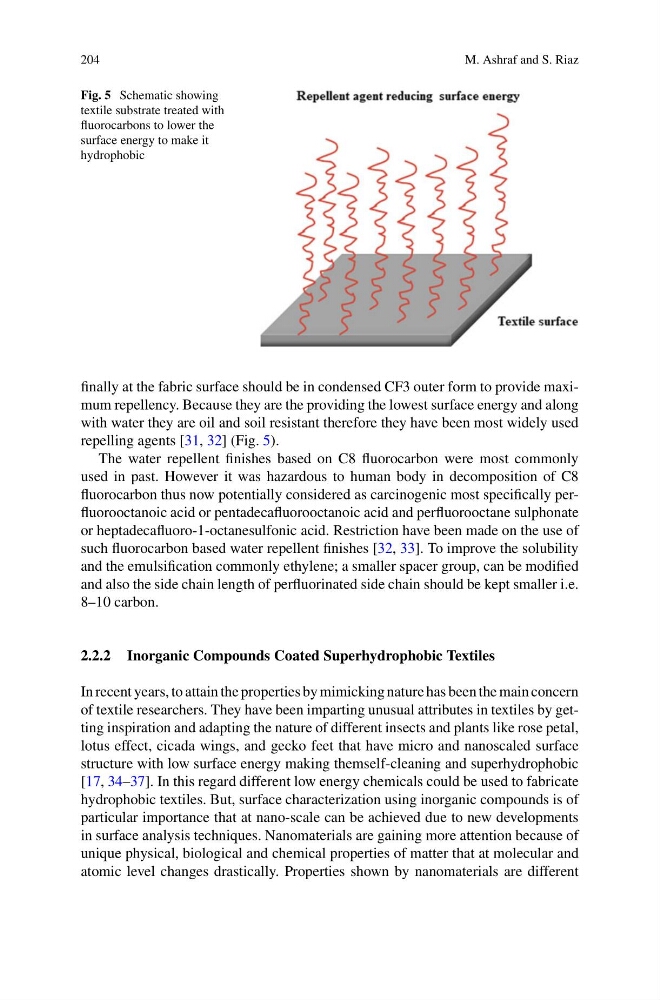
Fig. 5 Schematic showing
textile substrate treated with
fluorocarbons to lower the
surface energy to make it
hydrophobic
finally at the fabric surface should be in condensed CF3 outer form to provide maximum repellency. Because they are the providing the lowest surface energy and along
with water they are oil and soil resistant therefore they have been most widely used
repelling agents [31, 32] (Fig. 5).
The water repellent finishes based on C8 fluorocarbon were most commonly
used in past. However it was hazardous to human body in decomposition of C8
fluorocarbon thus now potentially considered as carcinogenic most specifically perfluorooctanoic acid or pentadecafluorooctanoic acid and perfluorooctane sulphonate
or heptadecafluoro-1-octanesulfonic acid. Restriction have been made on the use of
such fluorocarbon based water repellent finishes [32, 33]. To improve the solubility
and the emulsification commonly ethylene; a smaller spacer group, can be modified
and also the side chain length of perfluorinated side chain should be kept smaller i.e.
8–10 carbon.
2.2.2 Inorganic Compounds Coated Superhydrophobic Textiles
In recent years, to attain the properties by mimicking nature has been the main concern
of textile researchers. They have been imparting unusual attributes in textiles by getting inspiration and adapting the nature of different insects and plants like rose petal,
lotus effect, cicada wings, and gecko feet that have micro and nanoscaled surface
structure with low surface energy making themself-cleaning and superhydrophobic
[17, 34–37]. In this regard different low energy chemicals could be used to fabricate
hydrophobic textiles. But, surface characterization using inorganic compounds is of
particular importance that at nano-scale can be achieved due to new developments
in surface analysis techniques. Nanomaterials are gaining more attention because of
unique physical, biological and chemical properties of matter that at molecular and
atomic level changes drastically. Properties shown by nanomaterials are different
M. Ashraf and S. Riaz
Fig. 5 Schematic showing
textile substrate treated with
fluorocarbons to lower the
surface energy to make it
hydrophobic
finally at the fabric surface should be in condensed CF3 outer form to provide maximum repellency. Because they are the providing the lowest surface energy and along
with water they are oil and soil resistant therefore they have been most widely used
repelling agents [31, 32] (Fig. 5).
The water repellent finishes based on C8 fluorocarbon were most commonly
used in past. However it was hazardous to human body in decomposition of C8
fluorocarbon thus now potentially considered as carcinogenic most specifically perfluorooctanoic acid or pentadecafluorooctanoic acid and perfluorooctane sulphonate
or heptadecafluoro-1-octanesulfonic acid. Restriction have been made on the use of
such fluorocarbon based water repellent finishes [32, 33]. To improve the solubility
and the emulsification commonly ethylene; a smaller spacer group, can be modified
and also the side chain length of perfluorinated side chain should be kept smaller i.e.
8–10 carbon.
2.2.2 Inorganic Compounds Coated Superhydrophobic Textiles
In recent years, to attain the properties by mimicking nature has been the main concern
of textile researchers. They have been imparting unusual attributes in textiles by getting inspiration and adapting the nature of different insects and plants like rose petal,
lotus effect, cicada wings, and gecko feet that have micro and nanoscaled surface
structure with low surface energy making themself-cleaning and superhydrophobic
[17, 34–37]. In this regard different low energy chemicals could be used to fabricate
hydrophobic textiles. But, surface characterization using inorganic compounds is of
particular importance that at nano-scale can be achieved due to new developments
in surface analysis techniques. Nanomaterials are gaining more attention because of
unique physical, biological and chemical properties of matter that at molecular and
atomic level changes drastically. Properties shown by nanomaterials are different