

Advances of Textiles in Tissue Engineering Scaffolds
181
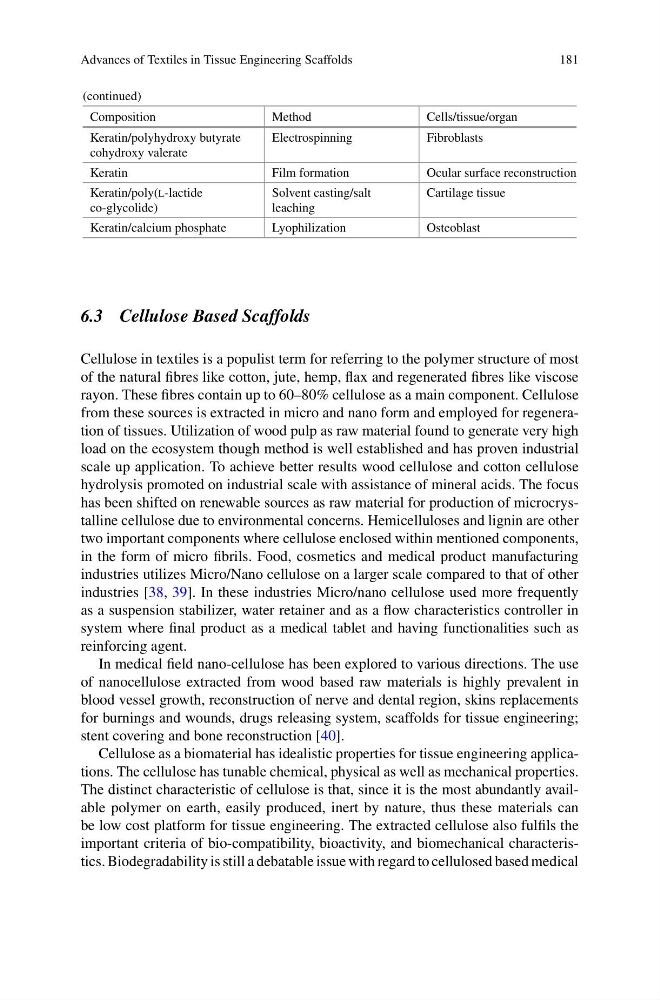
(continued)
Composition
Method
Cells/tissue/organ
Keratin/polyhydroxy butyrate
cohydroxy valerate
Electrospinning
Fibroblasts
Keratin
Film formation
Ocular surface reconstruction
Keratin/poly(l-lactide
co-glycolide)
Solvent casting/salt
leaching
Cartilage tissue
Keratin/calcium phosphate
Lyophilization
Osteoblast
6.3 Cellulose Based Scaffolds
Cellulose in textiles is a populist term for referring to the polymer structure of most
of the natural fibres like cotton, jute, hemp, flax and regenerated fibres like viscose
rayon. These fibres contain up to 60–80% cellulose as a main component. Cellulose
from these sources is extracted in micro and nano form and employed for regeneration of tissues. Utilization of wood pulp as raw material found to generate very high
load on the ecosystem though method is well established and has proven industrial
scale up application. To achieve better results wood cellulose and cotton cellulose
hydrolysis promoted on industrial scale with assistance of mineral acids. The focus
has been shifted on renewable sources as raw material for production of microcrystalline cellulose due to environmental concerns. Hemicelluloses and lignin are other
two important components where cellulose enclosed within mentioned components,
in the form of micro fibrils. Food, cosmetics and medical product manufacturing
industries utilizes Micro/Nano cellulose on a larger scale compared to that of other
industries [38, 39]. In these industries Micro/nano cellulose used more frequently
as a suspension stabilizer, water retainer and as a flow characteristics controller in
system where final product as a medical tablet and having functionalities such as
reinforcing agent.
In medical field nano-cellulose has been explored to various directions. The use
of nanocellulose extracted from wood based raw materials is highly prevalent in
blood vessel growth, reconstruction of nerve and dental region, skins replacements
for burnings and wounds, drugs releasing system, scaffolds for tissue engineering;
stent covering and bone reconstruction [40].
Cellulose as a biomaterial has idealistic properties for tissue engineering applications. The cellulose has tunable chemical, physical as well as mechanical properties.
The distinct characteristic of cellulose is that, since it is the most abundantly available polymer on earth, easily produced, inert by nature, thus these materials can
be low cost platform for tissue engineering. The extracted cellulose also fulfils the
important criteria of bio-compatibility, bioactivity, and biomechanical characteristics. Biodegradability is still a debatable issue with regard to cellulosed based medical
181
(continued)
Composition
Method
Cells/tissue/organ
Keratin/polyhydroxy butyrate
cohydroxy valerate
Electrospinning
Fibroblasts
Keratin
Film formation
Ocular surface reconstruction
Keratin/poly(l-lactide
co-glycolide)
Solvent casting/salt
leaching
Cartilage tissue
Keratin/calcium phosphate
Lyophilization
Osteoblast
6.3 Cellulose Based Scaffolds
Cellulose in textiles is a populist term for referring to the polymer structure of most
of the natural fibres like cotton, jute, hemp, flax and regenerated fibres like viscose
rayon. These fibres contain up to 60–80% cellulose as a main component. Cellulose
from these sources is extracted in micro and nano form and employed for regeneration of tissues. Utilization of wood pulp as raw material found to generate very high
load on the ecosystem though method is well established and has proven industrial
scale up application. To achieve better results wood cellulose and cotton cellulose
hydrolysis promoted on industrial scale with assistance of mineral acids. The focus
has been shifted on renewable sources as raw material for production of microcrystalline cellulose due to environmental concerns. Hemicelluloses and lignin are other
two important components where cellulose enclosed within mentioned components,
in the form of micro fibrils. Food, cosmetics and medical product manufacturing
industries utilizes Micro/Nano cellulose on a larger scale compared to that of other
industries [38, 39]. In these industries Micro/nano cellulose used more frequently
as a suspension stabilizer, water retainer and as a flow characteristics controller in
system where final product as a medical tablet and having functionalities such as
reinforcing agent.
In medical field nano-cellulose has been explored to various directions. The use
of nanocellulose extracted from wood based raw materials is highly prevalent in
blood vessel growth, reconstruction of nerve and dental region, skins replacements
for burnings and wounds, drugs releasing system, scaffolds for tissue engineering;
stent covering and bone reconstruction [40].
Cellulose as a biomaterial has idealistic properties for tissue engineering applications. The cellulose has tunable chemical, physical as well as mechanical properties.
The distinct characteristic of cellulose is that, since it is the most abundantly available polymer on earth, easily produced, inert by nature, thus these materials can
be low cost platform for tissue engineering. The extracted cellulose also fulfils the
important criteria of bio-compatibility, bioactivity, and biomechanical characteristics. Biodegradability is still a debatable issue with regard to cellulosed based medical