

180
P. Madiwale et al.
6.2.3 Keratin Fibres by Wet and Electro-spinning
The traditional fibre wet-spinning technique used for manufacturing synthetic fibres
has been studied for creating single fibre strand for its application as biomaterials.
The low mechanical strength keratin protein is a hindrance for spinning which is
overcome by blending with synthetic and natural polymers. Formation of keratin
nano-fibres using the electro-spinning technique is also explored by the researchers.
The poor mechanical properties of keratin protein have been improved by blending
with synthetic or natural polymers. It also improves the processability of keratin
for fibre formation. The important feature as noted by the researchers was that the
blending of the keratin protein with silk fibroin not only improved the processability of keratin but also increased the macromolecular interaction hence induced the
formation of network structures leading to finer nano-fibres with smaller diameters.
6.2.4 Keratin Hydrogel
The self-assembling property of keratin is been used for preparing the hydrogel
of keratin protein through regenerated keratin. The keratin is extracted in suitable
solvent and subjected to dialysis with distilled water in controlled environment. Keratins have the inclination to polymerize in an aqueous environment to form hydrogels
which is induced by addition of metal ion reagent. Also, alone disulfide and hydrogen
bonds can formed a hydrogel keratin, without any cross-linking agent.
6.2.5 Application of Keratin Scaffolds
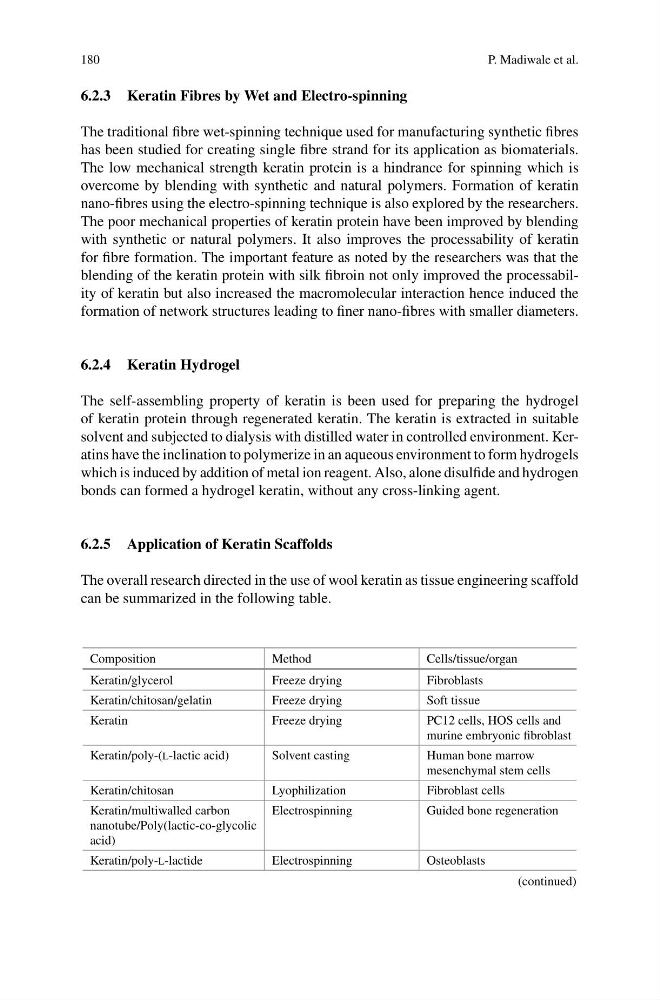
The overall research directed in the use of wool keratin as tissue engineering scaffold
can be summarized in the following table.
Composition
Method
Cells/tissue/organ
Keratin/glycerol
Freeze drying
Fibroblasts
Keratin/chitosan/gelatin
Freeze drying
Soft tissue
Keratin
Freeze drying
PC12 cells, HOS cells and
murine embryonic fibroblast
Keratin/poly-(l-lactic acid)
Solvent casting
Human bone marrow
mesenchymal stem cells
Keratin/chitosan
Lyophilization
Fibroblast cells
Keratin/multiwalled carbon
nanotube/Poly(lactic-co-glycolic
acid)
Electrospinning
Guided bone regeneration
Keratin/poly-l-lactide
Electrospinning
Osteoblasts
(continued)
P. Madiwale et al.
6.2.3 Keratin Fibres by Wet and Electro-spinning
The traditional fibre wet-spinning technique used for manufacturing synthetic fibres
has been studied for creating single fibre strand for its application as biomaterials.
The low mechanical strength keratin protein is a hindrance for spinning which is
overcome by blending with synthetic and natural polymers. Formation of keratin
nano-fibres using the electro-spinning technique is also explored by the researchers.
The poor mechanical properties of keratin protein have been improved by blending
with synthetic or natural polymers. It also improves the processability of keratin
for fibre formation. The important feature as noted by the researchers was that the
blending of the keratin protein with silk fibroin not only improved the processability of keratin but also increased the macromolecular interaction hence induced the
formation of network structures leading to finer nano-fibres with smaller diameters.
6.2.4 Keratin Hydrogel
The self-assembling property of keratin is been used for preparing the hydrogel
of keratin protein through regenerated keratin. The keratin is extracted in suitable
solvent and subjected to dialysis with distilled water in controlled environment. Keratins have the inclination to polymerize in an aqueous environment to form hydrogels
which is induced by addition of metal ion reagent. Also, alone disulfide and hydrogen
bonds can formed a hydrogel keratin, without any cross-linking agent.
6.2.5 Application of Keratin Scaffolds
The overall research directed in the use of wool keratin as tissue engineering scaffold
can be summarized in the following table.
Composition
Method
Cells/tissue/organ
Keratin/glycerol
Freeze drying
Fibroblasts
Keratin/chitosan/gelatin
Freeze drying
Soft tissue
Keratin
Freeze drying
PC12 cells, HOS cells and
murine embryonic fibroblast
Keratin/poly-(l-lactic acid)
Solvent casting
Human bone marrow
mesenchymal stem cells
Keratin/chitosan
Lyophilization
Fibroblast cells
Keratin/multiwalled carbon
nanotube/Poly(lactic-co-glycolic
acid)
Electrospinning
Guided bone regeneration
Keratin/poly-l-lactide
Electrospinning
Osteoblasts
(continued)