

Recent Advances in Development of Antimicrobial Textiles
139
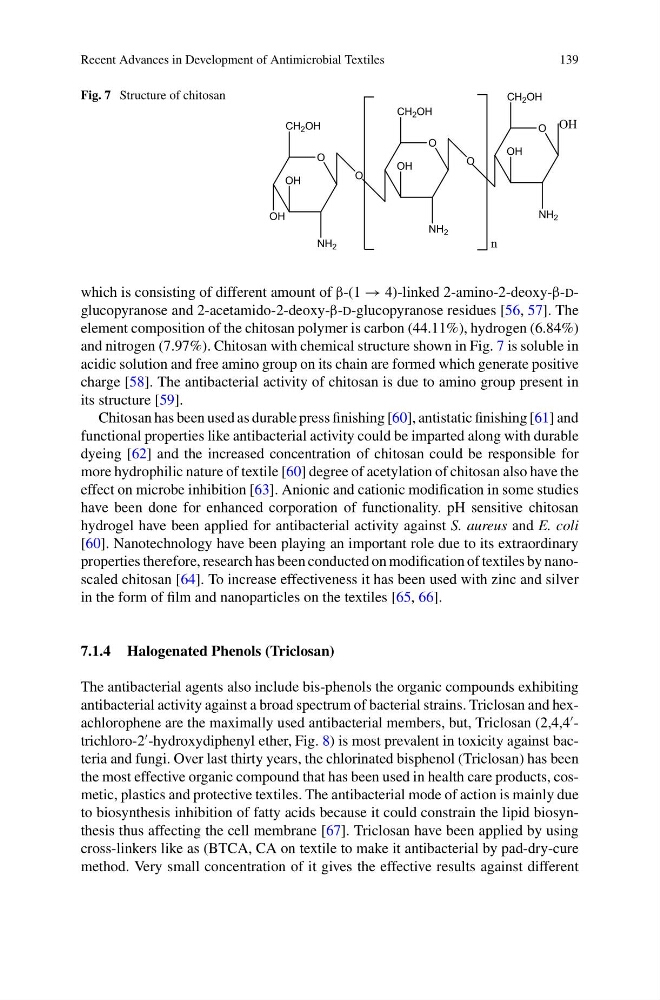
Fig. 7 Structure of chitosan
O
O
O
CH 2 OH
OH
OH
NH 2
O
CH 2 OH
OH
NH 2
O
CH 2 OH
OH
NH 2
OH
n
which is consisting of different amount of β-(1 → 4)-linked 2-amino-2-deoxy-β-dglucopyranose and 2-acetamido-2-deoxy-β-d-glucopyranose residues [56, 57]. The
element composition of the chitosan polymer is carbon (44.11%), hydrogen (6.84%)
and nitrogen (7.97%). Chitosan with chemical structure shown in Fig. 7 is soluble in
acidic solution and free amino group on its chain are formed which generate positive
charge [58]. The antibacterial activity of chitosan is due to amino group present in
its structure [59].
Chitosan has been used as durable press finishing [60], antistatic finishing [61] and
functional properties like antibacterial activity could be imparted along with durable
dyeing [62] and the increased concentration of chitosan could be responsible for
more hydrophilic nature of textile [60] degree of acetylation of chitosan also have the
effect on microbe inhibition [63]. Anionic and cationic modification in some studies
have been done for enhanced corporation of functionality. pH sensitive chitosan
hydrogel have been applied for antibacterial activity against S. aureus and E. coli
[60]. Nanotechnology have been playing an important role due to its extraordinary
properties therefore, research has been conducted on modification of textiles by nanoscaled chitosan [64]. To increase effectiveness it has been used with zinc and silver
in the form of film and nanoparticles on the textiles [65, 66].
7.1.4 Halogenated Phenols (Triclosan)
The antibacterial agents also include bis-phenols the organic compounds exhibiting
antibacterial activity against a broad spectrum of bacterial strains. Triclosan and hexachlorophene are the maximally used antibacterial members, but, Triclosan (2,4,4
-
trichloro-2
-hydroxydiphenyl ether, Fig. 8) is most prevalent in toxicity against bacteria and fungi. Over last thirty years, the chlorinated bisphenol (Triclosan) has been
the most effective organic compound that has been used in health care products, cosmetic, plastics and protective textiles. The antibacterial mode of action is mainly due
to biosynthesis inhibition of fatty acids because it could constrain the lipid biosynthesis thus affecting the cell membrane [67]. Triclosan have been applied by using
cross-linkers like as (BTCA, CA on textile to make it antibacterial by pad-dry-cure
method. Very small concentration of it gives the effective results against different
139
Fig. 7 Structure of chitosan
O
O
O
CH 2 OH
OH
OH
NH 2
O
CH 2 OH
OH
NH 2
O
CH 2 OH
OH
NH 2
OH
n
which is consisting of different amount of β-(1 → 4)-linked 2-amino-2-deoxy-β-dglucopyranose and 2-acetamido-2-deoxy-β-d-glucopyranose residues [56, 57]. The
element composition of the chitosan polymer is carbon (44.11%), hydrogen (6.84%)
and nitrogen (7.97%). Chitosan with chemical structure shown in Fig. 7 is soluble in
acidic solution and free amino group on its chain are formed which generate positive
charge [58]. The antibacterial activity of chitosan is due to amino group present in
its structure [59].
Chitosan has been used as durable press finishing [60], antistatic finishing [61] and
functional properties like antibacterial activity could be imparted along with durable
dyeing [62] and the increased concentration of chitosan could be responsible for
more hydrophilic nature of textile [60] degree of acetylation of chitosan also have the
effect on microbe inhibition [63]. Anionic and cationic modification in some studies
have been done for enhanced corporation of functionality. pH sensitive chitosan
hydrogel have been applied for antibacterial activity against S. aureus and E. coli
[60]. Nanotechnology have been playing an important role due to its extraordinary
properties therefore, research has been conducted on modification of textiles by nanoscaled chitosan [64]. To increase effectiveness it has been used with zinc and silver
in the form of film and nanoparticles on the textiles [65, 66].
7.1.4 Halogenated Phenols (Triclosan)
The antibacterial agents also include bis-phenols the organic compounds exhibiting
antibacterial activity against a broad spectrum of bacterial strains. Triclosan and hexachlorophene are the maximally used antibacterial members, but, Triclosan (2,4,4
-
trichloro-2
-hydroxydiphenyl ether, Fig. 8) is most prevalent in toxicity against bacteria and fungi. Over last thirty years, the chlorinated bisphenol (Triclosan) has been
the most effective organic compound that has been used in health care products, cosmetic, plastics and protective textiles. The antibacterial mode of action is mainly due
to biosynthesis inhibition of fatty acids because it could constrain the lipid biosynthesis thus affecting the cell membrane [67]. Triclosan have been applied by using
cross-linkers like as (BTCA, CA on textile to make it antibacterial by pad-dry-cure
method. Very small concentration of it gives the effective results against different