

138
S. Riaz and M. Ashraf
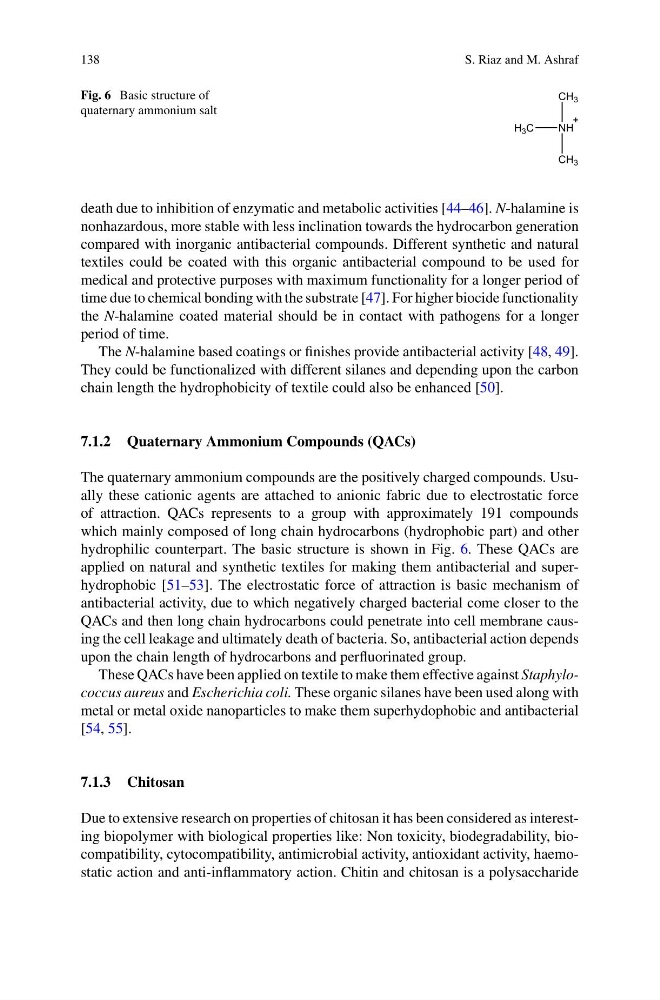
Fig. 6 Basic structure of
quaternary ammonium salt
NH
H 3 C
CH 3
CH 3
death due to inhibition of enzymatic and metabolic activities [44–46]. N-halamine is
nonhazardous, more stable with less inclination towards the hydrocarbon generation
compared with inorganic antibacterial compounds. Different synthetic and natural
textiles could be coated with this organic antibacterial compound to be used for
medical and protective purposes with maximum functionality for a longer period of
time due to chemical bonding with the substrate [47]. For higher biocide functionality
the N-halamine coated material should be in contact with pathogens for a longer
period of time.
The N-halamine based coatings or finishes provide antibacterial activity [48, 49].
They could be functionalized with different silanes and depending upon the carbon
chain length the hydrophobicity of textile could also be enhanced [50].
7.1.2 Quaternary Ammonium Compounds (QACs)
The quaternary ammonium compounds are the positively charged compounds. Usually these cationic agents are attached to anionic fabric due to electrostatic force
of attraction. QACs represents to a group with approximately 191 compounds
which mainly composed of long chain hydrocarbons (hydrophobic part) and other
hydrophilic counterpart. The basic structure is shown in Fig. 6. These QACs are
applied on natural and synthetic textiles for making them antibacterial and superhydrophobic [51–53]. The electrostatic force of attraction is basic mechanism of
antibacterial activity, due to which negatively charged bacterial come closer to the
QACs and then long chain hydrocarbons could penetrate into cell membrane causing the cell leakage and ultimately death of bacteria. So, antibacterial action depends
upon the chain length of hydrocarbons and perfluorinated group.
These QACs have been applied on textile to make them effective against Staphylococcus aureus and Escherichia coli. These organic silanes have been used along with
metal or metal oxide nanoparticles to make them superhydophobic and antibacterial
[54, 55].
7.1.3 Chitosan
Due to extensive research on properties of chitosan it has been considered as interesting biopolymer with biological properties like: Non toxicity, biodegradability, biocompatibility, cytocompatibility, antimicrobial activity, antioxidant activity, haemostatic action and anti-inflammatory action. Chitin and chitosan is a polysaccharide
S. Riaz and M. Ashraf
Fig. 6 Basic structure of
quaternary ammonium salt
NH
H 3 C
CH 3
CH 3
death due to inhibition of enzymatic and metabolic activities [44–46]. N-halamine is
nonhazardous, more stable with less inclination towards the hydrocarbon generation
compared with inorganic antibacterial compounds. Different synthetic and natural
textiles could be coated with this organic antibacterial compound to be used for
medical and protective purposes with maximum functionality for a longer period of
time due to chemical bonding with the substrate [47]. For higher biocide functionality
the N-halamine coated material should be in contact with pathogens for a longer
period of time.
The N-halamine based coatings or finishes provide antibacterial activity [48, 49].
They could be functionalized with different silanes and depending upon the carbon
chain length the hydrophobicity of textile could also be enhanced [50].
7.1.2 Quaternary Ammonium Compounds (QACs)
The quaternary ammonium compounds are the positively charged compounds. Usually these cationic agents are attached to anionic fabric due to electrostatic force
of attraction. QACs represents to a group with approximately 191 compounds
which mainly composed of long chain hydrocarbons (hydrophobic part) and other
hydrophilic counterpart. The basic structure is shown in Fig. 6. These QACs are
applied on natural and synthetic textiles for making them antibacterial and superhydrophobic [51–53]. The electrostatic force of attraction is basic mechanism of
antibacterial activity, due to which negatively charged bacterial come closer to the
QACs and then long chain hydrocarbons could penetrate into cell membrane causing the cell leakage and ultimately death of bacteria. So, antibacterial action depends
upon the chain length of hydrocarbons and perfluorinated group.
These QACs have been applied on textile to make them effective against Staphylococcus aureus and Escherichia coli. These organic silanes have been used along with
metal or metal oxide nanoparticles to make them superhydophobic and antibacterial
[54, 55].
7.1.3 Chitosan
Due to extensive research on properties of chitosan it has been considered as interesting biopolymer with biological properties like: Non toxicity, biodegradability, biocompatibility, cytocompatibility, antimicrobial activity, antioxidant activity, haemostatic action and anti-inflammatory action. Chitin and chitosan is a polysaccharide