

140
S. Riaz and M. Ashraf
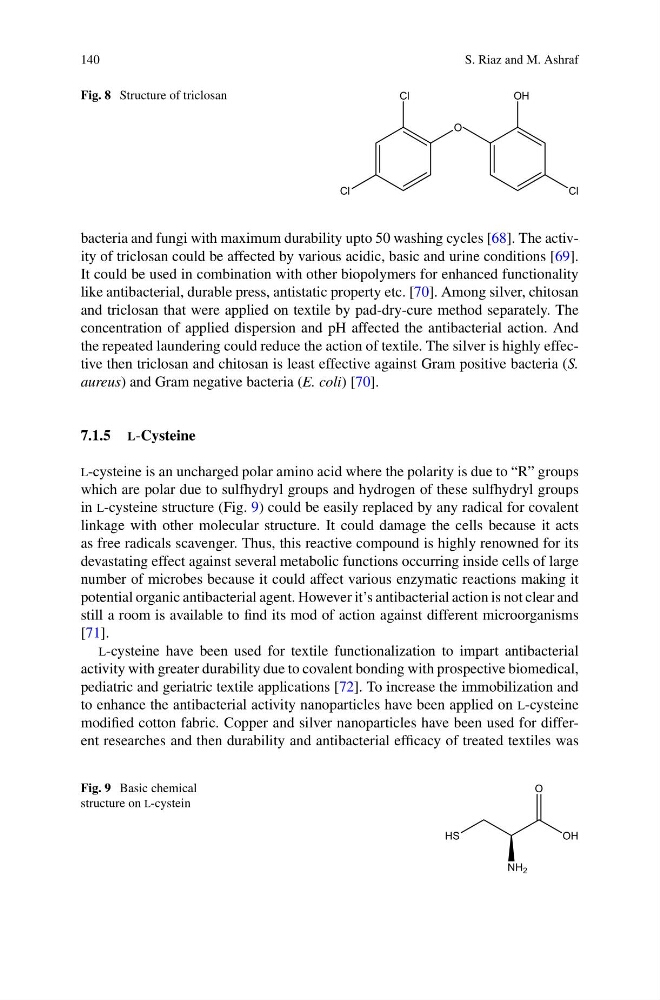
Fig. 8 Structure of triclosan
Cl
OH
Cl
Cl
O
bacteria and fungi with maximum durability upto 50 washing cycles [68]. The activity of triclosan could be affected by various acidic, basic and urine conditions [69].
It could be used in combination with other biopolymers for enhanced functionality
like antibacterial, durable press, antistatic property etc. [70]. Among silver, chitosan
and triclosan that were applied on textile by pad-dry-cure method separately. The
concentration of applied dispersion and pH affected the antibacterial action. And
the repeated laundering could reduce the action of textile. The silver is highly effective then triclosan and chitosan is least effective against Gram positive bacteria (S.
aureus) and Gram negative bacteria (E. coli) [70].
7.1.5 L-Cysteine
l-cysteine is an uncharged polar amino acid where the polarity is due to “R” groups
which are polar due to sulfhydryl groups and hydrogen of these sulfhydryl groups
in l-cysteine structure (Fig. 9) could be easily replaced by any radical for covalent
linkage with other molecular structure. It could damage the cells because it acts
as free radicals scavenger. Thus, this reactive compound is highly renowned for its
devastating effect against several metabolic functions occurring inside cells of large
number of microbes because it could affect various enzymatic reactions making it
potential organic antibacterial agent. However it’s antibacterial action is not clear and
still a room is available to find its mod of action against different microorganisms
[71].
l-cysteine have been used for textile functionalization to impart antibacterial
activity with greater durability due to covalent bonding with prospective biomedical,
pediatric and geriatric textile applications [72]. To increase the immobilization and
to enhance the antibacterial activity nanoparticles have been applied on l-cysteine
modified cotton fabric. Copper and silver nanoparticles have been used for different researches and then durability and antibacterial efficacy of treated textiles was
Fig. 9 Basic chemical
structure on l-cystein
HS
OH
NH 2
O
S. Riaz and M. Ashraf
Fig. 8 Structure of triclosan
Cl
OH
Cl
Cl
O
bacteria and fungi with maximum durability upto 50 washing cycles [68]. The activity of triclosan could be affected by various acidic, basic and urine conditions [69].
It could be used in combination with other biopolymers for enhanced functionality
like antibacterial, durable press, antistatic property etc. [70]. Among silver, chitosan
and triclosan that were applied on textile by pad-dry-cure method separately. The
concentration of applied dispersion and pH affected the antibacterial action. And
the repeated laundering could reduce the action of textile. The silver is highly effective then triclosan and chitosan is least effective against Gram positive bacteria (S.
aureus) and Gram negative bacteria (E. coli) [70].
7.1.5 L-Cysteine
l-cysteine is an uncharged polar amino acid where the polarity is due to “R” groups
which are polar due to sulfhydryl groups and hydrogen of these sulfhydryl groups
in l-cysteine structure (Fig. 9) could be easily replaced by any radical for covalent
linkage with other molecular structure. It could damage the cells because it acts
as free radicals scavenger. Thus, this reactive compound is highly renowned for its
devastating effect against several metabolic functions occurring inside cells of large
number of microbes because it could affect various enzymatic reactions making it
potential organic antibacterial agent. However it’s antibacterial action is not clear and
still a room is available to find its mod of action against different microorganisms
[71].
l-cysteine have been used for textile functionalization to impart antibacterial
activity with greater durability due to covalent bonding with prospective biomedical,
pediatric and geriatric textile applications [72]. To increase the immobilization and
to enhance the antibacterial activity nanoparticles have been applied on l-cysteine
modified cotton fabric. Copper and silver nanoparticles have been used for different researches and then durability and antibacterial efficacy of treated textiles was
Fig. 9 Basic chemical
structure on l-cystein
HS
OH
NH 2
O