

Application of Enzymes in Textile Functional Finishing
121
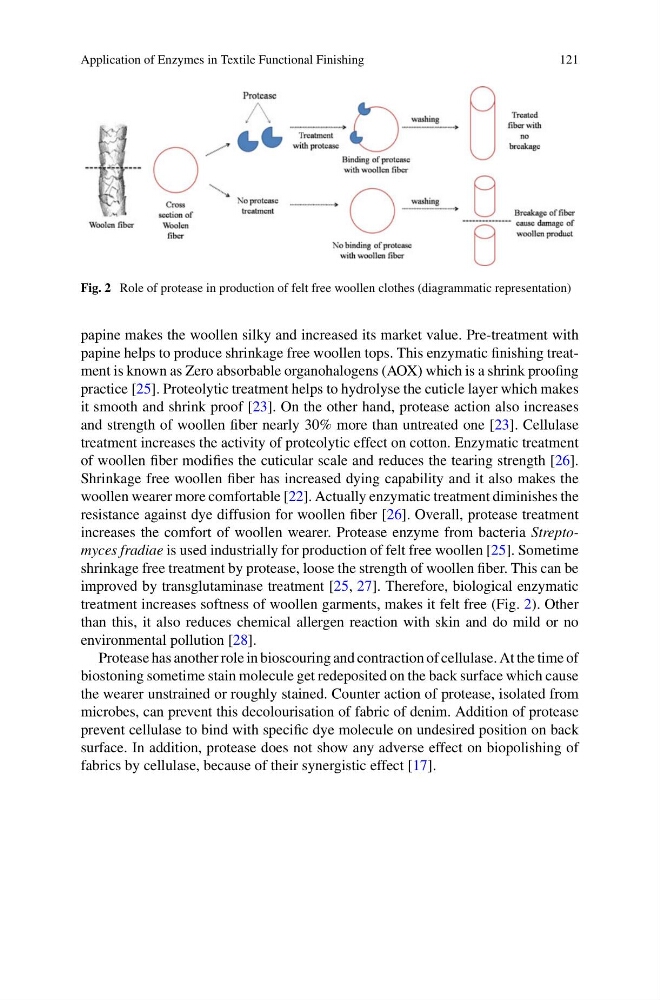
Fig. 2 Role of protease in production of felt free woollen clothes (diagrammatic representation)
papine makes the woollen silky and increased its market value. Pre-treatment with
papine helps to produce shrinkage free woollen tops. This enzymatic finishing treatment is known as Zero absorbable organohalogens (AOX) which is a shrink proofing
practice [25]. Proteolytic treatment helps to hydrolyse the cuticle layer which makes
it smooth and shrink proof [23]. On the other hand, protease action also increases
and strength of woollen fiber nearly 30% more than untreated one [23]. Cellulase
treatment increases the activity of proteolytic effect on cotton. Enzymatic treatment
of woollen fiber modifies the cuticular scale and reduces the tearing strength [26].
Shrinkage free woollen fiber has increased dying capability and it also makes the
woollen wearer more comfortable [22]. Actually enzymatic treatment diminishes the
resistance against dye diffusion for woollen fiber [26]. Overall, protease treatment
increases the comfort of woollen wearer. Protease enzyme from bacteria Streptomyces fradiae is used industrially for production of felt free woollen [25]. Sometime
shrinkage free treatment by protease, loose the strength of woollen fiber. This can be
improved by transglutaminase treatment [25, 27]. Therefore, biological enzymatic
treatment increases softness of woollen garments, makes it felt free (Fig. 2). Other
than this, it also reduces chemical allergen reaction with skin and do mild or no
environmental pollution [28].
Protease has another role in bioscouring and contraction of cellulase. At the time of
biostoning sometime stain molecule get redeposited on the back surface which cause
the wearer unstrained or roughly stained. Counter action of protease, isolated from
microbes, can prevent this decolourisation of fabric of denim. Addition of protease
prevent cellulase to bind with specific dye molecule on undesired position on back
surface. In addition, protease does not show any adverse effect on biopolishing of
fabrics by cellulase, because of their synergistic effect [17].
121
Fig. 2 Role of protease in production of felt free woollen clothes (diagrammatic representation)
papine makes the woollen silky and increased its market value. Pre-treatment with
papine helps to produce shrinkage free woollen tops. This enzymatic finishing treatment is known as Zero absorbable organohalogens (AOX) which is a shrink proofing
practice [25]. Proteolytic treatment helps to hydrolyse the cuticle layer which makes
it smooth and shrink proof [23]. On the other hand, protease action also increases
and strength of woollen fiber nearly 30% more than untreated one [23]. Cellulase
treatment increases the activity of proteolytic effect on cotton. Enzymatic treatment
of woollen fiber modifies the cuticular scale and reduces the tearing strength [26].
Shrinkage free woollen fiber has increased dying capability and it also makes the
woollen wearer more comfortable [22]. Actually enzymatic treatment diminishes the
resistance against dye diffusion for woollen fiber [26]. Overall, protease treatment
increases the comfort of woollen wearer. Protease enzyme from bacteria Streptomyces fradiae is used industrially for production of felt free woollen [25]. Sometime
shrinkage free treatment by protease, loose the strength of woollen fiber. This can be
improved by transglutaminase treatment [25, 27]. Therefore, biological enzymatic
treatment increases softness of woollen garments, makes it felt free (Fig. 2). Other
than this, it also reduces chemical allergen reaction with skin and do mild or no
environmental pollution [28].
Protease has another role in bioscouring and contraction of cellulase. At the time of
biostoning sometime stain molecule get redeposited on the back surface which cause
the wearer unstrained or roughly stained. Counter action of protease, isolated from
microbes, can prevent this decolourisation of fabric of denim. Addition of protease
prevent cellulase to bind with specific dye molecule on undesired position on back
surface. In addition, protease does not show any adverse effect on biopolishing of
fabrics by cellulase, because of their synergistic effect [17].