

118
S. Sarkar et al.
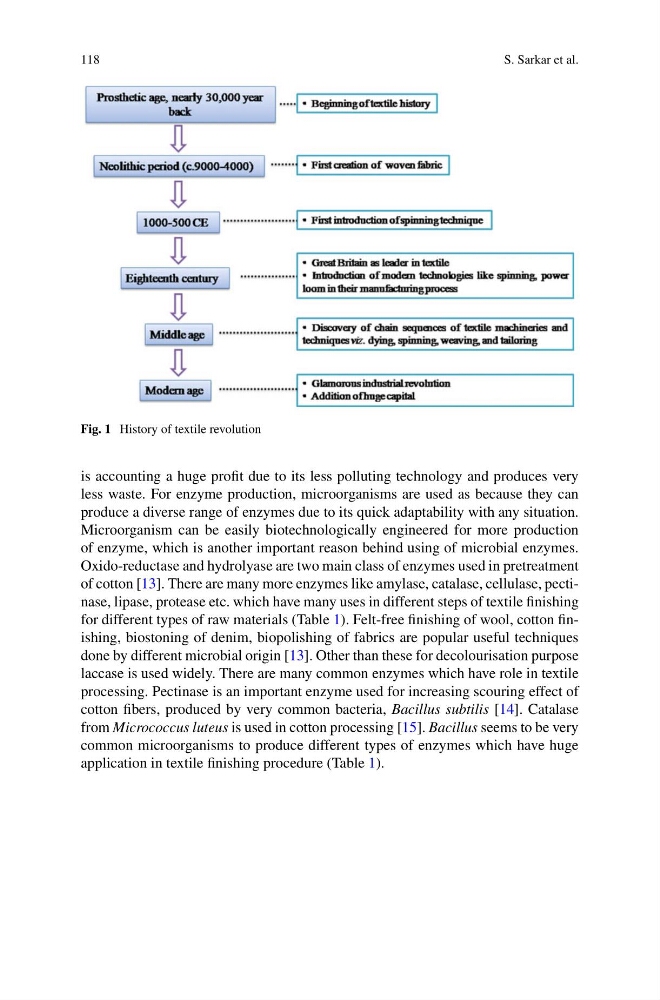
Fig. 1 History of textile revolution
is accounting a huge profit due to its less polluting technology and produces very
less waste. For enzyme production, microorganisms are used as because they can
produce a diverse range of enzymes due to its quick adaptability with any situation.
Microorganism can be easily biotechnologically engineered for more production
of enzyme, which is another important reason behind using of microbial enzymes.
Oxido-reductase and hydrolyase are two main class of enzymes used in pretreatment
of cotton [13]. There are many more enzymes like amylase, catalase, cellulase, pectinase, lipase, protease etc. which have many uses in different steps of textile finishing
for different types of raw materials (Table 1). Felt-free finishing of wool, cotton finishing, biostoning of denim, biopolishing of fabrics are popular useful techniques
done by different microbial origin [13]. Other than these for decolourisation purpose
laccase is used widely. There are many common enzymes which have role in textile
processing. Pectinase is an important enzyme used for increasing scouring effect of
cotton fibers, produced by very common bacteria, Bacillus subtilis [14]. Catalase
from Micrococcus luteus is used in cotton processing [15]. Bacillus seems to be very
common microorganisms to produce different types of enzymes which have huge
application in textile finishing procedure (Table 1).
S. Sarkar et al.
Fig. 1 History of textile revolution
is accounting a huge profit due to its less polluting technology and produces very
less waste. For enzyme production, microorganisms are used as because they can
produce a diverse range of enzymes due to its quick adaptability with any situation.
Microorganism can be easily biotechnologically engineered for more production
of enzyme, which is another important reason behind using of microbial enzymes.
Oxido-reductase and hydrolyase are two main class of enzymes used in pretreatment
of cotton [13]. There are many more enzymes like amylase, catalase, cellulase, pectinase, lipase, protease etc. which have many uses in different steps of textile finishing
for different types of raw materials (Table 1). Felt-free finishing of wool, cotton finishing, biostoning of denim, biopolishing of fabrics are popular useful techniques
done by different microbial origin [13]. Other than these for decolourisation purpose
laccase is used widely. There are many common enzymes which have role in textile
processing. Pectinase is an important enzyme used for increasing scouring effect of
cotton fibers, produced by very common bacteria, Bacillus subtilis [14]. Catalase
from Micrococcus luteus is used in cotton processing [15]. Bacillus seems to be very
common microorganisms to produce different types of enzymes which have huge
application in textile finishing procedure (Table 1).