

Biotechnology: An Eco-friendly Tool of Nature for Textile …
101
8 Enzymes Engineering as a Tailoring Tool
Re-designing of enzymatic traits are called enzyme tailoring [136]. It is necessary to
make the most suitable candidates for industrial processes [137]. The engineering of
1st enzyme “Subtilisins” in the early twenty-first century began the revolutionized
era of protein engineering [138]. Currently, numerous optimized enzymes such as
amylases, cellulases, laccases, proteases, pectinases, and lipases are available to
meet industrial applications [139]. Following strategies are commonly applied in the
tailoring process:
(i) Directed evolution technique
(ii) High throughput screening
(iii) Computational designs
(iv) Rational designs are commonly applied [13, 140].
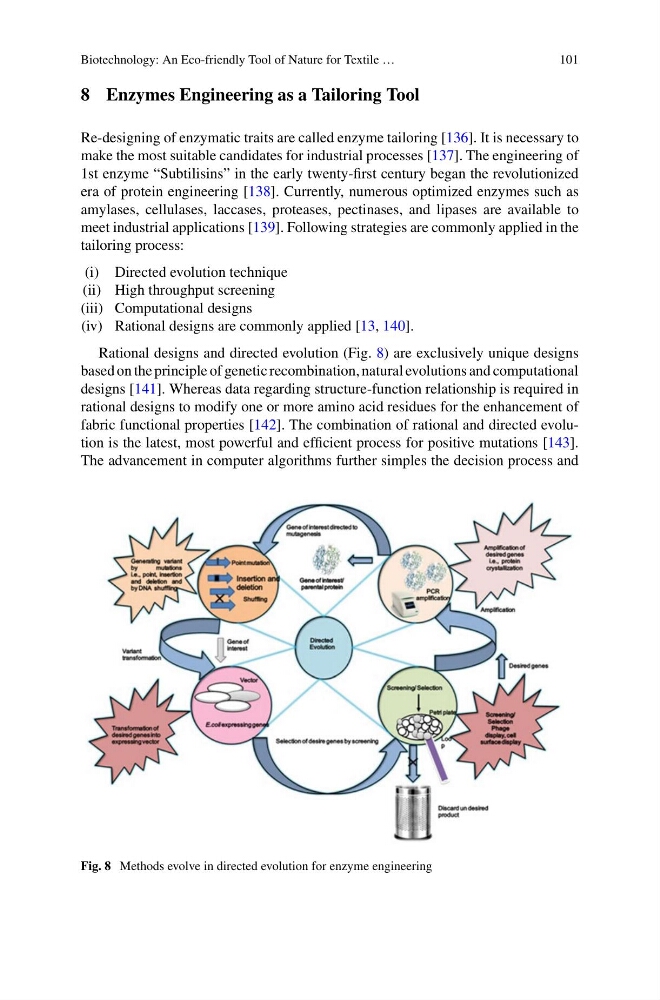
Rational designs and directed evolution (Fig. 8) are exclusively unique designs
based on the principle of genetic recombination, natural evolutions and computational
designs [141]. Whereas data regarding structure-function relationship is required in
rational designs to modify one or more amino acid residues for the enhancement of
fabric functional properties [142]. The combination of rational and directed evolution is the latest, most powerful and efficient process for positive mutations [143].
The advancement in computer algorithms further simples the decision process and
Fig. 8 Methods evolve in directed evolution for enzyme engineering
101
8 Enzymes Engineering as a Tailoring Tool
Re-designing of enzymatic traits are called enzyme tailoring [136]. It is necessary to
make the most suitable candidates for industrial processes [137]. The engineering of
1st enzyme “Subtilisins” in the early twenty-first century began the revolutionized
era of protein engineering [138]. Currently, numerous optimized enzymes such as
amylases, cellulases, laccases, proteases, pectinases, and lipases are available to
meet industrial applications [139]. Following strategies are commonly applied in the
tailoring process:
(i) Directed evolution technique
(ii) High throughput screening
(iii) Computational designs
(iv) Rational designs are commonly applied [13, 140].
Rational designs and directed evolution (Fig. 8) are exclusively unique designs
based on the principle of genetic recombination, natural evolutions and computational
designs [141]. Whereas data regarding structure-function relationship is required in
rational designs to modify one or more amino acid residues for the enhancement of
fabric functional properties [142]. The combination of rational and directed evolution is the latest, most powerful and efficient process for positive mutations [143].
The advancement in computer algorithms further simples the decision process and
Fig. 8 Methods evolve in directed evolution for enzyme engineering