

100
S. Adeel et al.
7 Advantages of Enzymatic Textile Processing
The value of the global market for industrial enzymes was 7082 million USD in
2017 and estimated to increase by 10,519 million USD in 2024 [135]. The detailed
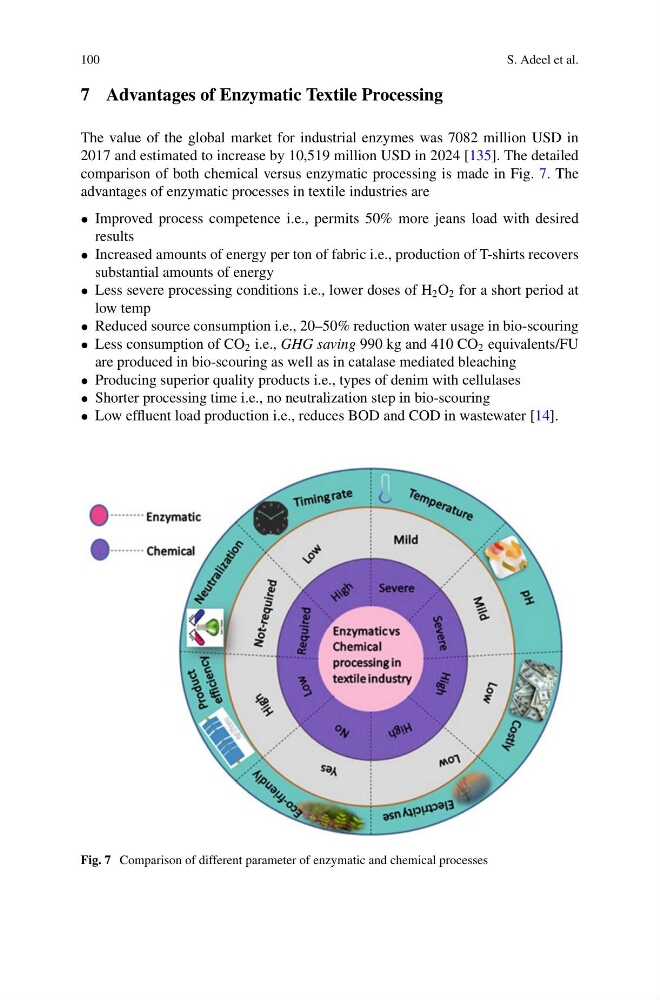
comparison of both chemical versus enzymatic processing is made in Fig. 7. The
advantages of enzymatic processes in textile industries are
• Improved process competence i.e., permits 50% more jeans load with desired
results
• Increased amounts of energy per ton of fabric i.e., production of T-shirts recovers
substantial amounts of energy
• Less severe processing conditions i.e., lower doses of H 2 O 2 for a short period at
low temp
• Reduced source consumption i.e., 20–50% reduction water usage in bio-scouring
• Less consumption of CO 2 i.e., GHG saving 990 kg and 410 CO 2 equivalents/FU
are produced in bio-scouring as well as in catalase mediated bleaching
• Producing superior quality products i.e., types of denim with cellulases
• Shorter processing time i.e., no neutralization step in bio-scouring
• Low effluent load production i.e., reduces BOD and COD in wastewater [14].
Fig. 7 Comparison of different parameter of enzymatic and chemical processes
S. Adeel et al.
7 Advantages of Enzymatic Textile Processing
The value of the global market for industrial enzymes was 7082 million USD in
2017 and estimated to increase by 10,519 million USD in 2024 [135]. The detailed
comparison of both chemical versus enzymatic processing is made in Fig. 7. The
advantages of enzymatic processes in textile industries are
• Improved process competence i.e., permits 50% more jeans load with desired
results
• Increased amounts of energy per ton of fabric i.e., production of T-shirts recovers
substantial amounts of energy
• Less severe processing conditions i.e., lower doses of H 2 O 2 for a short period at
low temp
• Reduced source consumption i.e., 20–50% reduction water usage in bio-scouring
• Less consumption of CO 2 i.e., GHG saving 990 kg and 410 CO 2 equivalents/FU
are produced in bio-scouring as well as in catalase mediated bleaching
• Producing superior quality products i.e., types of denim with cellulases
• Shorter processing time i.e., no neutralization step in bio-scouring
• Low effluent load production i.e., reduces BOD and COD in wastewater [14].
Fig. 7 Comparison of different parameter of enzymatic and chemical processes