

96
S. Adeel et al.
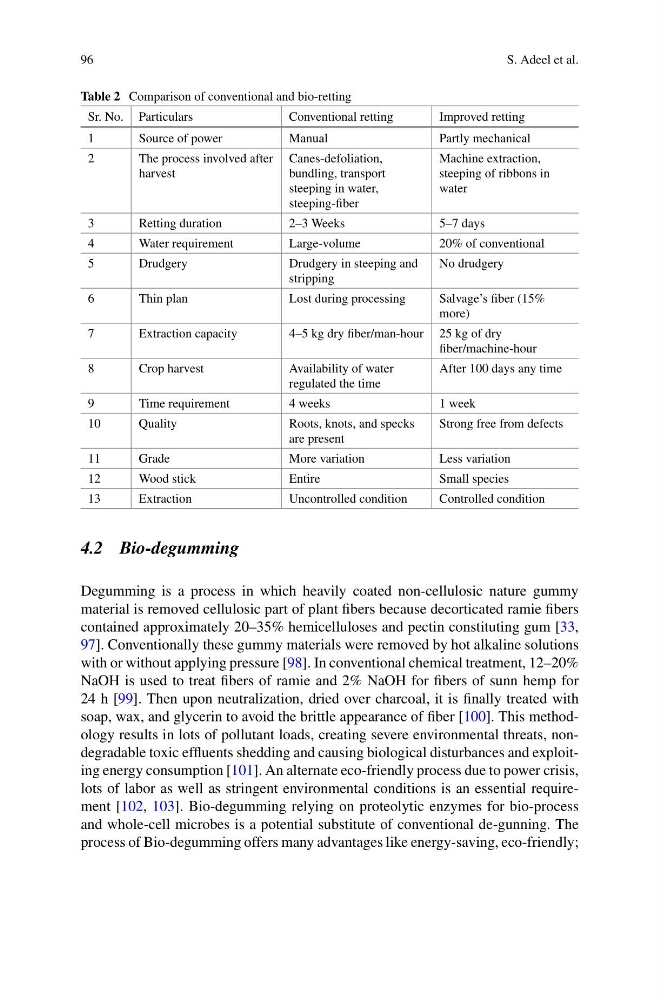
Table 2 Comparison of conventional and bio-retting
Sr. No. Particulars
Conventional retting
Improved retting
1
Source of power
Manual
Partly mechanical
2
The process involved after
harvest
Canes-defoliation,
bundling, transport
steeping in water,
steeping-fiber
Machine extraction,
steeping of ribbons in
water
3
Retting duration
2–3 Weeks
5–7 days
4
Water requirement
Large-volume
20% of conventional
5
Drudgery
Drudgery in steeping and
stripping
No drudgery
6
Thin plan
Lost during processing
Salvage’s fiber (15%
more)
7
Extraction capacity
4–5 kg dry fiber/man-hour 25 kg of dry
fiber/machine-hour
8
Crop harvest
Availability of water
regulated the time
After 100 days any time
9
Time requirement
4 weeks
1 week
10
Quality
Roots, knots, and specks
are present
Strong free from defects
11
Grade
More variation
Less variation
12
Wood stick
Entire
Small species
13
Extraction
Uncontrolled condition
Controlled condition
4.2 Bio-degumming
Degumming is a process in which heavily coated non-cellulosic nature gummy
material is removed cellulosic part of plant fibers because decorticated ramie fibers
contained approximately 20–35% hemicelluloses and pectin constituting gum [33,
97]. Conventionally these gummy materials were removed by hot alkaline solutions
with or without applying pressure [98]. In conventional chemical treatment, 12–20%
NaOH is used to treat fibers of ramie and 2% NaOH for fibers of sunn hemp for
24 h [99]. Then upon neutralization, dried over charcoal, it is finally treated with
soap, wax, and glycerin to avoid the brittle appearance of fiber [100]. This methodology results in lots of pollutant loads, creating severe environmental threats, nondegradable toxic effluents shedding and causing biological disturbances and exploiting energy consumption [101]. An alternate eco-friendly process due to power crisis,
lots of labor as well as stringent environmental conditions is an essential requirement [102, 103]. Bio-degumming relying on proteolytic enzymes for bio-process
and whole-cell microbes is a potential substitute of conventional de-gunning. The
process of Bio-degumming offers many advantages like energy-saving, eco-friendly;
S. Adeel et al.
Table 2 Comparison of conventional and bio-retting
Sr. No. Particulars
Conventional retting
Improved retting
1
Source of power
Manual
Partly mechanical
2
The process involved after
harvest
Canes-defoliation,
bundling, transport
steeping in water,
steeping-fiber
Machine extraction,
steeping of ribbons in
water
3
Retting duration
2–3 Weeks
5–7 days
4
Water requirement
Large-volume
20% of conventional
5
Drudgery
Drudgery in steeping and
stripping
No drudgery
6
Thin plan
Lost during processing
Salvage’s fiber (15%
more)
7
Extraction capacity
4–5 kg dry fiber/man-hour 25 kg of dry
fiber/machine-hour
8
Crop harvest
Availability of water
regulated the time
After 100 days any time
9
Time requirement
4 weeks
1 week
10
Quality
Roots, knots, and specks
are present
Strong free from defects
11
Grade
More variation
Less variation
12
Wood stick
Entire
Small species
13
Extraction
Uncontrolled condition
Controlled condition
4.2 Bio-degumming
Degumming is a process in which heavily coated non-cellulosic nature gummy
material is removed cellulosic part of plant fibers because decorticated ramie fibers
contained approximately 20–35% hemicelluloses and pectin constituting gum [33,
97]. Conventionally these gummy materials were removed by hot alkaline solutions
with or without applying pressure [98]. In conventional chemical treatment, 12–20%
NaOH is used to treat fibers of ramie and 2% NaOH for fibers of sunn hemp for
24 h [99]. Then upon neutralization, dried over charcoal, it is finally treated with
soap, wax, and glycerin to avoid the brittle appearance of fiber [100]. This methodology results in lots of pollutant loads, creating severe environmental threats, nondegradable toxic effluents shedding and causing biological disturbances and exploiting energy consumption [101]. An alternate eco-friendly process due to power crisis,
lots of labor as well as stringent environmental conditions is an essential requirement [102, 103]. Bio-degumming relying on proteolytic enzymes for bio-process
and whole-cell microbes is a potential substitute of conventional de-gunning. The
process of Bio-degumming offers many advantages like energy-saving, eco-friendly;