

Biotechnology: An Eco-friendly Tool of Nature for Textile …
95
4 Bast Fibers Bioprocessing
4.1 Retting
Bast fibers extraction process from plant stem is called “retting” [89]. Jute, linen,
ramie, and hemp are the types of natural bast fibers with more than 50% cellulose
and 15–30% non-cellulosic impurities [90, 91]. Natural bast fibers are extracted from
plants using specified methods. Retting is the process of bast fiber extraction from
plants [89]. Conventional alkali treatments are used as pre-treatment to remove impurities. A single component of impurities can be removed by an individual enzyme
such as proteases, hemicellulases, and pectinases [79]. However, a combination of
these enzymes results in much better, efficient and faster pre-treatment. Cellulases in
multi-enzyme complex remove cellulosic components and facilitate other enzymes
to attack the inner layer of the fiber [92]. Bio-finishing treatment conditions influence
differently on different fabrics e.g., linen may be destroyed in extreme conditions
[93]. The first biotechnological process used since BC in the textile sector is microbial
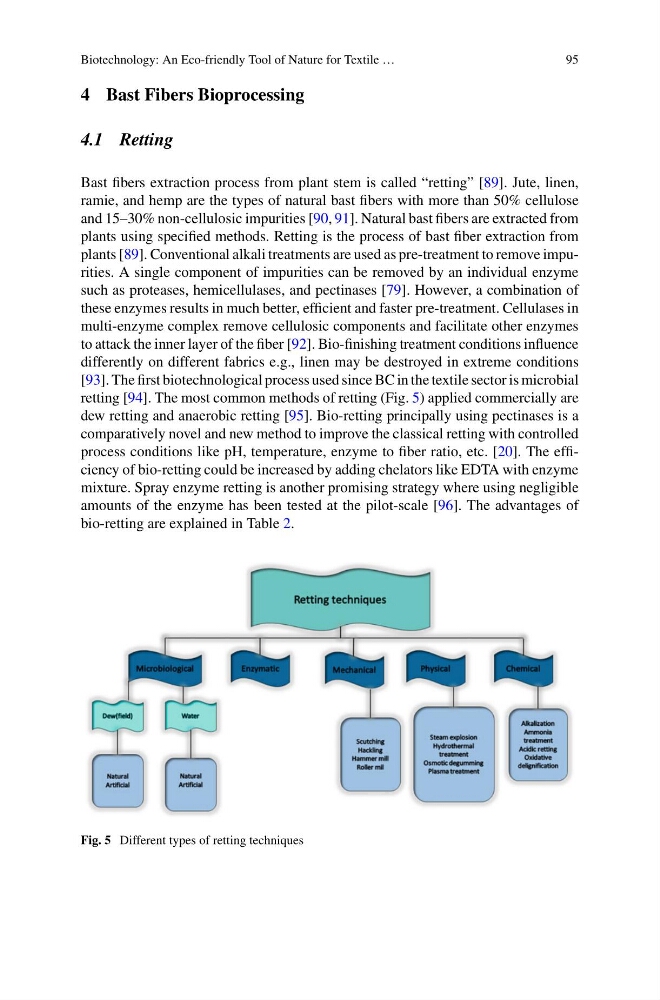
retting [94]. The most common methods of retting (Fig. 5) applied commercially are
dew retting and anaerobic retting [95]. Bio-retting principally using pectinases is a
comparatively novel and new method to improve the classical retting with controlled
process conditions like pH, temperature, enzyme to fiber ratio, etc. [20]. The efficiency of bio-retting could be increased by adding chelators like EDTA with enzyme
mixture. Spray enzyme retting is another promising strategy where using negligible
amounts of the enzyme has been tested at the pilot-scale [96]. The advantages of
bio-retting are explained in Table 2.
Fig. 5 Different types of retting techniques
95
4 Bast Fibers Bioprocessing
4.1 Retting
Bast fibers extraction process from plant stem is called “retting” [89]. Jute, linen,
ramie, and hemp are the types of natural bast fibers with more than 50% cellulose
and 15–30% non-cellulosic impurities [90, 91]. Natural bast fibers are extracted from
plants using specified methods. Retting is the process of bast fiber extraction from
plants [89]. Conventional alkali treatments are used as pre-treatment to remove impurities. A single component of impurities can be removed by an individual enzyme
such as proteases, hemicellulases, and pectinases [79]. However, a combination of
these enzymes results in much better, efficient and faster pre-treatment. Cellulases in
multi-enzyme complex remove cellulosic components and facilitate other enzymes
to attack the inner layer of the fiber [92]. Bio-finishing treatment conditions influence
differently on different fabrics e.g., linen may be destroyed in extreme conditions
[93]. The first biotechnological process used since BC in the textile sector is microbial
retting [94]. The most common methods of retting (Fig. 5) applied commercially are
dew retting and anaerobic retting [95]. Bio-retting principally using pectinases is a
comparatively novel and new method to improve the classical retting with controlled
process conditions like pH, temperature, enzyme to fiber ratio, etc. [20]. The efficiency of bio-retting could be increased by adding chelators like EDTA with enzyme
mixture. Spray enzyme retting is another promising strategy where using negligible
amounts of the enzyme has been tested at the pilot-scale [96]. The advantages of
bio-retting are explained in Table 2.
Fig. 5 Different types of retting techniques