

76
4 Nanofiller Dispersion in Rubber as Revealed by 3D-TEM
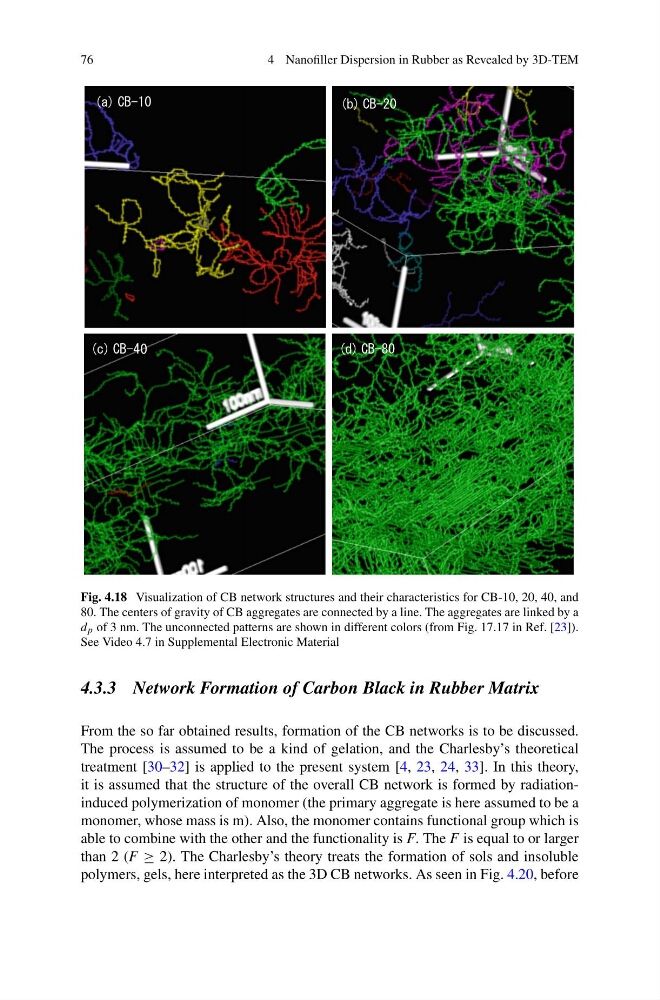
Fig. 4.18 Visualization of CB network structures and their characteristics for CB-10, 20, 40, and
80. The centers of gravity of CB aggregates are connected by a line. The aggregates are linked by a
d p of 3 nm. The unconnected patterns are shown in different colors (from Fig. 17.17 in Ref. [23]).
See Video 4.7 in Supplemental Electronic Material
4.3.3 Network Formation of Carbon Black in Rubber Matrix
From the so far obtained results, formation of the CB networks is to be discussed.
The process is assumed to be a kind of gelation, and the Charlesby’s theoretical
treatment [30–32] is applied to the present system [4, 23, 24, 33]. In this theory,
it is assumed that the structure of the overall CB network is formed by radiationinduced polymerization of monomer (the primary aggregate is here assumed to be a
monomer, whose mass is m). Also, the monomer contains functional group which is
able to combine with the other and the functionality is F. The F is equal to or larger
than 2 (F ≥ 2). The Charlesby’s theory treats the formation of sols and insoluble
polymers, gels, here interpreted as the 3D CB networks. As seen in Fig. 4.20, before
4 Nanofiller Dispersion in Rubber as Revealed by 3D-TEM
Fig. 4.18 Visualization of CB network structures and their characteristics for CB-10, 20, 40, and
80. The centers of gravity of CB aggregates are connected by a line. The aggregates are linked by a
d p of 3 nm. The unconnected patterns are shown in different colors (from Fig. 17.17 in Ref. [23]).
See Video 4.7 in Supplemental Electronic Material
4.3.3 Network Formation of Carbon Black in Rubber Matrix
From the so far obtained results, formation of the CB networks is to be discussed.
The process is assumed to be a kind of gelation, and the Charlesby’s theoretical
treatment [30–32] is applied to the present system [4, 23, 24, 33]. In this theory,
it is assumed that the structure of the overall CB network is formed by radiationinduced polymerization of monomer (the primary aggregate is here assumed to be a
monomer, whose mass is m). Also, the monomer contains functional group which is
able to combine with the other and the functionality is F. The F is equal to or larger
than 2 (F ≥ 2). The Charlesby’s theory treats the formation of sols and insoluble
polymers, gels, here interpreted as the 3D CB networks. As seen in Fig. 4.20, before