

4.3 Carbon Black Dispersion as Revealed by 3D-TEM
77
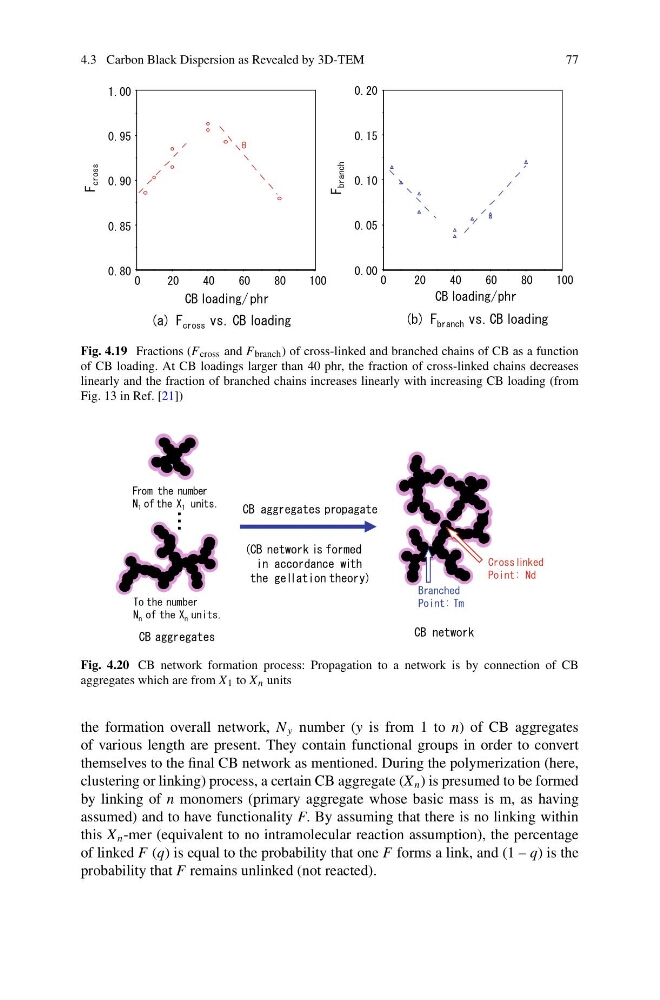
Fig. 4.19 Fractions (F cross and F branch ) of cross-linked and branched chains of CB as a function
of CB loading. At CB loadings larger than 40 phr, the fraction of cross-linked chains decreases
linearly and the fraction of branched chains increases linearly with increasing CB loading (from
Fig. 13 in Ref. [21])
Fig. 4.20 CB network formation process: Propagation to a network is by connection of CB
aggregates which are from X 1 to X n units
the formation overall network, N y number (y is from 1 to n) of CB aggregates
of various length are present. They contain functional groups in order to convert
themselves to the final CB network as mentioned. During the polymerization (here,
clustering or linking) process, a certain CB aggregate (X n ) is presumed to be formed
by linking of n monomers (primary aggregate whose basic mass is m, as having
assumed) and to have functionality F. By assuming that there is no linking within
this X n -mer (equivalent to no intramolecular reaction assumption), the percentage
of linked F (q) is equal to the probability that one F forms a link, and (1 – q) is the
probability that F remains unlinked (not reacted).
77
Fig. 4.19 Fractions (F cross and F branch ) of cross-linked and branched chains of CB as a function
of CB loading. At CB loadings larger than 40 phr, the fraction of cross-linked chains decreases
linearly and the fraction of branched chains increases linearly with increasing CB loading (from
Fig. 13 in Ref. [21])
Fig. 4.20 CB network formation process: Propagation to a network is by connection of CB
aggregates which are from X 1 to X n units
the formation overall network, N y number (y is from 1 to n) of CB aggregates
of various length are present. They contain functional groups in order to convert
themselves to the final CB network as mentioned. During the polymerization (here,
clustering or linking) process, a certain CB aggregate (X n ) is presumed to be formed
by linking of n monomers (primary aggregate whose basic mass is m, as having
assumed) and to have functionality F. By assuming that there is no linking within
this X n -mer (equivalent to no intramolecular reaction assumption), the percentage
of linked F (q) is equal to the probability that one F forms a link, and (1 – q) is the
probability that F remains unlinked (not reacted).