

66
4 Nanofiller Dispersion in Rubber as Revealed by 3D-TEM
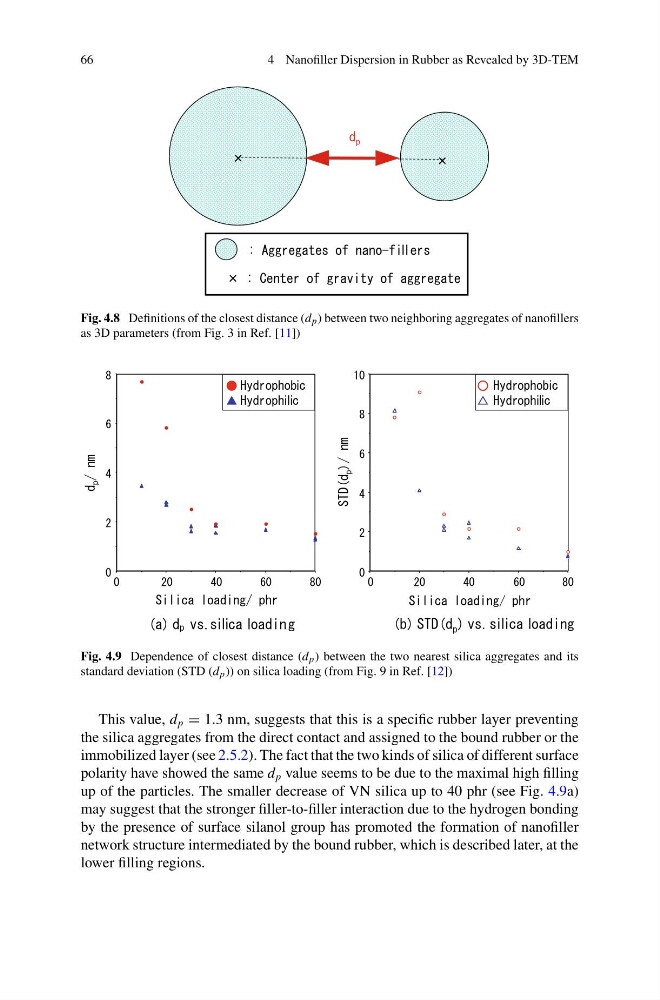
Fig. 4.8 Definitions of the closest distance (d p ) between two neighboring aggregates of nanofillers
as 3D parameters (from Fig. 3 in Ref. [11])
Fig. 4.9 Dependence of closest distance (d p ) between the two nearest silica aggregates and its
standard deviation (STD (d p )) on silica loading (from Fig. 9 in Ref. [12])
This value, d p = 1.3 nm, suggests that this is a specific rubber layer preventing
the silica aggregates from the direct contact and assigned to the bound rubber or the
immobilized layer (see 2.5.2). The fact that the two kinds of silica of different surface
polarity have showed the same d p value seems to be due to the maximal high filling
up of the particles. The smaller decrease of VN silica up to 40 phr (see Fig. 4.9a)
may suggest that the stronger filler-to-filler interaction due to the hydrogen bonding
by the presence of surface silanol group has promoted the formation of nanofiller
network structure intermediated by the bound rubber, which is described later, at the
lower filling regions.
4 Nanofiller Dispersion in Rubber as Revealed by 3D-TEM
Fig. 4.8 Definitions of the closest distance (d p ) between two neighboring aggregates of nanofillers
as 3D parameters (from Fig. 3 in Ref. [11])
Fig. 4.9 Dependence of closest distance (d p ) between the two nearest silica aggregates and its
standard deviation (STD (d p )) on silica loading (from Fig. 9 in Ref. [12])
This value, d p = 1.3 nm, suggests that this is a specific rubber layer preventing
the silica aggregates from the direct contact and assigned to the bound rubber or the
immobilized layer (see 2.5.2). The fact that the two kinds of silica of different surface
polarity have showed the same d p value seems to be due to the maximal high filling
up of the particles. The smaller decrease of VN silica up to 40 phr (see Fig. 4.9a)
may suggest that the stronger filler-to-filler interaction due to the hydrogen bonding
by the presence of surface silanol group has promoted the formation of nanofiller
network structure intermediated by the bound rubber, which is described later, at the
lower filling regions.