

4.2 Particulate Silica Dispersion as Revealed by 3D-TEM
65
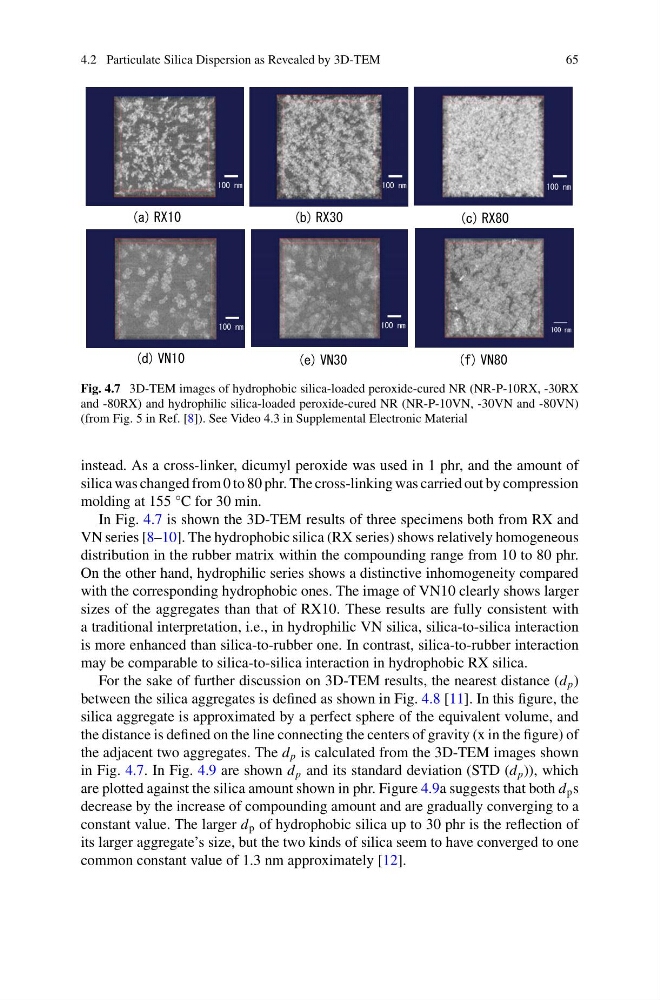
Fig. 4.7 3D-TEM images of hydrophobic silica-loaded peroxide-cured NR (NR-P-10RX, -30RX
and -80RX) and hydrophilic silica-loaded peroxide-cured NR (NR-P-10VN, -30VN and -80VN)
(from Fig. 5 in Ref. [8]). See Video 4.3 in Supplemental Electronic Material
instead. As a cross-linker, dicumyl peroxide was used in 1 phr, and the amount of
silica was changed from 0 to 80 phr. The cross-linking was carried out by compression
molding at 155 °C for 30 min.
In Fig. 4.7 is shown the 3D-TEM results of three specimens both from RX and
VN series [8–10]. The hydrophobic silica (RX series) shows relatively homogeneous
distribution in the rubber matrix within the compounding range from 10 to 80 phr.
On the other hand, hydrophilic series shows a distinctive inhomogeneity compared
with the corresponding hydrophobic ones. The image of VN10 clearly shows larger
sizes of the aggregates than that of RX10. These results are fully consistent with
a traditional interpretation, i.e., in hydrophilic VN silica, silica-to-silica interaction
is more enhanced than silica-to-rubber one. In contrast, silica-to-rubber interaction
may be comparable to silica-to-silica interaction in hydrophobic RX silica.
For the sake of further discussion on 3D-TEM results, the nearest distance (d p )
between the silica aggregates is defined as shown in Fig. 4.8 [11]. In this figure, the
silica aggregate is approximated by a perfect sphere of the equivalent volume, and
the distance is defined on the line connecting the centers of gravity (x in the figure) of
the adjacent two aggregates. The d p is calculated from the 3D-TEM images shown
in Fig. 4.7. In Fig. 4.9 are shown d p and its standard deviation (STD (d p )), which
are plotted against the silica amount shown in phr. Figure 4.9a suggests that both d p s
decrease by the increase of compounding amount and are gradually converging to a
constant value. The larger d p of hydrophobic silica up to 30 phr is the reflection of
its larger aggregate’s size, but the two kinds of silica seem to have converged to one
common constant value of 1.3 nm approximately [12].
65
Fig. 4.7 3D-TEM images of hydrophobic silica-loaded peroxide-cured NR (NR-P-10RX, -30RX
and -80RX) and hydrophilic silica-loaded peroxide-cured NR (NR-P-10VN, -30VN and -80VN)
(from Fig. 5 in Ref. [8]). See Video 4.3 in Supplemental Electronic Material
instead. As a cross-linker, dicumyl peroxide was used in 1 phr, and the amount of
silica was changed from 0 to 80 phr. The cross-linking was carried out by compression
molding at 155 °C for 30 min.
In Fig. 4.7 is shown the 3D-TEM results of three specimens both from RX and
VN series [8–10]. The hydrophobic silica (RX series) shows relatively homogeneous
distribution in the rubber matrix within the compounding range from 10 to 80 phr.
On the other hand, hydrophilic series shows a distinctive inhomogeneity compared
with the corresponding hydrophobic ones. The image of VN10 clearly shows larger
sizes of the aggregates than that of RX10. These results are fully consistent with
a traditional interpretation, i.e., in hydrophilic VN silica, silica-to-silica interaction
is more enhanced than silica-to-rubber one. In contrast, silica-to-rubber interaction
may be comparable to silica-to-silica interaction in hydrophobic RX silica.
For the sake of further discussion on 3D-TEM results, the nearest distance (d p )
between the silica aggregates is defined as shown in Fig. 4.8 [11]. In this figure, the
silica aggregate is approximated by a perfect sphere of the equivalent volume, and
the distance is defined on the line connecting the centers of gravity (x in the figure) of
the adjacent two aggregates. The d p is calculated from the 3D-TEM images shown
in Fig. 4.7. In Fig. 4.9 are shown d p and its standard deviation (STD (d p )), which
are plotted against the silica amount shown in phr. Figure 4.9a suggests that both d p s
decrease by the increase of compounding amount and are gradually converging to a
constant value. The larger d p of hydrophobic silica up to 30 phr is the reflection of
its larger aggregate’s size, but the two kinds of silica seem to have converged to one
common constant value of 1.3 nm approximately [12].