

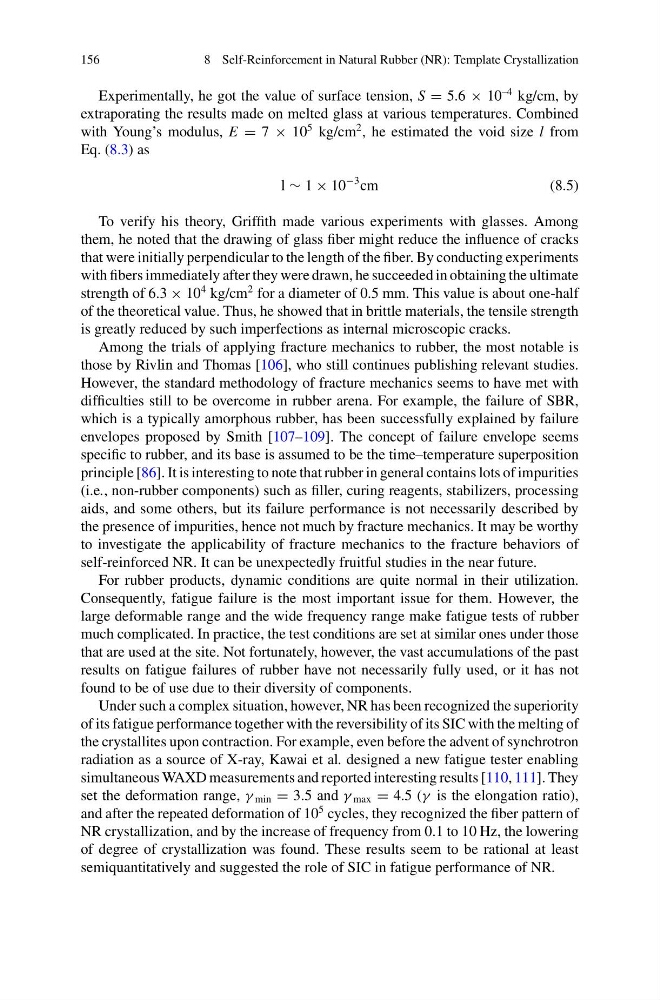
156
8 Self-Reinforcement in Natural Rubber (NR): Template Crystallization
Experimentally, he got the value of surface tension, S = 5.6 × 10
–4 kg/cm, by
extraporating the results made on melted glass at various temperatures. Combined
with Young’s modulus, E = 7 × 10
5 kg/cm
2 , he estimated the void size l from
Eq. (8.3) as
l ∼ 1 × 10
−3 cm
(8.5)
To verify his theory, Griffith made various experiments with glasses. Among
them, he noted that the drawing of glass fiber might reduce the influence of cracks
that were initially perpendicular to the length of the fiber. By conducting experiments
with fibers immediately after they were drawn, he succeeded in obtaining the ultimate
strength of 6.3 × 10
4 kg/cm
2 for a diameter of 0.5 mm. This value is about one-half
of the theoretical value. Thus, he showed that in brittle materials, the tensile strength
is greatly reduced by such imperfections as internal microscopic cracks.
Among the trials of applying fracture mechanics to rubber, the most notable is
those by Rivlin and Thomas [106], who still continues publishing relevant studies.
However, the standard methodology of fracture mechanics seems to have met with
difficulties still to be overcome in rubber arena. For example, the failure of SBR,
which is a typically amorphous rubber, has been successfully explained by failure
envelopes proposed by Smith [107–109]. The concept of failure envelope seems
specific to rubber, and its base is assumed to be the time–temperature superposition
principle [86]. It is interesting to note that rubber in general contains lots of impurities
(i.e., non-rubber components) such as filler, curing reagents, stabilizers, processing
aids, and some others, but its failure performance is not necessarily described by
the presence of impurities, hence not much by fracture mechanics. It may be worthy
to investigate the applicability of fracture mechanics to the fracture behaviors of
self-reinforced NR. It can be unexpectedly fruitful studies in the near future.
For rubber products, dynamic conditions are quite normal in their utilization.
Consequently, fatigue failure is the most important issue for them. However, the
large deformable range and the wide frequency range make fatigue tests of rubber
much complicated. In practice, the test conditions are set at similar ones under those
that are used at the site. Not fortunately, however, the vast accumulations of the past
results on fatigue failures of rubber have not necessarily fully used, or it has not
found to be of use due to their diversity of components.
Under such a complex situation, however, NR has been recognized the superiority
of its fatigue performance together with the reversibility of its SIC with the melting of
the crystallites upon contraction. For example, even before the advent of synchrotron
radiation as a source of X-ray, Kawai et al. designed a new fatigue tester enabling
simultaneous WAXD measurements and reported interesting results [110, 111]. They
set the deformation range, γ min = 3.5 and γ max = 4.5 (γ is the elongation ratio),
and after the repeated deformation of 10
5 cycles, they recognized the fiber pattern of
NR crystallization, and by the increase of frequency from 0.1 to 10 Hz, the lowering
of degree of crystallization was found. These results seem to be rational at least
semiquantitatively and suggested the role of SIC in fatigue performance of NR.
8 Self-Reinforcement in Natural Rubber (NR): Template Crystallization
Experimentally, he got the value of surface tension, S = 5.6 × 10
–4 kg/cm, by
extraporating the results made on melted glass at various temperatures. Combined
with Young’s modulus, E = 7 × 10
5 kg/cm
2 , he estimated the void size l from
Eq. (8.3) as
l ∼ 1 × 10
−3 cm
(8.5)
To verify his theory, Griffith made various experiments with glasses. Among
them, he noted that the drawing of glass fiber might reduce the influence of cracks
that were initially perpendicular to the length of the fiber. By conducting experiments
with fibers immediately after they were drawn, he succeeded in obtaining the ultimate
strength of 6.3 × 10
4 kg/cm
2 for a diameter of 0.5 mm. This value is about one-half
of the theoretical value. Thus, he showed that in brittle materials, the tensile strength
is greatly reduced by such imperfections as internal microscopic cracks.
Among the trials of applying fracture mechanics to rubber, the most notable is
those by Rivlin and Thomas [106], who still continues publishing relevant studies.
However, the standard methodology of fracture mechanics seems to have met with
difficulties still to be overcome in rubber arena. For example, the failure of SBR,
which is a typically amorphous rubber, has been successfully explained by failure
envelopes proposed by Smith [107–109]. The concept of failure envelope seems
specific to rubber, and its base is assumed to be the time–temperature superposition
principle [86]. It is interesting to note that rubber in general contains lots of impurities
(i.e., non-rubber components) such as filler, curing reagents, stabilizers, processing
aids, and some others, but its failure performance is not necessarily described by
the presence of impurities, hence not much by fracture mechanics. It may be worthy
to investigate the applicability of fracture mechanics to the fracture behaviors of
self-reinforced NR. It can be unexpectedly fruitful studies in the near future.
For rubber products, dynamic conditions are quite normal in their utilization.
Consequently, fatigue failure is the most important issue for them. However, the
large deformable range and the wide frequency range make fatigue tests of rubber
much complicated. In practice, the test conditions are set at similar ones under those
that are used at the site. Not fortunately, however, the vast accumulations of the past
results on fatigue failures of rubber have not necessarily fully used, or it has not
found to be of use due to their diversity of components.
Under such a complex situation, however, NR has been recognized the superiority
of its fatigue performance together with the reversibility of its SIC with the melting of
the crystallites upon contraction. For example, even before the advent of synchrotron
radiation as a source of X-ray, Kawai et al. designed a new fatigue tester enabling
simultaneous WAXD measurements and reported interesting results [110, 111]. They
set the deformation range, γ min = 3.5 and γ max = 4.5 (γ is the elongation ratio),
and after the repeated deformation of 10
5 cycles, they recognized the fiber pattern of
NR crystallization, and by the increase of frequency from 0.1 to 10 Hz, the lowering
of degree of crystallization was found. These results seem to be rational at least
semiquantitatively and suggested the role of SIC in fatigue performance of NR.