

8.3 Self-Reinforcement Behavior of NR
155
of crack growth, the crystallized region of 3 mm width is formed, which effectively
functions to delay the crack growth in the tip area. Characteristic of the instantaneous
template crystallization of NR vulcanizates is given full play for arresting the crack
growth under the dynamic and complex straining conditions.
8.3.3 Fatigue Failure
Failure is a general term, and for materials in general, fracture is used as well. Both
mean either yielding or actual rupture, whichever occurs first, and are of utmost
importance both technically and socially [1, 101, 102]. Fatigue failure, in particular, is
a fracture under repeated loading and unloading, or under reversal of stress, at stresses
smaller than the ultimate strength of the material under static loads. Phenomenon of
the decreased resistance of a material to repeated stresses is called fatigue and is the
most crucial performance for majority of rubber goods, in order to display a stable
elastomeric performance [103]. When used under dynamic usages, the time period
up to the fracture, namely the lifetime of rubber goods, is therefore an indispensable
information for the users. The long lifetime is certainly important, but the more
crucial is to know the exact lifetime beforehand. Socially speaking, capability to
predict until when an article or a device would technically continue functioning
is absolutely requested; hence, the lifetime is the most precious information [85,
104]. These social and technical requirements being at the background, fracture
mechanics of metallic materials, inorganics, and lots of polymeric materials have
been progressed and established by the end of the twentieth century.
The beginning of fracture mechanics was a study by Griffith [105]. He chose
inorganic glasses, i.e., worked on a brittle fracture. In this connection, other than the
brittle fracture, many metals are subject to a shear fracture, and rubbers are mainly
to a tensile fracture. The glass is an amorphous, hard, and brittle material, while
the metal is a crystalline and ductile material. Glass is easily broken, and Griffith
had an idea to explain the fracture of it. He proposed a model of glass plate which
contained a void of ellipse shape. This void is a structural one, originated from the
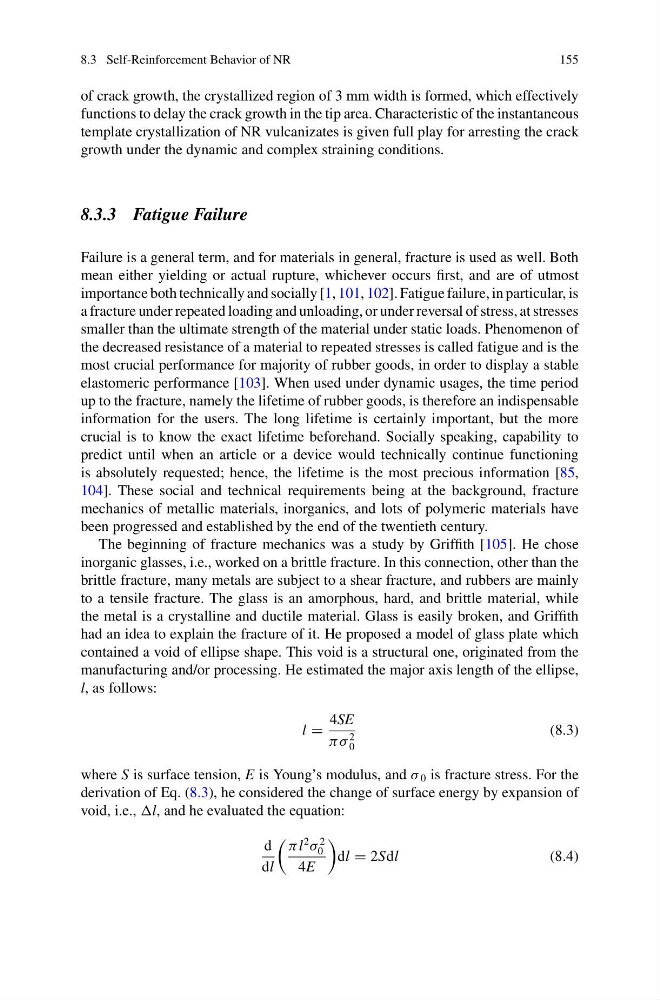
manufacturing and/or processing. He estimated the major axis length of the ellipse,
l, as follows:
l =
4SE
πσ
2
0
(8.3)
where S is surface tension, E is Young’s modulus, and σ 0 is fracture stress. For the
derivation of Eq. (8.3), he considered the change of surface energy by expansion of
void, i.e., l, and he evaluated the equation:
d
dl
π l
2
σ
2
0
4E
dl = 2Sdl
(8.4)
155
of crack growth, the crystallized region of 3 mm width is formed, which effectively
functions to delay the crack growth in the tip area. Characteristic of the instantaneous
template crystallization of NR vulcanizates is given full play for arresting the crack
growth under the dynamic and complex straining conditions.
8.3.3 Fatigue Failure
Failure is a general term, and for materials in general, fracture is used as well. Both
mean either yielding or actual rupture, whichever occurs first, and are of utmost
importance both technically and socially [1, 101, 102]. Fatigue failure, in particular, is
a fracture under repeated loading and unloading, or under reversal of stress, at stresses
smaller than the ultimate strength of the material under static loads. Phenomenon of
the decreased resistance of a material to repeated stresses is called fatigue and is the
most crucial performance for majority of rubber goods, in order to display a stable
elastomeric performance [103]. When used under dynamic usages, the time period
up to the fracture, namely the lifetime of rubber goods, is therefore an indispensable
information for the users. The long lifetime is certainly important, but the more
crucial is to know the exact lifetime beforehand. Socially speaking, capability to
predict until when an article or a device would technically continue functioning
is absolutely requested; hence, the lifetime is the most precious information [85,
104]. These social and technical requirements being at the background, fracture
mechanics of metallic materials, inorganics, and lots of polymeric materials have
been progressed and established by the end of the twentieth century.
The beginning of fracture mechanics was a study by Griffith [105]. He chose
inorganic glasses, i.e., worked on a brittle fracture. In this connection, other than the
brittle fracture, many metals are subject to a shear fracture, and rubbers are mainly
to a tensile fracture. The glass is an amorphous, hard, and brittle material, while
the metal is a crystalline and ductile material. Glass is easily broken, and Griffith
had an idea to explain the fracture of it. He proposed a model of glass plate which
contained a void of ellipse shape. This void is a structural one, originated from the
manufacturing and/or processing. He estimated the major axis length of the ellipse,
l, as follows:
l =
4SE
πσ
2
0
(8.3)
where S is surface tension, E is Young’s modulus, and σ 0 is fracture stress. For the
derivation of Eq. (8.3), he considered the change of surface energy by expansion of
void, i.e., l, and he evaluated the equation:
d
dl
π l
2
σ
2
0
4E
dl = 2Sdl
(8.4)