

154
8 Self-Reinforcement in Natural Rubber (NR): Template Crystallization
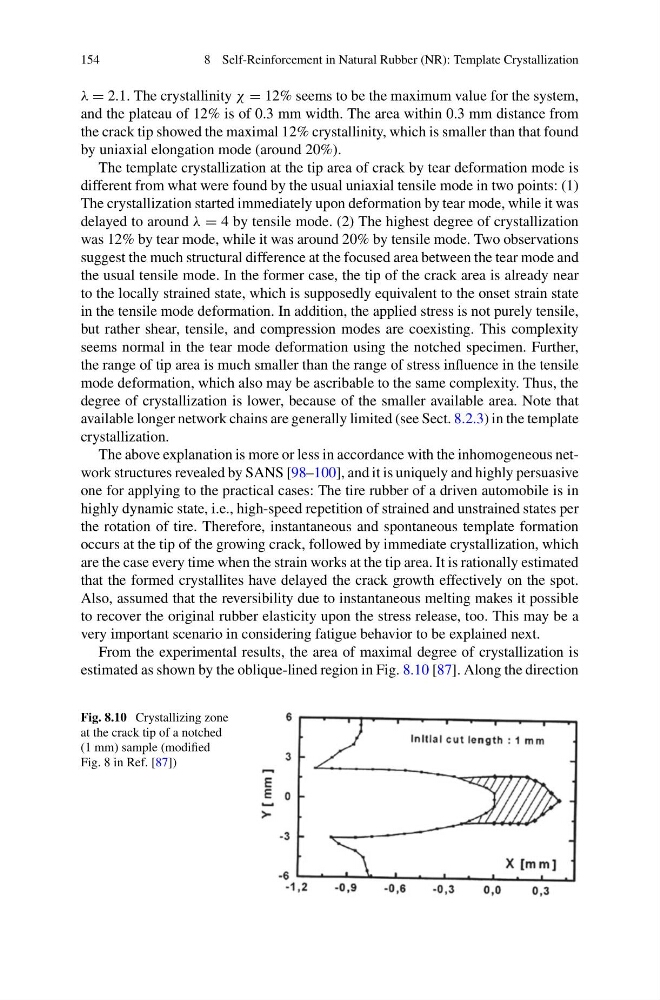
λ = 2.1. The crystallinity χ = 12% seems to be the maximum value for the system,
and the plateau of 12% is of 0.3 mm width. The area within 0.3 mm distance from
the crack tip showed the maximal 12% crystallinity, which is smaller than that found
by uniaxial elongation mode (around 20%).
The template crystallization at the tip area of crack by tear deformation mode is
different from what were found by the usual uniaxial tensile mode in two points: (1)
The crystallization started immediately upon deformation by tear mode, while it was
delayed to around λ = 4 by tensile mode. (2) The highest degree of crystallization
was 12% by tear mode, while it was around 20% by tensile mode. Two observations
suggest the much structural difference at the focused area between the tear mode and
the usual tensile mode. In the former case, the tip of the crack area is already near
to the locally strained state, which is supposedly equivalent to the onset strain state
in the tensile mode deformation. In addition, the applied stress is not purely tensile,
but rather shear, tensile, and compression modes are coexisting. This complexity
seems normal in the tear mode deformation using the notched specimen. Further,
the range of tip area is much smaller than the range of stress influence in the tensile
mode deformation, which also may be ascribable to the same complexity. Thus, the
degree of crystallization is lower, because of the smaller available area. Note that
available longer network chains are generally limited (see Sect. 8.2.3) in the template
crystallization.
The above explanation is more or less in accordance with the inhomogeneous network structures revealed by SANS [98–100], and it is uniquely and highly persuasive
one for applying to the practical cases: The tire rubber of a driven automobile is in
highly dynamic state, i.e., high-speed repetition of strained and unstrained states per
the rotation of tire. Therefore, instantaneous and spontaneous template formation
occurs at the tip of the growing crack, followed by immediate crystallization, which
are the case every time when the strain works at the tip area. It is rationally estimated
that the formed crystallites have delayed the crack growth effectively on the spot.
Also, assumed that the reversibility due to instantaneous melting makes it possible
to recover the original rubber elasticity upon the stress release, too. This may be a
very important scenario in considering fatigue behavior to be explained next.
From the experimental results, the area of maximal degree of crystallization is
estimated as shown by the oblique-lined region in Fig. 8.10 [87]. Along the direction
Fig. 8.10 Crystallizing zone
at the crack tip of a notched
(1 mm) sample (modified
Fig. 8 in Ref. [87])
8 Self-Reinforcement in Natural Rubber (NR): Template Crystallization
λ = 2.1. The crystallinity χ = 12% seems to be the maximum value for the system,
and the plateau of 12% is of 0.3 mm width. The area within 0.3 mm distance from
the crack tip showed the maximal 12% crystallinity, which is smaller than that found
by uniaxial elongation mode (around 20%).
The template crystallization at the tip area of crack by tear deformation mode is
different from what were found by the usual uniaxial tensile mode in two points: (1)
The crystallization started immediately upon deformation by tear mode, while it was
delayed to around λ = 4 by tensile mode. (2) The highest degree of crystallization
was 12% by tear mode, while it was around 20% by tensile mode. Two observations
suggest the much structural difference at the focused area between the tear mode and
the usual tensile mode. In the former case, the tip of the crack area is already near
to the locally strained state, which is supposedly equivalent to the onset strain state
in the tensile mode deformation. In addition, the applied stress is not purely tensile,
but rather shear, tensile, and compression modes are coexisting. This complexity
seems normal in the tear mode deformation using the notched specimen. Further,
the range of tip area is much smaller than the range of stress influence in the tensile
mode deformation, which also may be ascribable to the same complexity. Thus, the
degree of crystallization is lower, because of the smaller available area. Note that
available longer network chains are generally limited (see Sect. 8.2.3) in the template
crystallization.
The above explanation is more or less in accordance with the inhomogeneous network structures revealed by SANS [98–100], and it is uniquely and highly persuasive
one for applying to the practical cases: The tire rubber of a driven automobile is in
highly dynamic state, i.e., high-speed repetition of strained and unstrained states per
the rotation of tire. Therefore, instantaneous and spontaneous template formation
occurs at the tip of the growing crack, followed by immediate crystallization, which
are the case every time when the strain works at the tip area. It is rationally estimated
that the formed crystallites have delayed the crack growth effectively on the spot.
Also, assumed that the reversibility due to instantaneous melting makes it possible
to recover the original rubber elasticity upon the stress release, too. This may be a
very important scenario in considering fatigue behavior to be explained next.
From the experimental results, the area of maximal degree of crystallization is
estimated as shown by the oblique-lined region in Fig. 8.10 [87]. Along the direction
Fig. 8.10 Crystallizing zone
at the crack tip of a notched
(1 mm) sample (modified
Fig. 8 in Ref. [87])