

6.2 Rubber Reinforcement by In Situ Silica
115
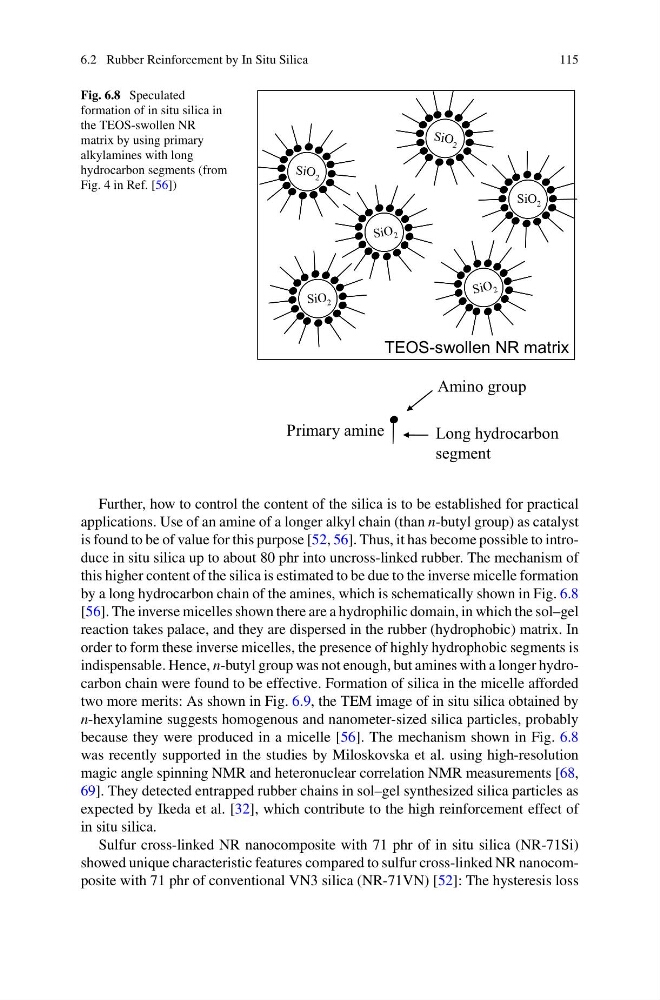
Fig. 6.8 Speculated
formation of in situ silica in
the TEOS-swollen NR
matrix by using primary
alkylamines with long
hydrocarbon segments (from
Fig. 4 in Ref. [56])
Amino group
Long hydrocarbon
segment
TEOS-swollen NR matrix
SiO
2
Si O 2
Si O 2
SiO 2
S iO2
SiO 2
Primary amine
Further, how to control the content of the silica is to be established for practical
applications. Use of an amine of a longer alkyl chain (than n-butyl group) as catalyst
is found to be of value for this purpose [52, 56]. Thus, it has become possible to introduce in situ silica up to about 80 phr into uncross-linked rubber. The mechanism of
this higher content of the silica is estimated to be due to the inverse micelle formation
by a long hydrocarbon chain of the amines, which is schematically shown in Fig. 6.8
[56]. The inverse micelles shown there are a hydrophilic domain, in which the sol–gel
reaction takes palace, and they are dispersed in the rubber (hydrophobic) matrix. In
order to form these inverse micelles, the presence of highly hydrophobic segments is
indispensable. Hence, n-butyl group was not enough, but amines with a longer hydrocarbon chain were found to be effective. Formation of silica in the micelle afforded
two more merits: As shown in Fig. 6.9, the TEM image of in situ silica obtained by
n-hexylamine suggests homogenous and nanometer-sized silica particles, probably
because they were produced in a micelle [56]. The mechanism shown in Fig. 6.8
was recently supported in the studies by Miloskovska et al. using high-resolution
magic angle spinning NMR and heteronuclear correlation NMR measurements [68,
69]. They detected entrapped rubber chains in sol–gel synthesized silica particles as
expected by Ikeda et al. [32], which contribute to the high reinforcement effect of
in situ silica.
Sulfur cross-linked NR nanocomposite with 71 phr of in situ silica (NR-71Si)
showed unique characteristic features compared to sulfur cross-linked NR nanocomposite with 71 phr of conventional VN3 silica (NR-71VN) [52]: The hysteresis loss
115
Fig. 6.8 Speculated
formation of in situ silica in
the TEOS-swollen NR
matrix by using primary
alkylamines with long
hydrocarbon segments (from
Fig. 4 in Ref. [56])
Amino group
Long hydrocarbon
segment
TEOS-swollen NR matrix
SiO
2
Si O 2
Si O 2
SiO 2
S iO2
SiO 2
Primary amine
Further, how to control the content of the silica is to be established for practical
applications. Use of an amine of a longer alkyl chain (than n-butyl group) as catalyst
is found to be of value for this purpose [52, 56]. Thus, it has become possible to introduce in situ silica up to about 80 phr into uncross-linked rubber. The mechanism of
this higher content of the silica is estimated to be due to the inverse micelle formation
by a long hydrocarbon chain of the amines, which is schematically shown in Fig. 6.8
[56]. The inverse micelles shown there are a hydrophilic domain, in which the sol–gel
reaction takes palace, and they are dispersed in the rubber (hydrophobic) matrix. In
order to form these inverse micelles, the presence of highly hydrophobic segments is
indispensable. Hence, n-butyl group was not enough, but amines with a longer hydrocarbon chain were found to be effective. Formation of silica in the micelle afforded
two more merits: As shown in Fig. 6.9, the TEM image of in situ silica obtained by
n-hexylamine suggests homogenous and nanometer-sized silica particles, probably
because they were produced in a micelle [56]. The mechanism shown in Fig. 6.8
was recently supported in the studies by Miloskovska et al. using high-resolution
magic angle spinning NMR and heteronuclear correlation NMR measurements [68,
69]. They detected entrapped rubber chains in sol–gel synthesized silica particles as
expected by Ikeda et al. [32], which contribute to the high reinforcement effect of
in situ silica.
Sulfur cross-linked NR nanocomposite with 71 phr of in situ silica (NR-71Si)
showed unique characteristic features compared to sulfur cross-linked NR nanocomposite with 71 phr of conventional VN3 silica (NR-71VN) [52]: The hysteresis loss