

114
6 Particulate Silica Reinforcement of Rubber
During the retracting process, the four-spot pattern to show the buckling structure
of in situ silica particles was more clearly detected than the stretching process as
shown in Fig. 6.5. The spacing between the silica layers decreased upon retracting.
Moreover, the degree of buckling to the stretching direction in the retracting process
became smaller with the decrease of strain, which was ascribed to releasing the
compression from the lateral directions. The buckling structure was also found to
partially remain when the sample was retracted to α = 1 at the retracting speeds of
100 mm min
−1 .
In addition, good linearity was observed between microscopic and macroscopic
strains measured by the simultaneous tensile measurements. This result may suggest
the affine deformation of the in situ silica-filled soft nanocomposite at low strain.
It should be kept in mind, however, that the silica particles are not deformable, and
consequently the deformation of the cross-linked IR matrix of the nanocomposite
cannot be affine: The affine deformation assumes a complete similarity between
microscopic and macroscopic deformations. On the morphological change of filler
aggregates in the cross-linked rubber, a similar deformation behavior to the in situ
silica particles was reported [67], although the ultra SAXS technique was required.
6.2.2 Conventional Processing of Rubber Mixture with Silica
Generated In Situ
For the practical rubber processing, the sol–gel reaction in the swollen vulcanizate
may limit the usage of Method A within relatively thin rubber products, i.e., applying
Method A to thick rubber products is often difficult. A modified method was proposed
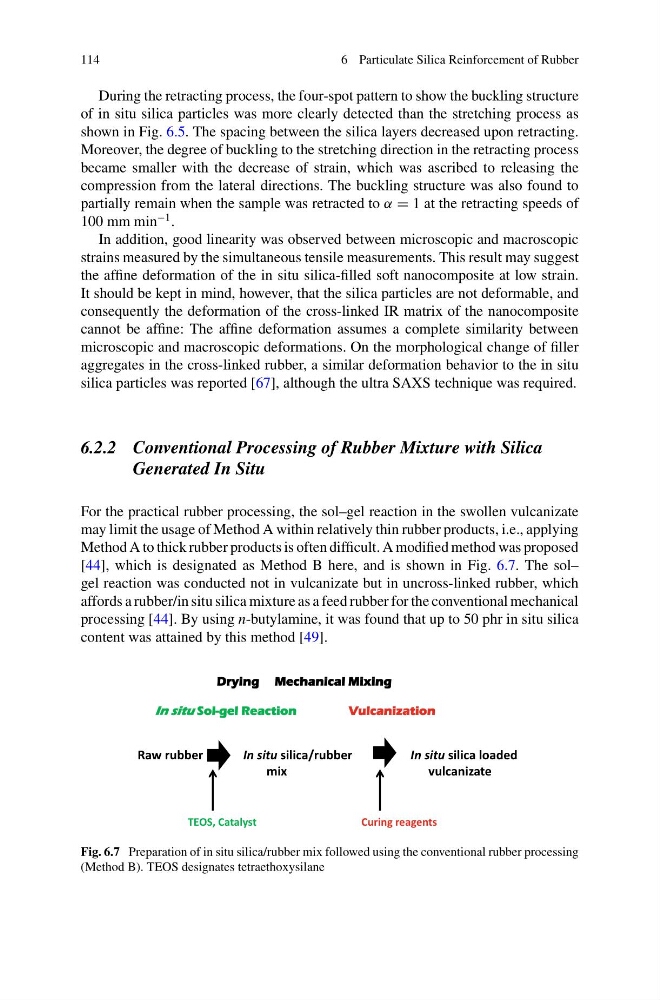
[44], which is designated as Method B here, and is shown in Fig. 6.7. The sol–
gel reaction was conducted not in vulcanizate but in uncross-linked rubber, which
affords a rubber/in situ silica mixture as a feed rubber for the conventional mechanical
processing [44]. By using n-butylamine, it was found that up to 50 phr in situ silica
content was attained by this method [49].
Drying Mechanical Mixing
In situ Sol-gel Reaction
Vulcanization
Raw rubber
In situ silica/rubber
In situ silica loaded
mix
vulcanizate
TEOS, Catalyst
Curing reagents
Fig. 6.7 Preparation of in situ silica/rubber mix followed using the conventional rubber processing
(Method B). TEOS designates tetraethoxysilane
6 Particulate Silica Reinforcement of Rubber
During the retracting process, the four-spot pattern to show the buckling structure
of in situ silica particles was more clearly detected than the stretching process as
shown in Fig. 6.5. The spacing between the silica layers decreased upon retracting.
Moreover, the degree of buckling to the stretching direction in the retracting process
became smaller with the decrease of strain, which was ascribed to releasing the
compression from the lateral directions. The buckling structure was also found to
partially remain when the sample was retracted to α = 1 at the retracting speeds of
100 mm min
−1 .
In addition, good linearity was observed between microscopic and macroscopic
strains measured by the simultaneous tensile measurements. This result may suggest
the affine deformation of the in situ silica-filled soft nanocomposite at low strain.
It should be kept in mind, however, that the silica particles are not deformable, and
consequently the deformation of the cross-linked IR matrix of the nanocomposite
cannot be affine: The affine deformation assumes a complete similarity between
microscopic and macroscopic deformations. On the morphological change of filler
aggregates in the cross-linked rubber, a similar deformation behavior to the in situ
silica particles was reported [67], although the ultra SAXS technique was required.
6.2.2 Conventional Processing of Rubber Mixture with Silica
Generated In Situ
For the practical rubber processing, the sol–gel reaction in the swollen vulcanizate
may limit the usage of Method A within relatively thin rubber products, i.e., applying
Method A to thick rubber products is often difficult. A modified method was proposed
[44], which is designated as Method B here, and is shown in Fig. 6.7. The sol–
gel reaction was conducted not in vulcanizate but in uncross-linked rubber, which
affords a rubber/in situ silica mixture as a feed rubber for the conventional mechanical
processing [44]. By using n-butylamine, it was found that up to 50 phr in situ silica
content was attained by this method [49].
Drying Mechanical Mixing
In situ Sol-gel Reaction
Vulcanization
Raw rubber
In situ silica/rubber
In situ silica loaded
mix
vulcanizate
TEOS, Catalyst
Curing reagents
Fig. 6.7 Preparation of in situ silica/rubber mix followed using the conventional rubber processing
(Method B). TEOS designates tetraethoxysilane