

116
6 Particulate Silica Reinforcement of Rubber
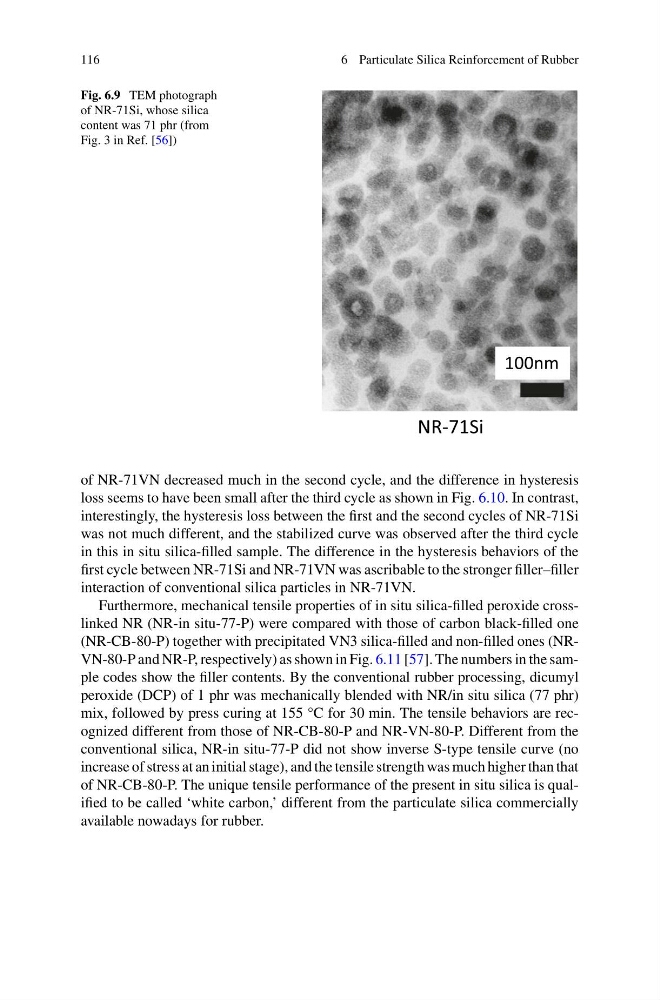
Fig. 6.9 TEM photograph
of NR-71Si, whose silica
content was 71 phr (from
Fig. 3 in Ref. [56])
NR-71Si
100nm
of NR-71VN decreased much in the second cycle, and the difference in hysteresis
loss seems to have been small after the third cycle as shown in Fig. 6.10. In contrast,
interestingly, the hysteresis loss between the first and the second cycles of NR-71Si
was not much different, and the stabilized curve was observed after the third cycle
in this in situ silica-filled sample. The difference in the hysteresis behaviors of the
first cycle between NR-71Si and NR-71VN was ascribable to the stronger filler–filler
interaction of conventional silica particles in NR-71VN.
Furthermore, mechanical tensile properties of in situ silica-filled peroxide crosslinked NR (NR-in situ-77-P) were compared with those of carbon black-filled one
(NR-CB-80-P) together with precipitated VN3 silica-filled and non-filled ones (NRVN-80-P and NR-P, respectively) as shown in Fig. 6.11 [57]. The numbers in the sample codes show the filler contents. By the conventional rubber processing, dicumyl
peroxide (DCP) of 1 phr was mechanically blended with NR/in situ silica (77 phr)
mix, followed by press curing at 155 °C for 30 min. The tensile behaviors are recognized different from those of NR-CB-80-P and NR-VN-80-P. Different from the
conventional silica, NR-in situ-77-P did not show inverse S-type tensile curve (no
increase of stress at an initial stage), and the tensile strength was much higher than that
of NR-CB-80-P. The unique tensile performance of the present in situ silica is qualified to be called ‘white carbon,’ different from the particulate silica commercially
available nowadays for rubber.
6 Particulate Silica Reinforcement of Rubber
Fig. 6.9 TEM photograph
of NR-71Si, whose silica
content was 71 phr (from
Fig. 3 in Ref. [56])
NR-71Si
100nm
of NR-71VN decreased much in the second cycle, and the difference in hysteresis
loss seems to have been small after the third cycle as shown in Fig. 6.10. In contrast,
interestingly, the hysteresis loss between the first and the second cycles of NR-71Si
was not much different, and the stabilized curve was observed after the third cycle
in this in situ silica-filled sample. The difference in the hysteresis behaviors of the
first cycle between NR-71Si and NR-71VN was ascribable to the stronger filler–filler
interaction of conventional silica particles in NR-71VN.
Furthermore, mechanical tensile properties of in situ silica-filled peroxide crosslinked NR (NR-in situ-77-P) were compared with those of carbon black-filled one
(NR-CB-80-P) together with precipitated VN3 silica-filled and non-filled ones (NRVN-80-P and NR-P, respectively) as shown in Fig. 6.11 [57]. The numbers in the sample codes show the filler contents. By the conventional rubber processing, dicumyl
peroxide (DCP) of 1 phr was mechanically blended with NR/in situ silica (77 phr)
mix, followed by press curing at 155 °C for 30 min. The tensile behaviors are recognized different from those of NR-CB-80-P and NR-VN-80-P. Different from the
conventional silica, NR-in situ-77-P did not show inverse S-type tensile curve (no
increase of stress at an initial stage), and the tensile strength was much higher than that
of NR-CB-80-P. The unique tensile performance of the present in situ silica is qualified to be called ‘white carbon,’ different from the particulate silica commercially
available nowadays for rubber.