

length exhibit hexagonal lattice with mixed structures. Thermal transitions of these
polymers with different peripheral lateral alkyl chains are listed in Table 13.
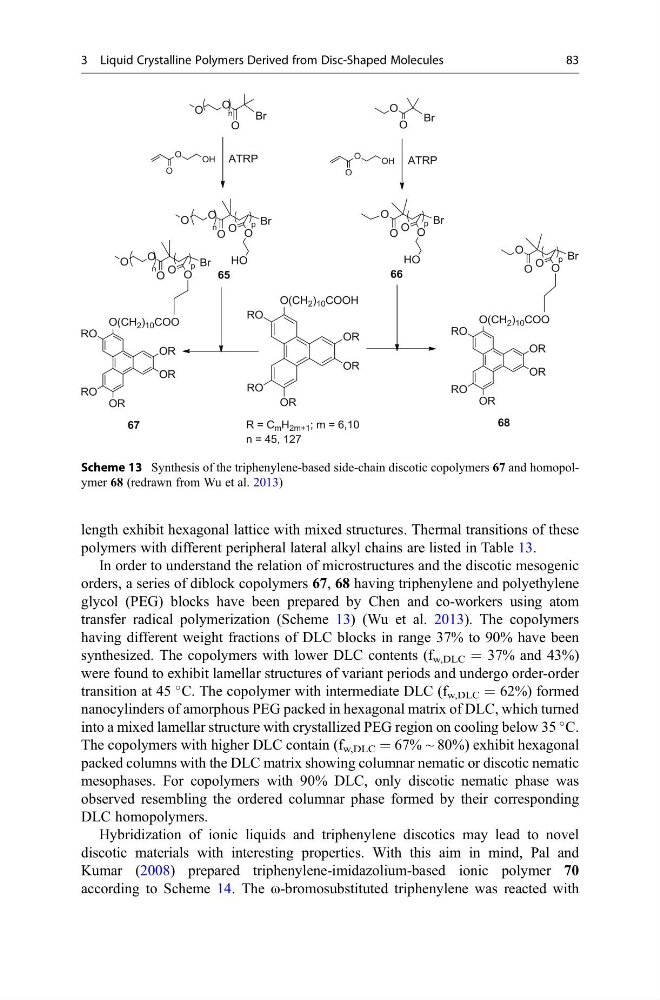
In order to understand the relation of microstructures and the discotic mesogenic
orders, a series of diblock copolymers 67, 68 having triphenylene and polyethylene
glycol (PEG) blocks have been prepared by Chen and co-workers using atom
transfer radical polymerization (Scheme 13) (Wu et al. 2013). The copolymers
having different weight fractions of DLC blocks in range 37% to 90% have been
synthesized. The copolymers with lower DLC contents (f w,DLC = 37% and 43%)
were found to exhibit lamellar structures of variant periods and undergo order-order
transition at 45
C. The copolymer with intermediate DLC (f w,DLC = 62%) formed
nanocylinders of amorphous PEG packed in hexagonal matrix of DLC, which turned
into a mixed lamellar structure with crystallized PEG region on cooling below 35
C.
The copolymers with higher DLC contain (f w,DLC = 67% ~ 80%) exhibit hexagonal
packed columns with the DLC matrix showing columnar nematic or discotic nematic
mesophases. For copolymers with 90% DLC, only discotic nematic phase was
observed resembling the ordered columnar phase formed by their corresponding
DLC homopolymers.
Hybridization of ionic liquids and triphenylene discotics may lead to novel
discotic materials with interesting properties. With this aim in mind, Pal and
Kumar (2008) prepared triphenylene-imidazolium-based ionic polymer 70
according to Scheme 14. The ω-bromosubstituted triphenylene was reacted with
Scheme 13 Synthesis of the triphenylene-based side-chain discotic copolymers 67 and homopolymer 68 (redrawn from Wu et al. 2013)
3 Liquid Crystalline Polymers Derived from Disc-Shaped Molecules
83
polymers with different peripheral lateral alkyl chains are listed in Table 13.
In order to understand the relation of microstructures and the discotic mesogenic
orders, a series of diblock copolymers 67, 68 having triphenylene and polyethylene
glycol (PEG) blocks have been prepared by Chen and co-workers using atom
transfer radical polymerization (Scheme 13) (Wu et al. 2013). The copolymers
having different weight fractions of DLC blocks in range 37% to 90% have been
synthesized. The copolymers with lower DLC contents (f w,DLC = 37% and 43%)
were found to exhibit lamellar structures of variant periods and undergo order-order
transition at 45
C. The copolymer with intermediate DLC (f w,DLC = 62%) formed
nanocylinders of amorphous PEG packed in hexagonal matrix of DLC, which turned
into a mixed lamellar structure with crystallized PEG region on cooling below 35
C.
The copolymers with higher DLC contain (f w,DLC = 67% ~ 80%) exhibit hexagonal
packed columns with the DLC matrix showing columnar nematic or discotic nematic
mesophases. For copolymers with 90% DLC, only discotic nematic phase was
observed resembling the ordered columnar phase formed by their corresponding
DLC homopolymers.
Hybridization of ionic liquids and triphenylene discotics may lead to novel
discotic materials with interesting properties. With this aim in mind, Pal and
Kumar (2008) prepared triphenylene-imidazolium-based ionic polymer 70
according to Scheme 14. The ω-bromosubstituted triphenylene was reacted with
Scheme 13 Synthesis of the triphenylene-based side-chain discotic copolymers 67 and homopolymer 68 (redrawn from Wu et al. 2013)
3 Liquid Crystalline Polymers Derived from Disc-Shaped Molecules
83