

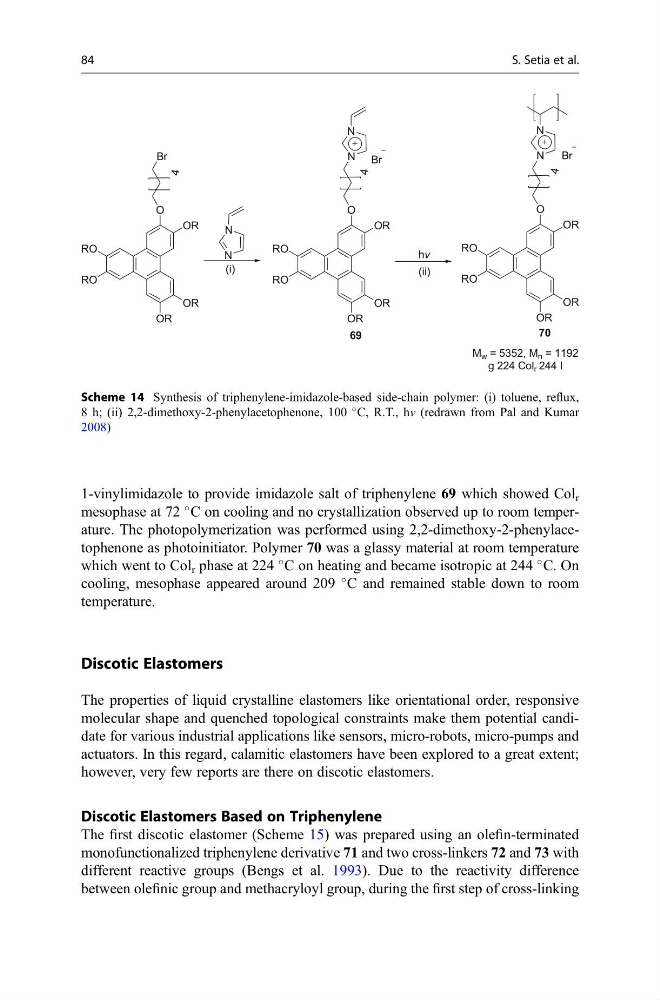
1-vinylimidazole to provide imidazole salt of triphenylene 69 which showed Col r
mesophase at 72
C on cooling and no crystallization observed up to room temperature. The photopolymerization was performed using 2,2-dimethoxy-2-phenylacetophenone as photoinitiator. Polymer 70 was a glassy material at room temperature
which went to Col r phase at 224
C on heating and became isotropic at 244
C. On
cooling, mesophase appeared around 209
C and remained stable down to room
temperature.
Discotic Elastomers
The properties of liquid crystalline elastomers like orientational order, responsive
molecular shape and quenched topological constraints make them potential candidate for various industrial applications like sensors, micro-robots, micro-pumps and
actuators. In this regard, calamitic elastomers have been explored to a great extent;
however, very few reports are there on discotic elastomers.
Discotic Elastomers Based on Triphenylene
The first discotic elastomer (Scheme 15) was prepared using an olefin-terminated
monofunctionalized triphenylene derivative 71 and two cross-linkers 72 and 73 with
different reactive groups (Bengs et al. 1993). Due to the reactivity difference
between olefinic group and methacryloyl group, during the first step of cross-linking
RO
OR
OR
RO
O
OR
RO
RO
OR
OR
OR
O
N
N
N
N
4
4
RO
RO
OR
OR
O
OR
Br
4
N
N
hv
69
70
Br
Br
M w = 5352, M n = 1192
g 224 Col r 244 I
(i)
(ii)
Scheme 14 Synthesis of triphenylene-imidazole-based side-chain polymer: (i) toluene, reflux,
8 h; (ii) 2,2-dimethoxy-2-phenylacetophenone, 100
C, R.T., hv (redrawn from Pal and Kumar
2008)
84
S. Setia et al.
mesophase at 72
C on cooling and no crystallization observed up to room temperature. The photopolymerization was performed using 2,2-dimethoxy-2-phenylacetophenone as photoinitiator. Polymer 70 was a glassy material at room temperature
which went to Col r phase at 224
C on heating and became isotropic at 244
C. On
cooling, mesophase appeared around 209
C and remained stable down to room
temperature.
Discotic Elastomers
The properties of liquid crystalline elastomers like orientational order, responsive
molecular shape and quenched topological constraints make them potential candidate for various industrial applications like sensors, micro-robots, micro-pumps and
actuators. In this regard, calamitic elastomers have been explored to a great extent;
however, very few reports are there on discotic elastomers.
Discotic Elastomers Based on Triphenylene
The first discotic elastomer (Scheme 15) was prepared using an olefin-terminated
monofunctionalized triphenylene derivative 71 and two cross-linkers 72 and 73 with
different reactive groups (Bengs et al. 1993). Due to the reactivity difference
between olefinic group and methacryloyl group, during the first step of cross-linking
RO
OR
OR
RO
O
OR
RO
RO
OR
OR
OR
O
N
N
N
N
4
4
RO
RO
OR
OR
O
OR
Br
4
N
N
hv
69
70
Br
Br
M w = 5352, M n = 1192
g 224 Col r 244 I
(i)
(ii)
Scheme 14 Synthesis of triphenylene-imidazole-based side-chain polymer: (i) toluene, reflux,
8 h; (ii) 2,2-dimethoxy-2-phenylacetophenone, 100
C, R.T., hv (redrawn from Pal and Kumar
2008)
84
S. Setia et al.