

61.1 with pentyl chains were found to be non-liquid crystalline. On further reduction
of polybutadiene polymer, 62.2 turns out to be liquid crystalline. Zhao and
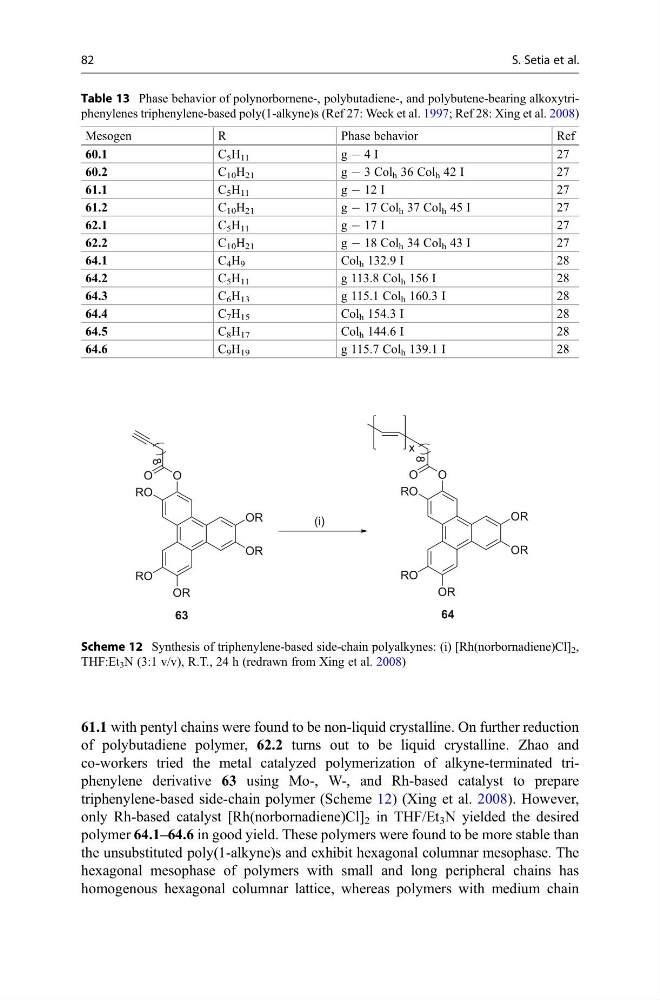
co-workers tried the metal catalyzed polymerization of alkyne-terminated triphenylene derivative 63 using Mo-, W-, and Rh-based catalyst to prepare
triphenylene-based side-chain polymer (Scheme 12) (Xing et al. 2008). However,
only Rh-based catalyst [Rh(norbornadiene)Cl] 2 in THF/Et 3 N yielded the desired
polymer 64.1–64.6 in good yield. These polymers were found to be more stable than
the unsubstituted poly(1-alkyne)s and exhibit hexagonal columnar mesophase. The
hexagonal mesophase of polymers with small and long peripheral chains has
homogenous hexagonal columnar lattice, whereas polymers with medium chain
Table 13 Phase behavior of polynorbornene-, polybutadiene-, and polybutene-bearing alkoxytriphenylenes triphenylene-based poly(1-alkyne)s (Ref 27: Weck et al. 1997; Ref 28: Xing et al. 2008)
Mesogen
R
Phase behavior
Ref
60.1
C 5 H 11
g À 4 I
27
60.2
C 10 H 21
g À 3 Col h 36 Col h 42 I
27
61.1
C 5 H 11
g À 12 I
27
61.2
C 10 H 21
g À 17 Col h 37 Col h 45 I
27
62.1
C 5 H 11
g À 17 I
27
62.2
C 10 H 21
g À 18 Col h 34 Col h 43 I
27
64.1
C 4 H 9
Col h 132.9 I
28
64.2
C 5 H 11
g 113.8 Col h 156 I
28
64.3
C 6 H 13
g 115.1 Col h 160.3 I
28
64.4
C 7 H 15
Col h 154.3 I
28
64.5
C 8 H 17
Col h 144.6 I
28
64.6
C 9 H 19
g 115.7 Col h 139.1 I
28
O
RO
OR
OR
OR
RO
O
O
RO
OR
OR
OR
RO
O
8
8
(i)
x
63
64
Scheme 12 Synthesis of triphenylene-based side-chain polyalkynes: (i) [Rh(norbornadiene)Cl] 2 ,
THF:Et 3 N (3:1 v/v), R.T., 24 h (redrawn from Xing et al. 2008)
82
S. Setia et al.
of polybutadiene polymer, 62.2 turns out to be liquid crystalline. Zhao and
co-workers tried the metal catalyzed polymerization of alkyne-terminated triphenylene derivative 63 using Mo-, W-, and Rh-based catalyst to prepare
triphenylene-based side-chain polymer (Scheme 12) (Xing et al. 2008). However,
only Rh-based catalyst [Rh(norbornadiene)Cl] 2 in THF/Et 3 N yielded the desired
polymer 64.1–64.6 in good yield. These polymers were found to be more stable than
the unsubstituted poly(1-alkyne)s and exhibit hexagonal columnar mesophase. The
hexagonal mesophase of polymers with small and long peripheral chains has
homogenous hexagonal columnar lattice, whereas polymers with medium chain
Table 13 Phase behavior of polynorbornene-, polybutadiene-, and polybutene-bearing alkoxytriphenylenes triphenylene-based poly(1-alkyne)s (Ref 27: Weck et al. 1997; Ref 28: Xing et al. 2008)
Mesogen
R
Phase behavior
Ref
60.1
C 5 H 11
g À 4 I
27
60.2
C 10 H 21
g À 3 Col h 36 Col h 42 I
27
61.1
C 5 H 11
g À 12 I
27
61.2
C 10 H 21
g À 17 Col h 37 Col h 45 I
27
62.1
C 5 H 11
g À 17 I
27
62.2
C 10 H 21
g À 18 Col h 34 Col h 43 I
27
64.1
C 4 H 9
Col h 132.9 I
28
64.2
C 5 H 11
g 113.8 Col h 156 I
28
64.3
C 6 H 13
g 115.1 Col h 160.3 I
28
64.4
C 7 H 15
Col h 154.3 I
28
64.5
C 8 H 17
Col h 144.6 I
28
64.6
C 9 H 19
g 115.7 Col h 139.1 I
28
O
RO
OR
OR
OR
RO
O
O
RO
OR
OR
OR
RO
O
8
8
(i)
x
63
64
Scheme 12 Synthesis of triphenylene-based side-chain polyalkynes: (i) [Rh(norbornadiene)Cl] 2 ,
THF:Et 3 N (3:1 v/v), R.T., 24 h (redrawn from Xing et al. 2008)
82
S. Setia et al.